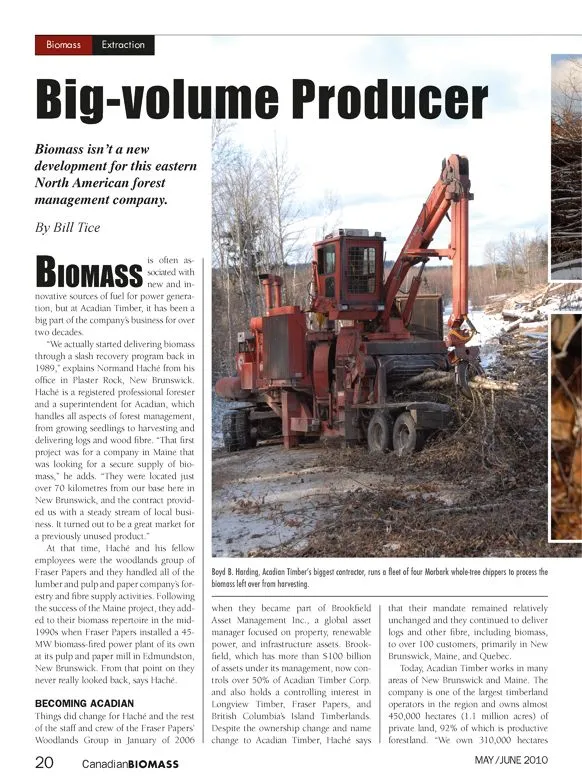
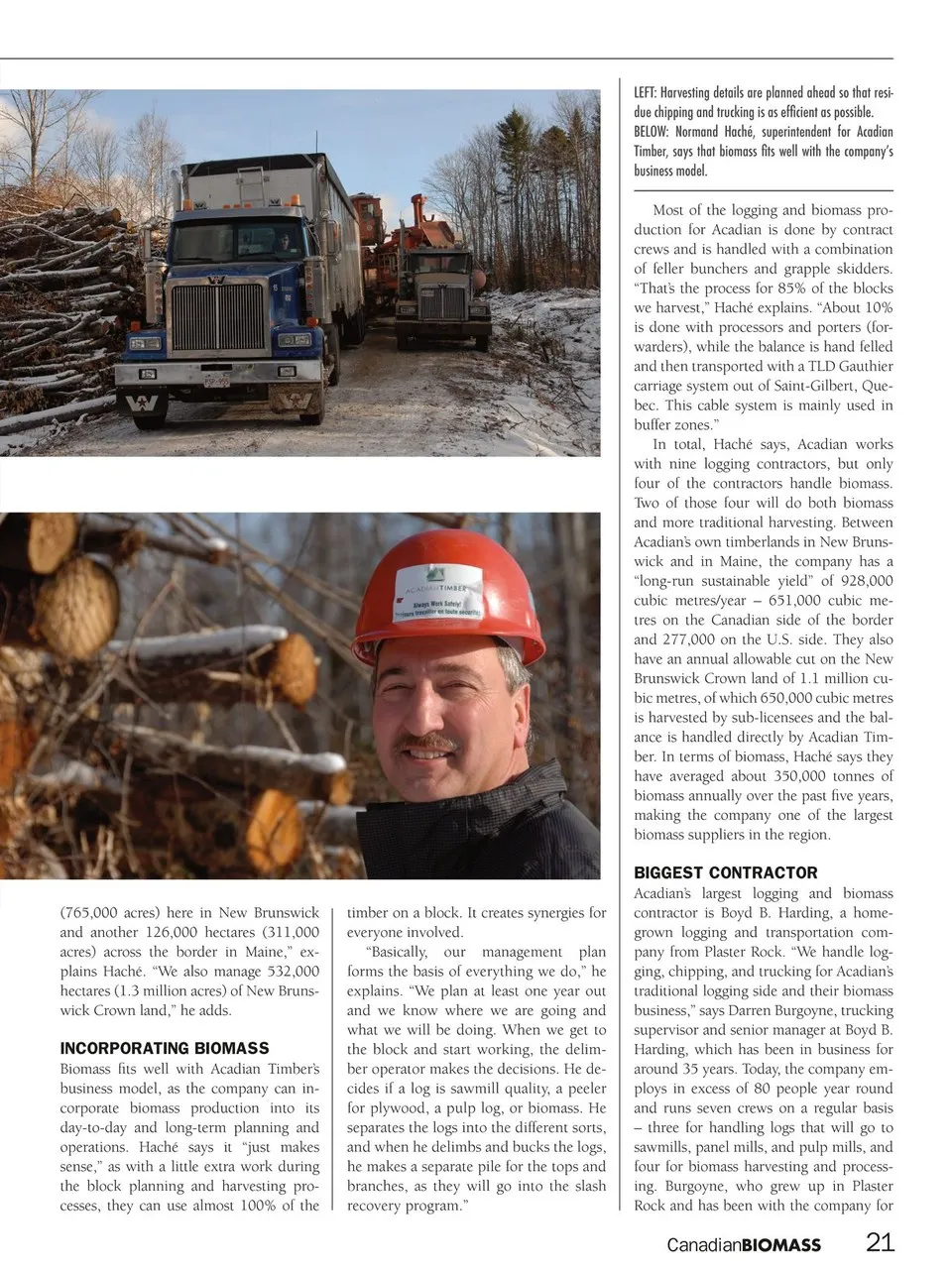
LEFT: Harvesting details are planned ahead so that resi- due chipping and trucking is as efficient as possible. BELOW: Normand Haché, superintendent for Acadian Timber, says that biomass fits well with the company’s business model. Most of the logging and biomass pro- duction for Acadian is done by contract crews and is handled with a combination of feller bunchers and grapple skidders. “That’s the process for 85% of the blocks we harvest,” Haché explains. “About 10% is done with processors and porters (for- warders), while the balance is hand felled and then transported with a TLD Gauthier carriage system out of Saint-Gilbert, Que- bec. This cable system is mainly used in buffer zones.” In total, Haché says, Acadian works with nine logging contractors, but only four of the contractors handle biomass. Two of those four will do both biomass and more traditional harvesting. Between Acadian’s own timberlands in New Bruns- wick and in Maine, the company has a “long-run sustainable yield” of 928,000 cubic metres/year – 651,000 cubic me- tres on the Canadian side of the border and 277,000 on the U.S. side. They also have an annual allowable cut on the New Brunswick Crown land of 1.1 million cu- bic metres, of which 650,000 cubic metres is harvested by sub-licensees and the bal- ance is handled directly by Acadian Tim- ber. In terms of biomass, Haché says they have averaged about 350,000 tonnes of biomass annually over the past five years, making the company one of the largest biomass suppliers in the region. (765,000 acres) here in New Brunswick and another 126,000 hectares (311,000 acres) across the border in Maine,” ex- plains Haché. “We also manage 532,000 hectares (1.3 million acres) of New Bruns- wick Crown land,” he adds. inCorporating Biomass Biomass fits well with Acadian Timber’s business model, as the company can in- corporate biomass production into its day-to-day and long-term planning and operations. Haché says it “just makes sense,” as with a little extra work during the block planning and harvesting pro- cesses, they can use almost 100% of the timber on a block. It creates synergies for everyone involved. “Basically, our management plan forms the basis of everything we do,” he explains. “We plan at least one year out and we know where we are going and what we will be doing. When we get to the block and start working, the delim- ber operator makes the decisions. He de- cides if a log is sawmill quality, a peeler for plywood, a pulp log, or biomass. He separates the logs into the different sorts, and when he delimbs and bucks the logs, he makes a separate pile for the tops and branches, as they will go into the slash recovery program.” Biggest ContraCtor Acadian’s largest logging and biomass contractor is Boyd B. Harding, a home- grown logging and transportation com- pany from Plaster Rock. “We handle log- ging, chipping, and trucking for Acadian’s traditional logging side and their biomass business,” says Darren Burgoyne, trucking supervisor and senior manager at Boyd B. Harding, which has been in business for around 35 years. Today, the company em- ploys in excess of 80 people year round and runs seven crews on a regular basis – three for handling logs that will go to sawmills, panel mills, and pulp mills, and four for biomass harvesting and process- ing. Burgoyne, who grew up in Plaster Rock and has been with the company for CanadianBIOMASS 21
Canadian Biomass May/June 2010: Page 21