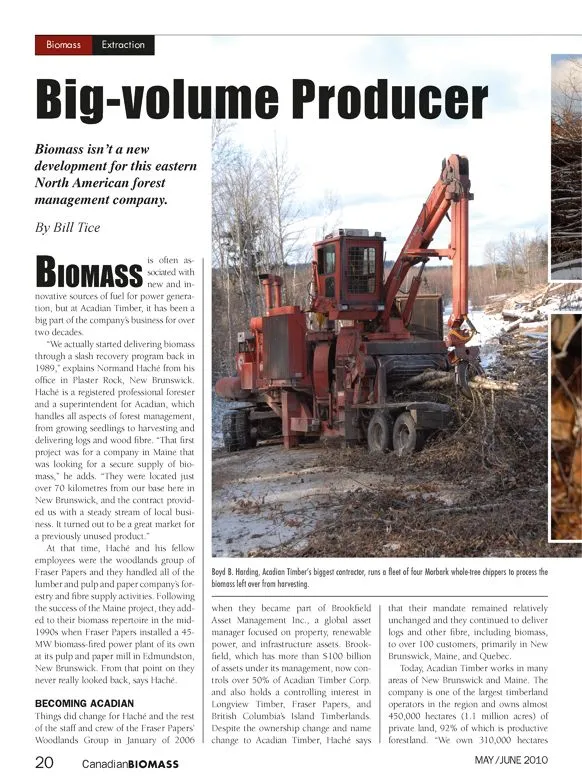
Biomass Extraction Big-volume Producer Biomass isn’t a new development for this eastern North American forest management company. By Bill Tice Biomass is often as- sociated with new and in- novative sources of fuel for power genera- tion, but at Acadian Timber, it has been a big part of the company’s business for over two decades. “We actually started delivering biomass through a slash recovery program back in 1989,” explains Normand Haché from his office in Plaster Rock, New Brunswick. Haché is a registered professional forester and a superintendent for Acadian, which handles all aspects of forest management, from growing seedlings to harvesting and delivering logs and wood fibre. “That first project was for a company in Maine that was looking for a secure supply of bio- mass,” he adds. “They were located just over 70 kilometres from our base here in New Brunswick, and the contract provid- ed us with a steady stream of local busi- ness. It turned out to be a great market for a previously unused product.” At that time, Haché and his fellow employees were the woodlands group of Fraser Papers and they handled all of the lumber and pulp and paper company’s for- estry and fibre supply activities. Following the success of the Maine project, they add- ed to their biomass repertoire in the mid- 1990s when Fraser Papers installed a 45- MW biomass-fired power plant of its own at its pulp and paper mill in Edmundston, New Brunswick. From that point on they never really looked back, says Haché. BeComing aCadian Things did change for Haché and the rest of the staff and crew of the Fraser Papers’ Woodlands Group in January of 2006 20 CanadianBIOMASS Boyd B. Harding, Acadian Timber’s biggest contractor, runs a fleet of four Morbark whole-tree chippers to process the biomass left over from harvesting. when they became part of Brookfield Asset Management Inc., a global asset manager focused on property, renewable power, and infrastructure assets. Brook- field, which has more than $100 billion of assets under its management, now con- trols over 50% of Acadian Timber Corp. and also holds a controlling interest in Longview Timber, Fraser Papers, and British Columbia’s Island Timberlands. Despite the ownership change and name change to Acadian Timber, Haché says that their mandate remained relatively unchanged and they continued to deliver logs and other fibre, including biomass, to over 100 customers, primarily in New Brunswick, Maine, and Quebec. Today, Acadian Timber works in many areas of New Brunswick and Maine. The company is one of the largest timberland operators in the region and owns almost 450,000 hectares (1.1 million acres) of private land, 92% of which is productive forestland. “We own 310,000 hectares MAY/JUNE 2010
Canadian Biomass May/June 2010: Page 20