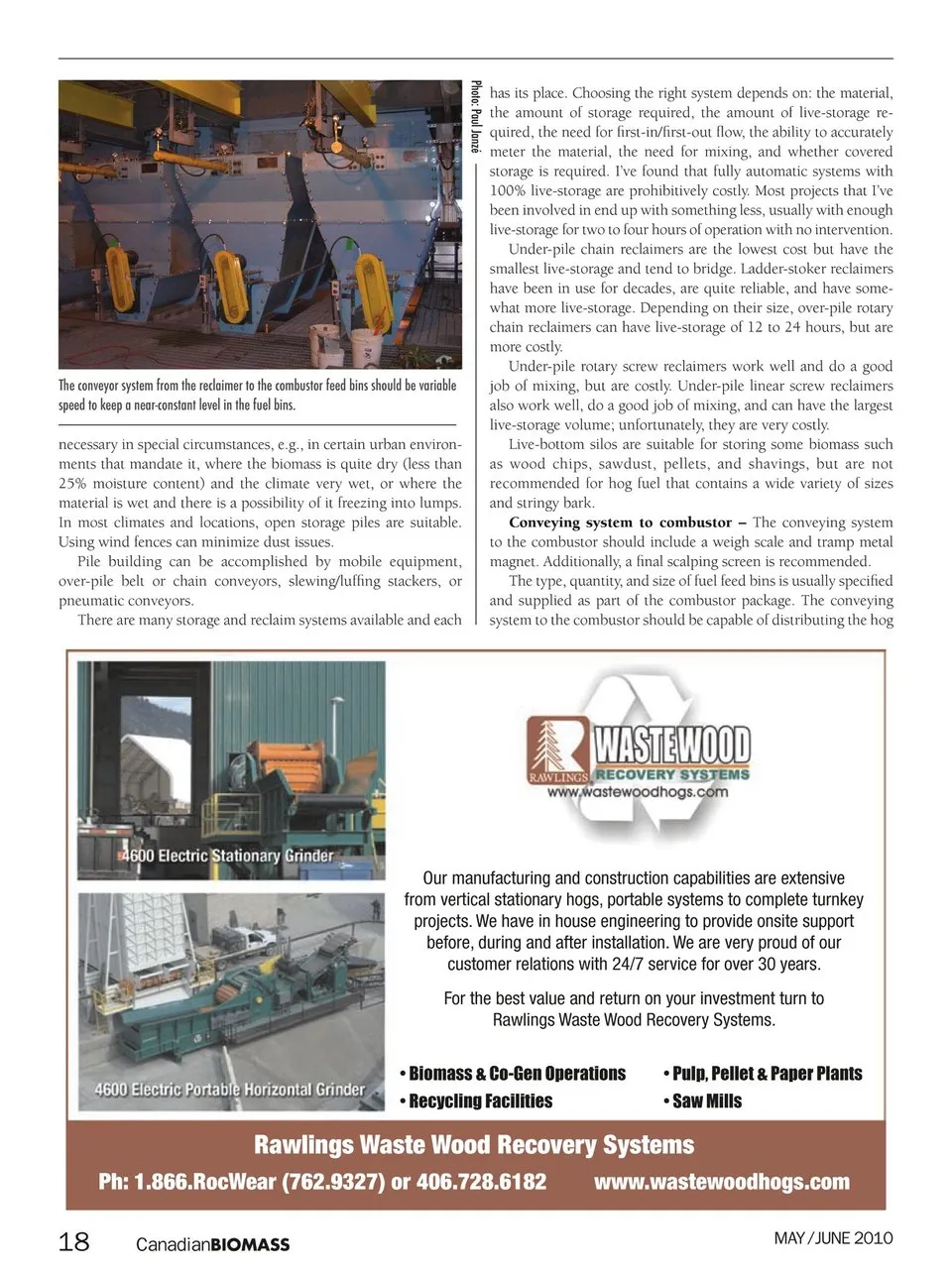
fuel uniformly so that the fuel bins remain full. The conveyor system from the reclaimer through to the com- bustor feed bins should be variable speed and should remain full to minimize the lag time between the reclaimer and the fuel feed bins, thereby keeping a near constant level in the fuel bins. With today’s accurate bin level sensors controlling the feed conveyors to the combustor, it is no longer necessary to overfeed the bins and have a return conveyor system to the storage pile. Dust collection systems – Hog fuel can be quite dusty, and you should provide for dust containment, suppression, and col- lection in your design. In some cases, high-efficiency cyclones may suffice, but in others, bag houses will be required. If the dust is sufficiently fine, spark detection, deluge systems, and abort gates may be required. Rock/sand removal systems – Rock and sand removal sys- tems are costly to install and operate and are rarely used. It is far better to prevent the rocks from entering the material flow than it is to remove them afterwards. Consequently, outdoor storage piles should be paved. Bark presses/dryers – In most greenfield cases, it is best to design the combustor to suit the moisture content of the material being used as fuel, rather than attempting to dry the biomass. However, in some brownfield installations, bark dryers are neces- sary to reduce the moisture content of the biomass to a range that is compatible with the combustor. Sometimes on the west coast, biomass is so wet (over 60% moisture content) that bark presses are necessary to reduce the moisture content to 55%. pellet Considerations Wood pellets are quite dry (12 to 15% moisture content), fragile, and break easily each time they are handled, so a material han- dling system for wood pellets has special requirements, includ- ing keeping them dry. The dust produced by degrading pellets is very fine, combustible, and explosive; therefore, dust collection systems with spark detection, deluge systems, and abort gates are essential. Minimize the number of times the pellets are handled and use gentle handling equipment, including: self-unloading, live-floor trucks or bottom dump railcars; live-floor hoppers; conventional belt conveyors or steep angle belt conveyors; silos with gentle loading chutes and sloped bottoms to variable opening discharge chutes; belt conveyors to the fuel bins; screw distribution conveyors over the bins; and dust collection systems. If the wood pellets are being co-fired with pulverized coal, they will also need grinding or pulverizing before injecting into the combustor. • Paul Janzé has more than 30 years of experience in engineering design, project management, and equipment manufacturing and maintenance, primarily in the forest products and energy industries. His material handling experience includes biomass handling and processing of forest residuals, logs, lumber, chips, wood waste, straw and poultry litter, sludge and biosolids, municipal solid waste, and coal and ash handling. His specialties are fibre flow analysis, process optimization, and designing novel solutions to complex processing and handling problems. Visit Paul’s blog at www.advancedbiomass.com or contact Paul at Ausenco Sandwell in Vancouver, 604-684-9311, [email protected]. CanadianBIOMASS 19
Canadian Biomass May/June 2010: Page 19