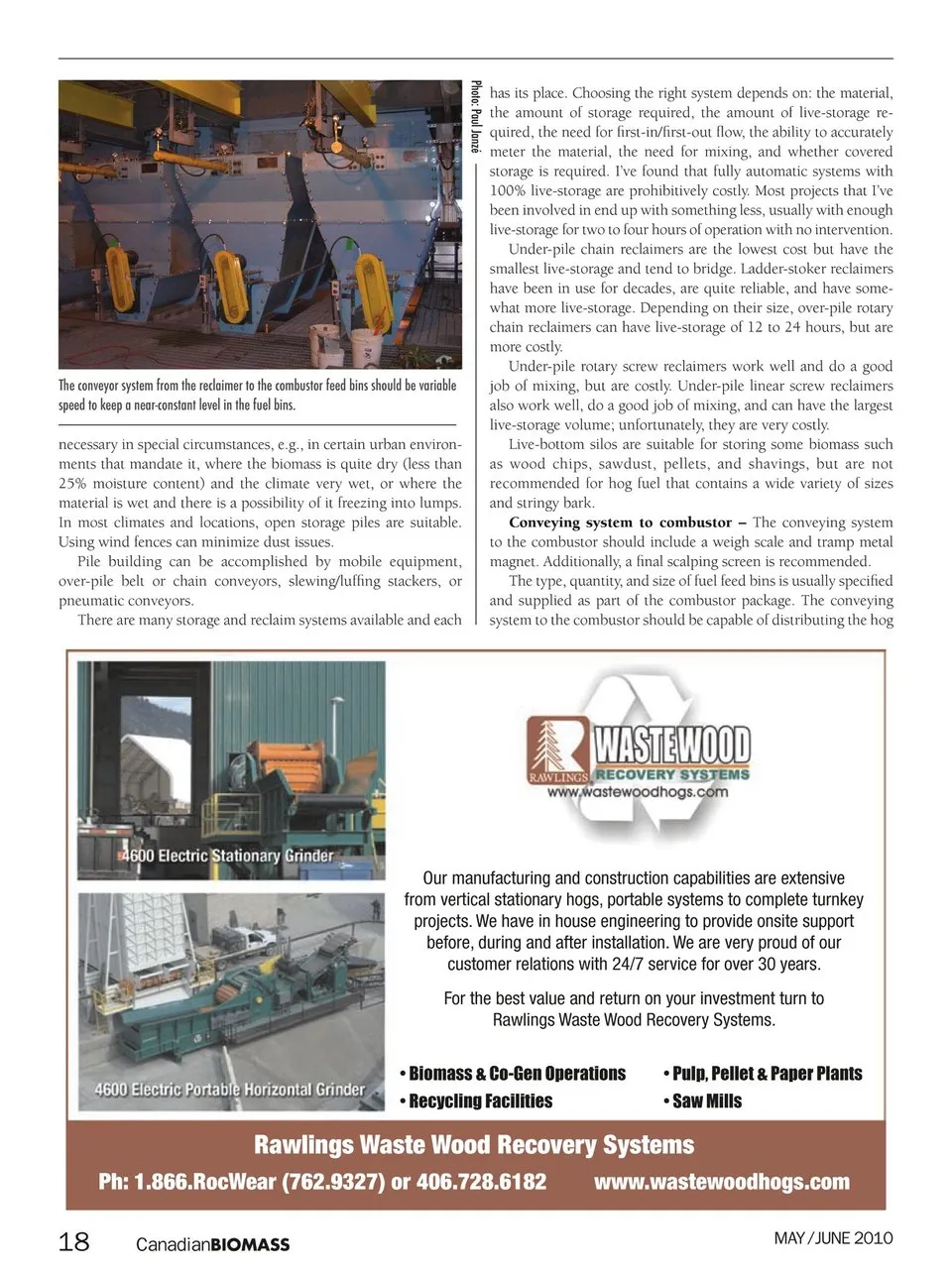
has its place. Choosing the right system depends on: the material, the amount of storage required, the amount of live-storage re- quired, the need for first-in/first-out flow, the ability to accurately meter the material, the need for mixing, and whether covered storage is required. I’ve found that fully automatic systems with 100% live-storage are prohibitively costly. Most projects that I’ve been involved in end up with something less, usually with enough live-storage for two to four hours of operation with no intervention. Under-pile chain reclaimers are the lowest cost but have the smallest live-storage and tend to bridge. Ladder-stoker reclaimers have been in use for decades, are quite reliable, and have some- what more live-storage. Depending on their size, over-pile rotary chain reclaimers can have live-storage of 12 to 24 hours, but are more costly. Under-pile rotary screw reclaimers work well and do a good The conveyor system from the reclaimer to the combustor feed bins should be variable speed to keep a near-constant level in the fuel bins. necessary in special circumstances, e.g., in certain urban environ- ments that mandate it, where the biomass is quite dry (less than 25% moisture content) and the climate very wet, or where the material is wet and there is a possibility of it freezing into lumps. In most climates and locations, open storage piles are suitable. Using wind fences can minimize dust issues. Pile building can be accomplished by mobile equipment, over-pile belt or chain conveyors, slewing/luffing stackers, or pneumatic conveyors. There are many storage and reclaim systems available and each job of mixing, but are costly. Under-pile linear screw reclaimers also work well, do a good job of mixing, and can have the largest live-storage volume; unfortunately, they are very costly. Live-bottom silos are suitable for storing some biomass such as wood chips, sawdust, pellets, and shavings, but are not recommended for hog fuel that contains a wide variety of sizes and stringy bark. Conveying system to combustor – The conveying system to the combustor should include a weigh scale and tramp metal magnet. Additionally, a final scalping screen is recommended. The type, quantity, and size of fuel feed bins is usually specified and supplied as part of the combustor package. The conveying system to the combustor should be capable of distributing the hog Our manufacturing and construction capabilities are extensive from vertical stationary hogs, portable systems to complete turnkey projects. We have in house engineering to provide onsite support before, during and after installation. We are very proud of our customer relations with 24/7 service for over 30 years. For the best value and return on your investment turn to Rawlings Waste Wood Recovery Systems. • Biomass & Co-Gen Operations • Recycling Facilities Ph: 1.866.RocWear (762.9327) or 406.728.6182 18 CanadianBIOMASS • Pulp, Pellet & Paper Plants • Saw Mills Rawlings Waste Wood Recovery Systems www.wastewoodhogs.com MAY/JUNE 2010 Photo: Paul Janzé
Canadian Biomass May/June 2010: Page 18