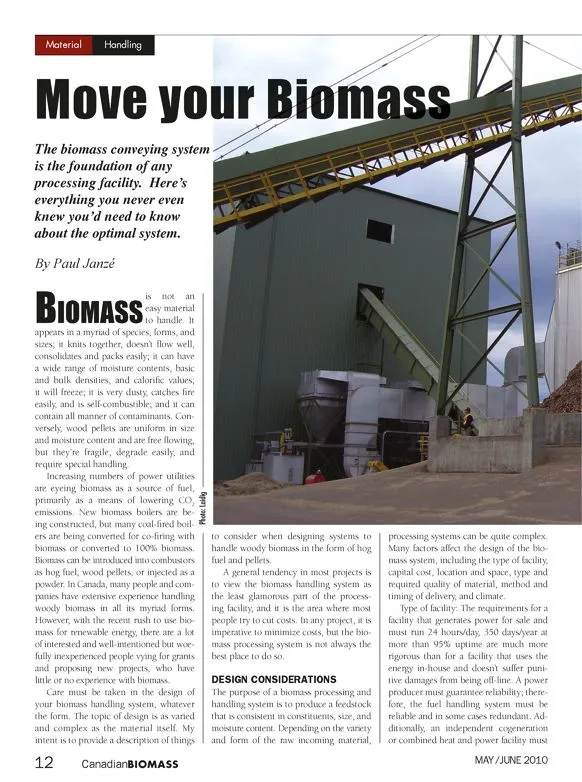
Material Handling Move your Biomass The biomass conveying system is the foundation of any processing facility. Here’s everything you never even knew you’d need to know about the optimal system. By Paul Janzé appears in a myriad of species, forms, and sizes; it knits together, doesn’t flow well, consolidates and packs easily; it can have a wide range of moisture contents, basic and bulk densities, and calorific values; it will freeze; it is very dusty, catches fire easily, and is self-combustible; and it can contain all manner of contaminants. Con- versely, wood pellets are uniform in size and moisture content and are free flowing, but they’re fragile, degrade easily, and require special handling. Increasing numbers of power utilities are eyeing biomass as a source of fuel, Biomass primarily as a means of lowering CO2 emissions. New biomass boilers are be- ing constructed, but many coal-fired boil- ers are being converted for co-firing with biomass or converted to 100% biomass. Biomass can be introduced into combustors as hog fuel, wood pellets, or injected as a powder. In Canada, many people and com- panies have extensive experience handling woody biomass in all its myriad forms. However, with the recent rush to use bio- mass for renewable energy, there are a lot of interested and well-intentioned but woe- fully inexperienced people vying for grants and proposing new projects, who have little or no experience with biomass. Care must be taken in the design of your biomass handling system, whatever the form. The topic of design is as varied and complex as the material itself. My intent is to provide a description of things 12 CanadianBIOMASS is not an easy material to handle. It to consider when designing systems to handle woody biomass in the form of hog fuel and pellets. A general tendency in most projects is to view the biomass handling system as the least glamorous part of the process- ing facility, and it is the area where most people try to cut costs. In any project, it is imperative to minimize costs, but the bio- mass processing system is not always the best place to do so. design Considerations The purpose of a biomass processing and handling system is to produce a feedstock that is consistent in constituents, size, and moisture content. Depending on the variety and form of the raw incoming material, processing systems can be quite complex. Many factors affect the design of the bio- mass system, including the type of facility, capital cost, location and space, type and required quality of material, method and timing of delivery, and climate. Type of facility: The requirements for a facility that generates power for sale and must run 24 hours/day, 350 days/year at more than 95% uptime are much more rigorous than for a facility that uses the energy in-house and doesn’t suffer puni- tive damages from being off-line. A power producer must guarantee reliability; there- fore, the fuel handling system must be reliable and in some cases redundant. Ad- ditionally, an independent cogeneration or combined heat and power facility must MAY/JUNE 2010 Photo: Laidig
Canadian Biomass May/June 2010: Page 12