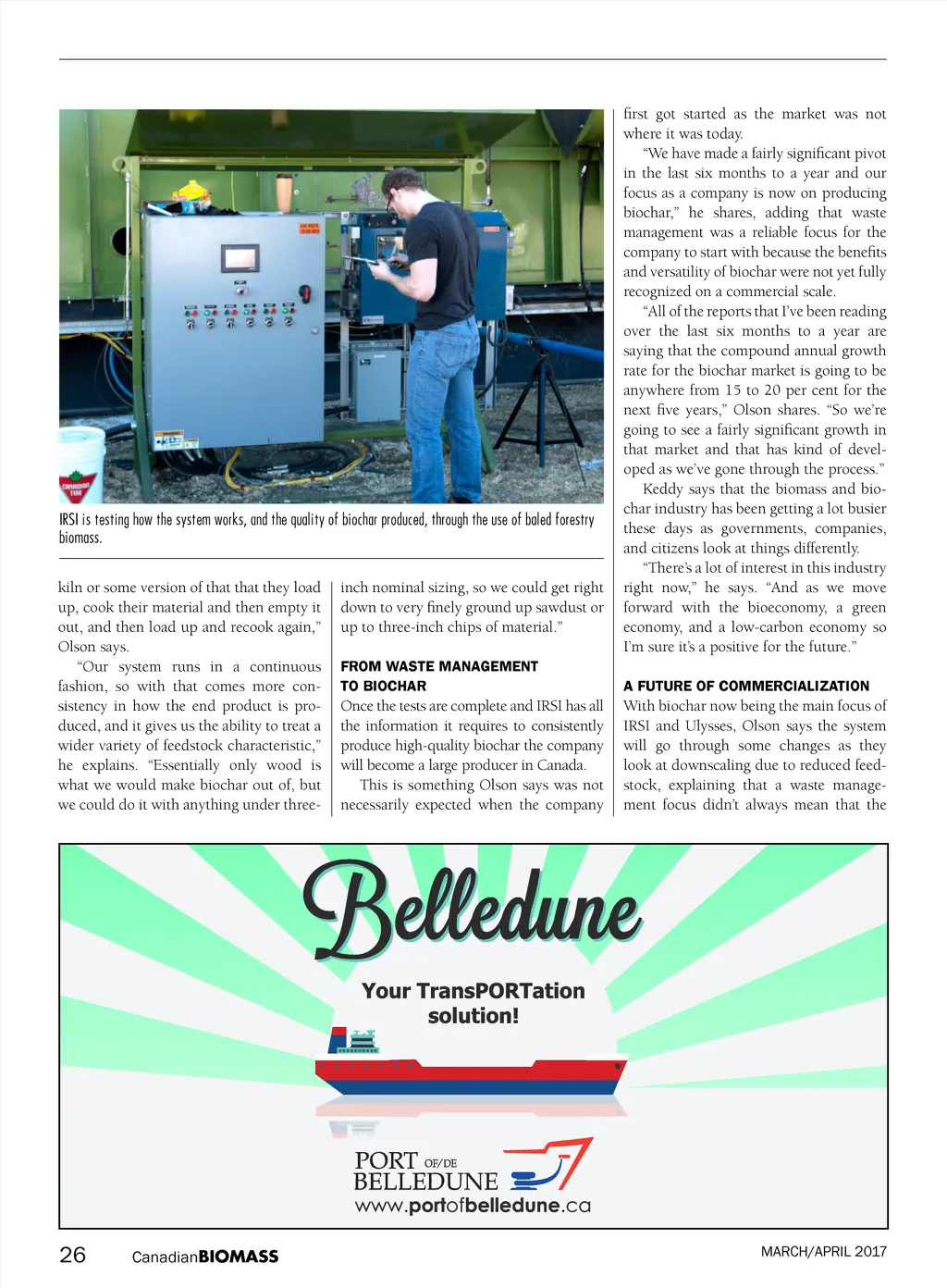
IRSI is testing how the system works, and the quality of biochar produced, through the use of baled forestry biomass. kiln or some version of that that they load up, cook their material and then empty it out, and then load up and recook again,” Olson says. “Our system runs in a continuous fashion, so with that comes more con-sistency in how the end product is pro-duced, and it gives us the ability to treat a wider variety of feedstock characteristic,” he explains. “Essentially only wood is what we would make biochar out of, but we could do it with anything under three-inch nominal sizing, so we could get right down to very finely ground up sawdust or up to three-inch chips of material.” FROM WASTE MANAGEMENT TO BIOCHAR first got started as the market was not where it was today. “We have made a fairly significant pivot in the last six months to a year and our focus as a company is now on producing biochar,” he shares, adding that waste management was a reliable focus for the company to start with because the benefits and versatility of biochar were not yet fully recognized on a commercial scale. “All of the reports that I’ve been reading over the last six months to a year are saying that the compound annual growth rate for the biochar market is going to be anywhere from 15 to 20 per cent for the next five years,” Olson shares. “So we’re going to see a fairly significant growth in that market and that has kind of devel-oped as we’ve gone through the process.” Keddy says that the biomass and bio-char industry has been getting a lot busier these days as governments, companies, and citizens look at things differently. “There’s a lot of interest in this industry right now,” he says. “And as we move forward with the bioeconomy, a green economy, and a low-carbon economy so I’m sure it’s a positive for the future.” A FUTURE OF COMMERCIALIZATION Once the tests are complete and IRSI has all the information it requires to consistently produce high-quality biochar the company will become a large producer in Canada. This is something Olson says was not necessarily expected when the company With biochar now being the main focus of IRSI and Ulysses, Olson says the system will go through some changes as they look at downscaling due to reduced feed-stock, explaining that a waste manage-ment focus didn’t always mean that the 26 Canadian BIOMASS CBM_Belldune_MarApr17_CSA.indd 1 MARCH/APRIL 2017 2017-03-07 8:30 AM
Canadian Biomass March-April 2017: Page 26