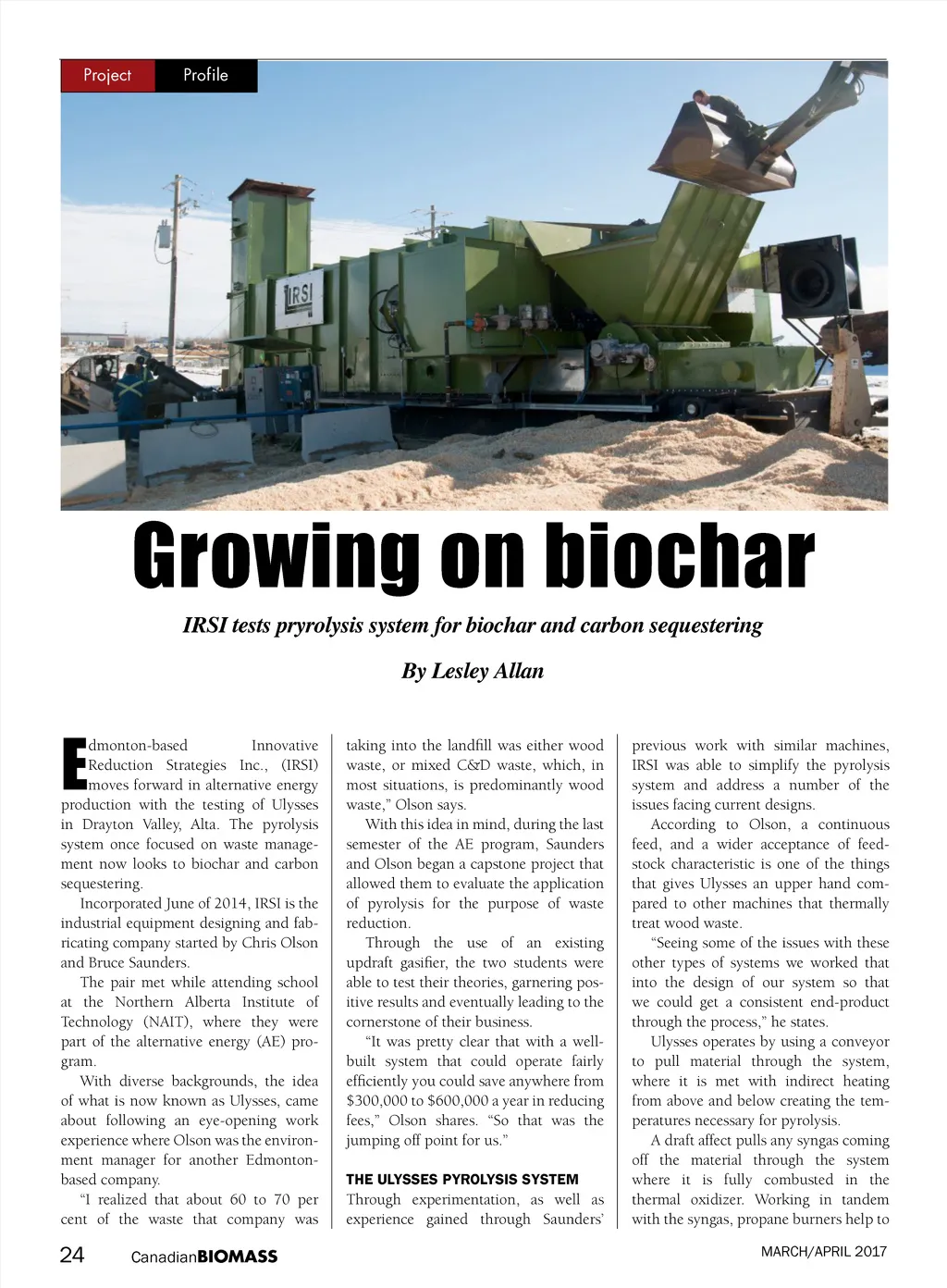
Project Profile Growing on biochar IRSI tests pryrolysis system for biochar and carbon sequestering By Lesley Allan E dmonton-based Innovative Reduction Strategies Inc., (IRSI) moves forward in alternative energy production with the testing of Ulysses in Drayton Valley, Alta. The pyrolysis system once focused on waste manage-ment now looks to biochar and carbon sequestering. Incorporated June of 2014, IRSI is the industrial equipment designing and fab-ricating company started by Chris Olson and Bruce Saunders. The pair met while attending school at the Northern Alberta Institute of Technology (NAIT), where they were part of the alternative energy (AE) pro-gram. With diverse backgrounds, the idea of what is now known as Ulysses, came about following an eye-opening work experience where Olson was the environ-ment manager for another Edmonton-based company. “I realized that about 60 to 70 per cent of the waste that company was taking into the landfill was either wood waste, or mixed C&D waste, which, in most situations, is predominantly wood waste,” Olson says. With this idea in mind, during the last semester of the AE program, Saunders and Olson began a capstone project that allowed them to evaluate the application of pyrolysis for the purpose of waste reduction. Through the use of an existing updraft gasifier, the two students were able to test their theories, garnering pos-itive results and eventually leading to the cornerstone of their business. “It was pretty clear that with a well-built system that could operate fairly efficiently you could save anywhere from $300,000 to $600,000 a year in reducing fees,” Olson shares. “So that was the jumping off point for us.” THE ULYSSES PYROLYSIS SYSTEM Through experimentation, as well as experience gained through Saunders’ previous work with similar machines, IRSI was able to simplify the pyrolysis system and address a number of the issues facing current designs. According to Olson, a continuous feed, and a wider acceptance of feed-stock characteristic is one of the things that gives Ulysses an upper hand com-pared to other machines that thermally treat wood waste. “Seeing some of the issues with these other types of systems we worked that into the design of our system so that we could get a consistent end-product through the process,” he states. Ulysses operates by using a conveyor to pull material through the system, where it is met with indirect heating from above and below creating the tem-peratures necessary for pyrolysis. A draft affect pulls any syngas coming off the material through the system where it is fully combusted in the thermal oxidizer. Working in tandem with the syngas, propane burners help to MARCH/APRIL 2017 24 Canadian BIOMASS
Canadian Biomass March-April 2017: Page 24