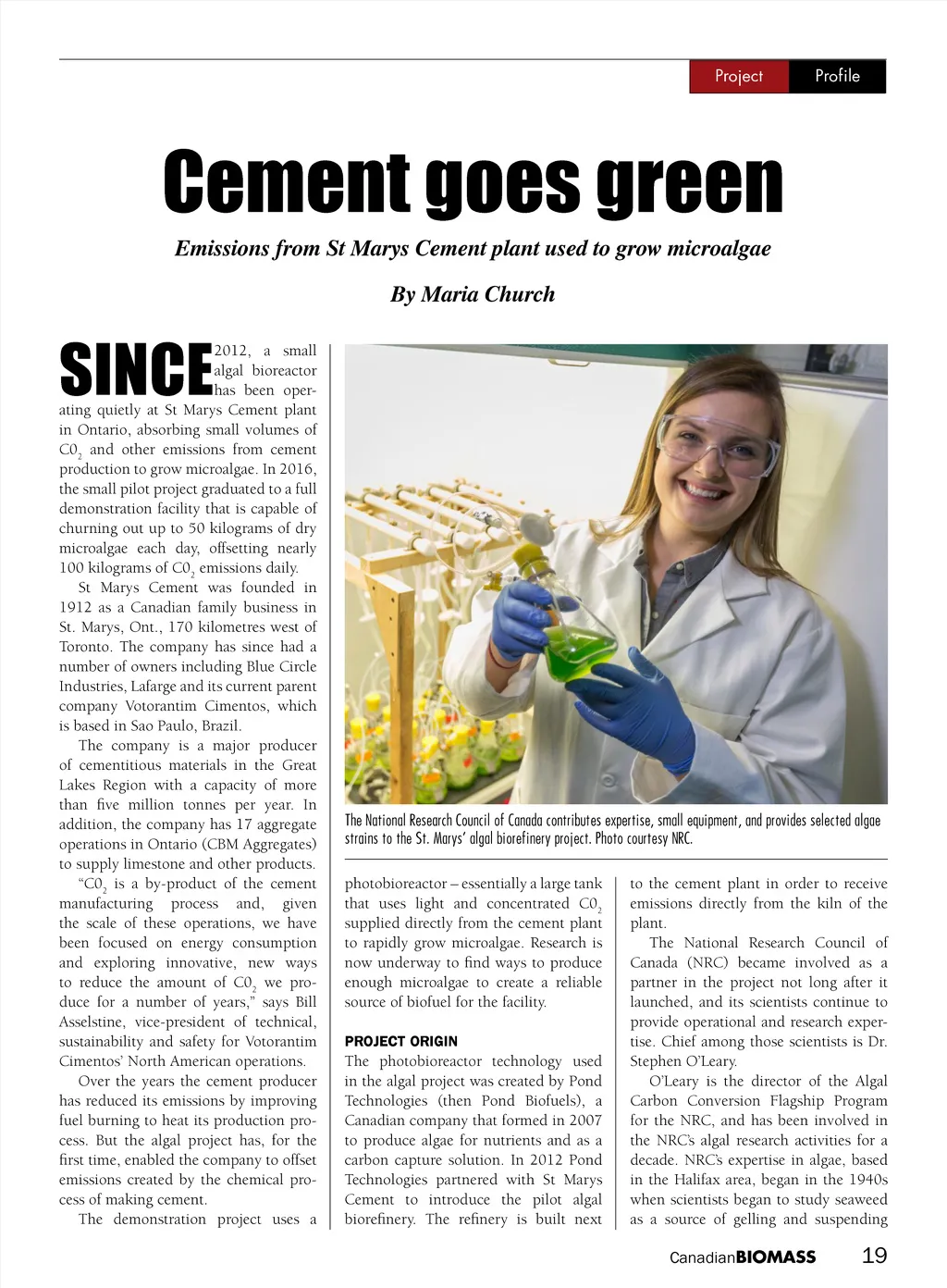
Project Profile Cement goes green Emissions from St Marys Cement plant used to grow microalgae By Maria Church SINCE 2012, a small algal bioreactor has been oper-ating quietly at St Marys Cement plant in Ontario, absorbing small volumes of C0 2 and other emissions from cement production to grow microalgae. In 2016, the small pilot project graduated to a full demonstration facility that is capable of churning out up to 50 kilograms of dry microalgae each day, offsetting nearly 100 kilograms of C0 2 emissions daily. St Marys Cement was founded in 1912 as a Canadian family business in St. Marys, Ont., 170 kilometres west of Toronto. The company has since had a number of owners including Blue Circle Industries, Lafarge and its current parent company Votorantim Cimentos, which is based in Sao Paulo, Brazil. The company is a major producer of cementitious materials in the Great Lakes Region with a capacity of more than five million tonnes per year. In addition, the company has 17 aggregate operations in Ontario (CBM Aggregates) to supply limestone and other products. “C0 2 is a by-product of the cement manufacturing process and, given the scale of these operations, we have been focused on energy consumption and exploring innovative, new ways to reduce the amount of C0 2 we pro-duce for a number of years,” says Bill Asselstine, vice-president of technical, sustainability and safety for Votorantim Cimentos’ North American operations. Over the years the cement producer has reduced its emissions by improving fuel burning to heat its production pro-cess. But the algal project has, for the first time, enabled the company to offset emissions created by the chemical pro-cess of making cement. The demonstration project uses a The National Research Council of Canada contributes expertise, small equipment, and provides selected algae strains to the St. Marys’ algal biorefinery project. Photo courtesy NRC. photobioreactor – essentially a large tank that uses light and concentrated C0 2 supplied directly from the cement plant to rapidly grow microalgae. Research is now underway to find ways to produce enough microalgae to create a reliable source of biofuel for the facility. PROJECT ORIGIN The photobioreactor technology used in the algal project was created by Pond Technologies (then Pond Biofuels), a Canadian company that formed in 2007 to produce algae for nutrients and as a carbon capture solution. In 2012 Pond Technologies partnered with St Marys Cement to introduce the pilot algal biorefinery. The refinery is built next to the cement plant in order to receive emissions directly from the kiln of the plant. The National Research Council of Canada (NRC) became involved as a partner in the project not long after it launched, and its scientists continue to provide operational and research exper-tise. Chief among those scientists is Dr. Stephen O’Leary. O’Leary is the director of the Algal Carbon Conversion Flagship Program for the NRC, and has been involved in the NRC’s algal research activities for a decade. NRC’s expertise in algae, based in the Halifax area, began in the 1940s when scientists began to study seaweed as a source of gelling and suspending Canadian BIOMASS 19
Canadian Biomass March-April 2017: Page 19