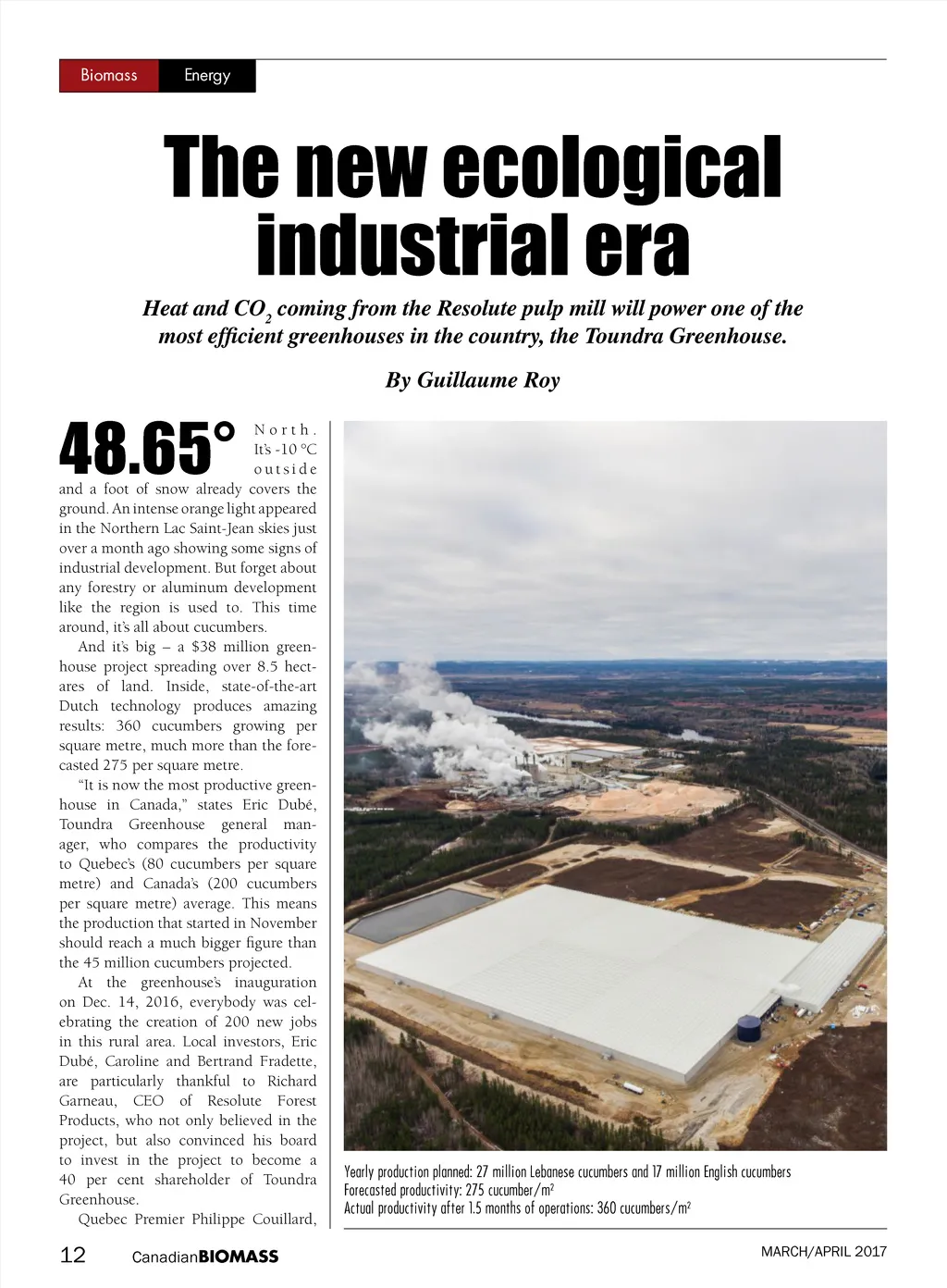
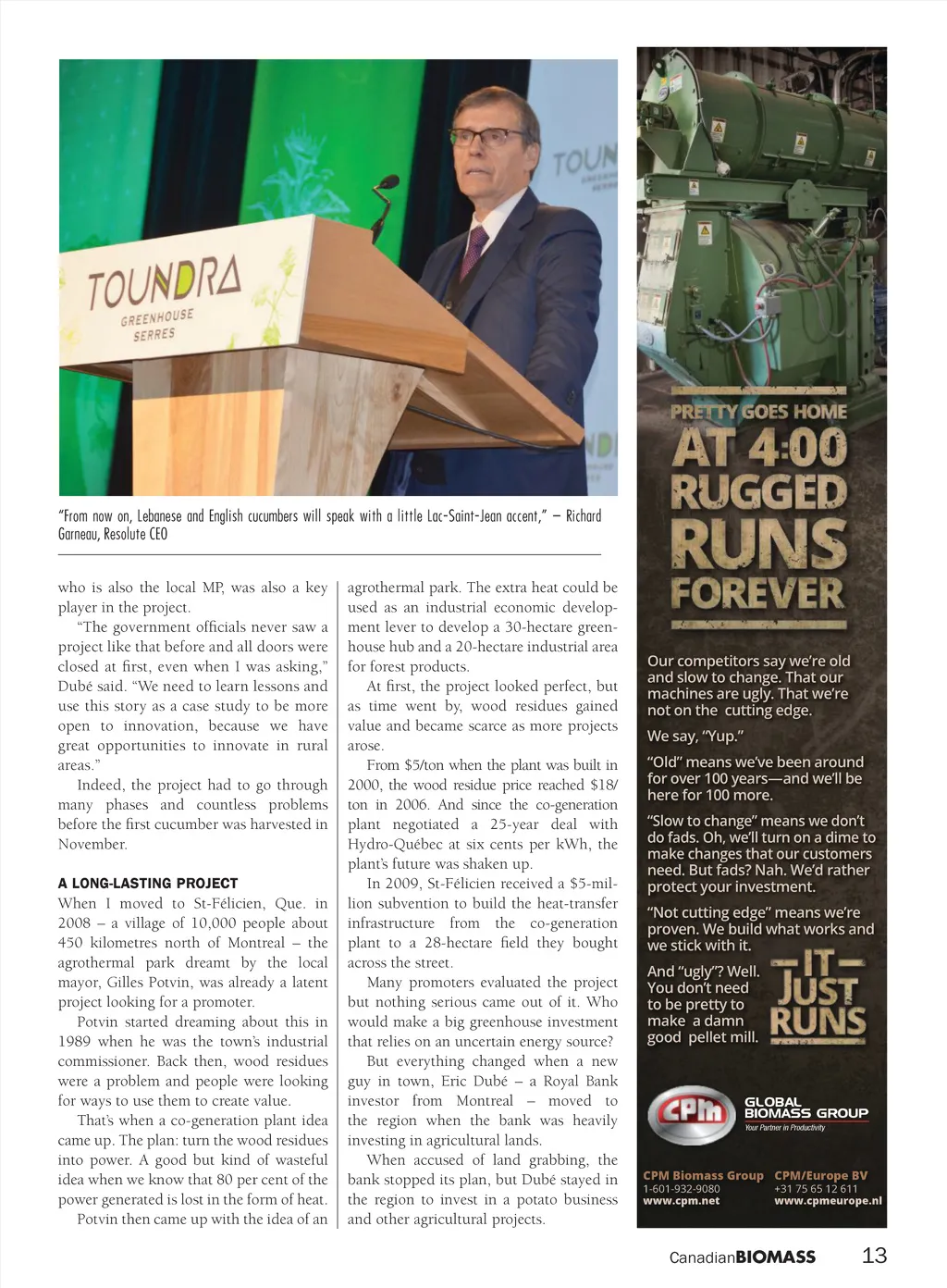
“From now on, Lebanese and English cucumbers will speak with a little Lac-Saint-Jean accent,” – Richard Garneau, Resolute CEO who is also the local MP, was also a key player in the project. “The government officials never saw a project like that before and all doors were closed at first, even when I was asking,” Dubé said. “We need to learn lessons and use this story as a case study to be more open to innovation, because we have great opportunities to innovate in rural areas.” Indeed, the project had to go through many phases and countless problems before the first cucumber was harvested in November. A LONG-LASTING PROJECT When I moved to St-Félicien, Que. in 2008 – a village of 10,000 people about 450 kilometres north of Montreal – the agrothermal park dreamt by the local mayor, Gilles Potvin, was already a latent project looking for a promoter. Potvin started dreaming about this in 1989 when he was the town’s industrial commissioner. Back then, wood residues were a problem and people were looking for ways to use them to create value. That’s when a co-generation plant idea came up. The plan: turn the wood residues into power. A good but kind of wasteful idea when we know that 80 per cent of the power generated is lost in the form of heat. Potvin then came up with the idea of an agrothermal park. The extra heat could be used as an industrial economic develop-ment lever to develop a 30-hectare green-house hub and a 20-hectare industrial area for forest products. At first, the project looked perfect, but as time went by, wood residues gained value and became scarce as more projects arose. From $5/ton when the plant was built in 2000, the wood residue price reached $18/ ton in 2006. And since the co-generation plant negotiated a 25-year deal with Hydro-Québec at six cents per kWh, the plant’s future was shaken up. In 2009, St-Félicien received a $5-mil-lion subvention to build the heat-transfer infrastructure from the co-generation plant to a 28-hectare field they bought across the street. Many promoters evaluated the project but nothing serious came out of it. Who would make a big greenhouse investment that relies on an uncertain energy source? But everything changed when a new guy in town, Eric Dubé – a Royal Bank investor from Montreal – moved to the region when the bank was heavily investing in agricultural lands. When accused of land grabbing, the bank stopped its plan, but Dubé stayed in the region to invest in a potato business and other agricultural projects. Our competitors say we’re old and slow to change. That our machines are ugly. That we’re not on the cutting edge. We say, “Yup.” “Old” means we’ve been around for over 100 years—and we’ll be here for 100 more. “Slow to change” means we don’t do fads. Oh, we’ll turn on a dime to make changes that our customers need. But fads? Nah. We’d rather protect your investment. “Not cutting edge” means we’re proven. We build what works and we stick with it. And “ugly”? Well. You don’t need to be pretty to make a damn good pellet mill. GLOBAL BIOMASS GROUP Your Partner in Productivity CPM Biomass Group CPM/Europe BV 1-601-932-9080 www.cpm.net +31 75 65 12 611 www.cpmeurope.nl Canadian BIOMASS 13
Canadian Biomass March-April 2017: Page 13