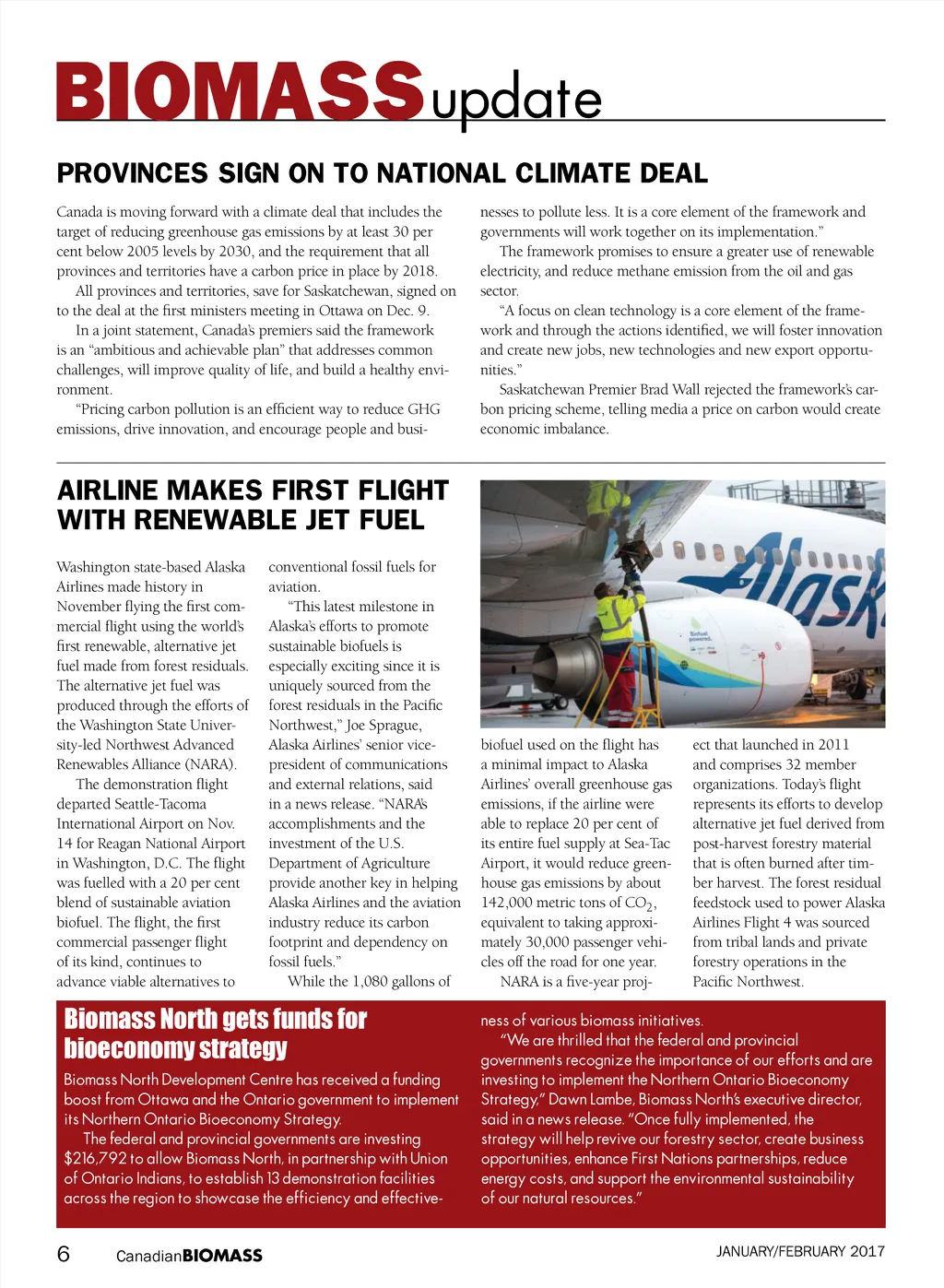
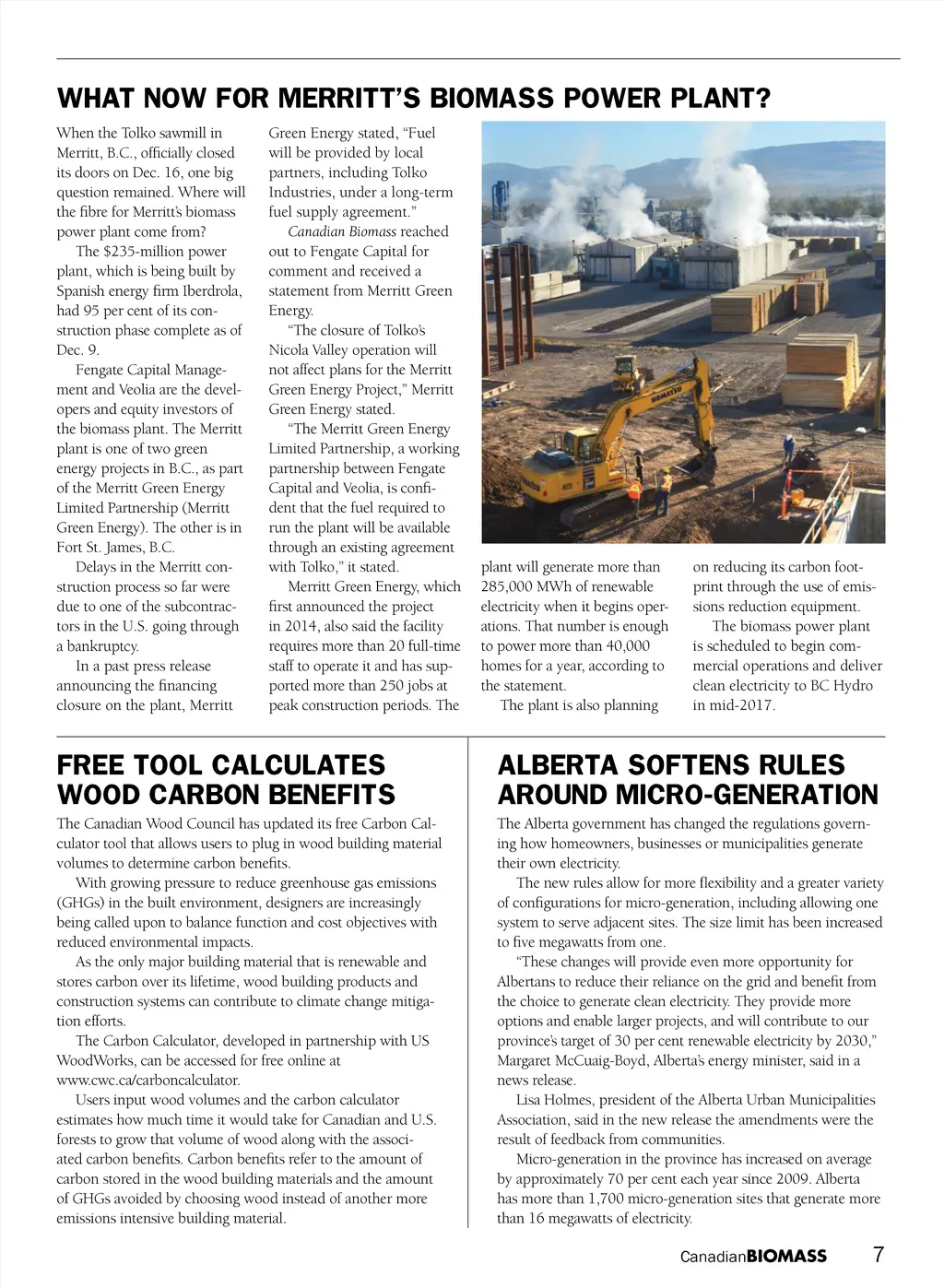
WHAT NOW FOR MERRITT’S BIOMASS POWER PLANT? When the Tolko sawmill in Merritt, B.C., officially closed its doors on Dec. 16, one big question remained. Where will the fibre for Merritt’s biomass power plant come from? The $235-million power plant, which is being built by Spanish energy firm Iberdrola, had 95 per cent of its con-struction phase complete as of Dec. 9. Fengate Capital Manage-ment and Veolia are the devel-opers and equity investors of the biomass plant. The Merritt plant is one of two green energy projects in B.C., as part of the Merritt Green Energy Limited Partnership (Merritt Green Energy). The other is in Fort St. James, B.C. Delays in the Merritt con-struction process so far were due to one of the subcontrac-tors in the U.S. going through a bankruptcy. In a past press release announcing the financing closure on the plant, Merritt Green Energy stated, “Fuel will be provided by local partners, including Tolko Industries, under a long-term fuel supply agreement.” Canadian Biomass reached out to Fengate Capital for comment and received a statement from Merritt Green Energy. “The closure of Tolko’s Nicola Valley operation will not affect plans for the Merritt Green Energy Project,” Merritt Green Energy stated. “The Merritt Green Energy Limited Partnership, a working partnership between Fengate Capital and Veolia, is confi-dent that the fuel required to run the plant will be available through an existing agreement with Tolko,” it stated. Merritt Green Energy, which first announced the project in 2014, also said the facility requires more than 20 full-time staff to operate it and has sup-ported more than 250 jobs at peak construction periods. The plant will generate more than 285,000 MWh of renewable electricity when it begins oper-ations. That number is enough to power more than 40,000 homes for a year, according to the statement. The plant is also planning on reducing its carbon foot-print through the use of emis-sions reduction equipment. The biomass power plant is scheduled to begin com-mercial operations and deliver clean electricity to BC Hydro in mid-2017. FREE TOOL CALCULATES WOOD CARBON BENEFITS The Canadian Wood Council has updated its free Carbon Cal-culator tool that allows users to plug in wood building material volumes to determine carbon benefits. With growing pressure to reduce greenhouse gas emissions (GHGs) in the built environment, designers are increasingly being called upon to balance function and cost objectives with reduced environmental impacts. As the only major building material that is renewable and stores carbon over its lifetime, wood building products and construction systems can contribute to climate change mitiga-tion efforts. The Carbon Calculator, developed in partnership with US WoodWorks, can be accessed for free online at www.cwc.ca/carboncalculator. Users input wood volumes and the carbon calculator estimates how much time it would take for Canadian and U.S. forests to grow that volume of wood along with the associ-ated carbon benefits. Carbon benefits refer to the amount of carbon stored in the wood building materials and the amount of GHGs avoided by choosing wood instead of another more emissions intensive building material. ALBERTA SOFTENS RULES AROUND MICRO-GENERATION The Alberta government has changed the regulations govern-ing how homeowners, businesses or municipalities generate their own electricity. The new rules allow for more flexibility and a greater variety of configurations for micro-generation, including allowing one system to serve adjacent sites. The size limit has been increased to five megawatts from one. “These changes will provide even more opportunity for Albertans to reduce their reliance on the grid and benefit from the choice to generate clean electricity. They provide more options and enable larger projects, and will contribute to our province’s target of 30 per cent renewable electricity by 2030,” Margaret McCuaig-Boyd, Alberta’s energy minister, said in a news release. Lisa Holmes, president of the Alberta Urban Municipalities Association, said in the new release the amendments were the result of feedback from communities. Micro-generation in the province has increased on average by approximately 70 per cent each year since 2009. Alberta has more than 1,700 micro-generation sites that generate more than 16 megawatts of electricity. Canadian BIOMASS 7
Canadian Biomass January February 2017: Page 7