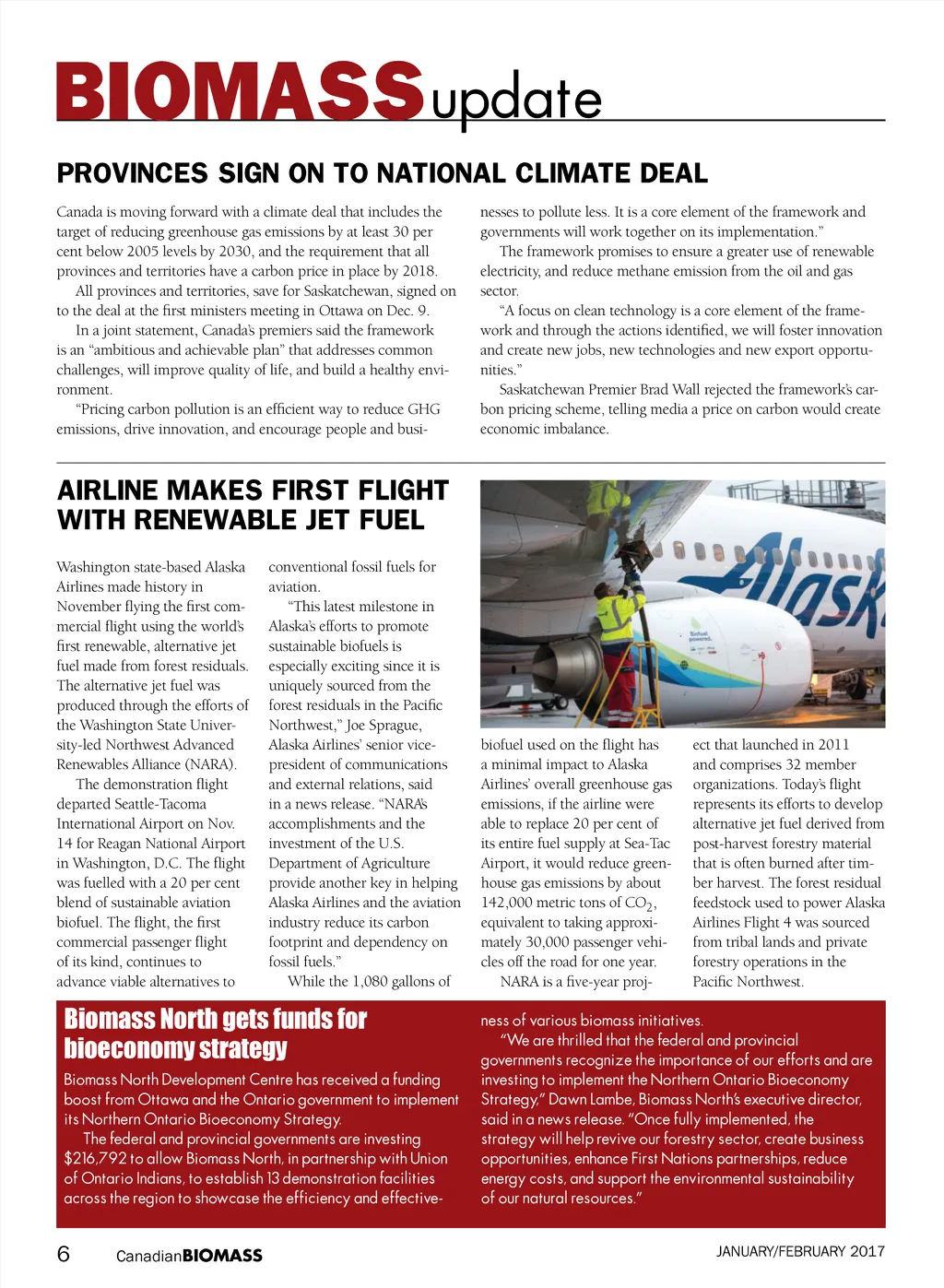
BIOMASS update PROVINCES SIGN ON TO NATIONAL CLIMATE DEAL Canada is moving forward with a climate deal that includes the target of reducing greenhouse gas emissions by at least 30 per cent below 2005 levels by 2030, and the requirement that all provinces and territories have a carbon price in place by 2018. All provinces and territories, save for Saskatchewan, signed on to the deal at the first ministers meeting in Ottawa on Dec. 9. In a joint statement, Canada’s premiers said the framework is an “ambitious and achievable plan” that addresses common challenges, will improve quality of life, and build a healthy envi-ronment. “Pricing carbon pollution is an efficient way to reduce GHG emissions, drive innovation, and encourage people and busi-nesses to pollute less. It is a core element of the framework and governments will work together on its implementation.” The framework promises to ensure a greater use of renewable electricity, and reduce methane emission from the oil and gas sector. “A focus on clean technology is a core element of the frame-work and through the actions identified, we will foster innovation and create new jobs, new technologies and new export opportu-nities.” Saskatchewan Premier Brad Wall rejected the framework’s car-bon pricing scheme, telling media a price on carbon would create economic imbalance. AIRLINE MAKES FIRST FLIGHT WITH RENEWABLE JET FUEL Washington state-based Alaska Airlines made history in November flying the first com-mercial flight using the world’s first renewable, alternative jet fuel made from forest residuals. The alternative jet fuel was produced through the efforts of the Washington State Univer-sity-led Northwest Advanced Renewables Alliance (NARA). The demonstration flight departed Seattle-Tacoma International Airport on Nov. 14 for Reagan National Airport in Washington, D.C. The flight was fuelled with a 20 per cent blend of sustainable aviation biofuel. The flight, the first commercial passenger flight of its kind, continues to advance viable alternatives to conventional fossil fuels for aviation. “This latest milestone in Alaska’s efforts to promote sustainable biofuels is especially exciting since it is uniquely sourced from the forest residuals in the Pacific Northwest,” Joe Sprague, Alaska Airlines’ senior vice-president of communications and external relations, said in a news release. “NARA’s accomplishments and the investment of the U.S. Department of Agriculture provide another key in helping Alaska Airlines and the aviation industry reduce its carbon footprint and dependency on fossil fuels.” While the 1,080 gallons of biofuel used on the flight has a minimal impact to Alaska Airlines’ overall greenhouse gas emissions, if the airline were able to replace 20 per cent of its entire fuel supply at Sea-Tac Airport, it would reduce green-house gas emissions by about 142,000 metric tons of CO 2 , equivalent to taking approxi-mately 30,000 passenger vehi-cles off the road for one year. NARA is a five-year proj-ect that launched in 2011 and comprises 32 member organizations. Today’s flight represents its efforts to develop alternative jet fuel derived from post-harvest forestry material that is often burned after tim-ber harvest. The forest residual feedstock used to power Alaska Airlines Flight 4 was sourced from tribal lands and private forestry operations in the Pacific Northwest. Biomass North gets funds for bioeconomy strategy Biomass North Development Centre has received a funding boost from Ottawa and the Ontario government to implement its Northern Ontario Bioeconomy Strategy. The federal and provincial governments are investing $216,792 to allow Biomass North, in partnership with Union of Ontario Indians, to establish 13 demonstration facilities across the region to showcase the efficiency and effective-ness of various biomass initiatives. “We are thrilled that the federal and provincial governments recognize the importance of our efforts and are investing to implement the Northern Ontario Bioeconomy Strategy,” Dawn Lambe, Biomass North’ s executive director, said in a news release. “Once fully implemented, the strategy will help revive our forestry sector, create business opportunities, enhance First Nations partnerships, reduce energy costs, and support the environmental sustainability of our natural resources.” JANUARY/FEBRUARY 2017 6 Canadian BIOMASS
Canadian Biomass January February 2017: Page 6