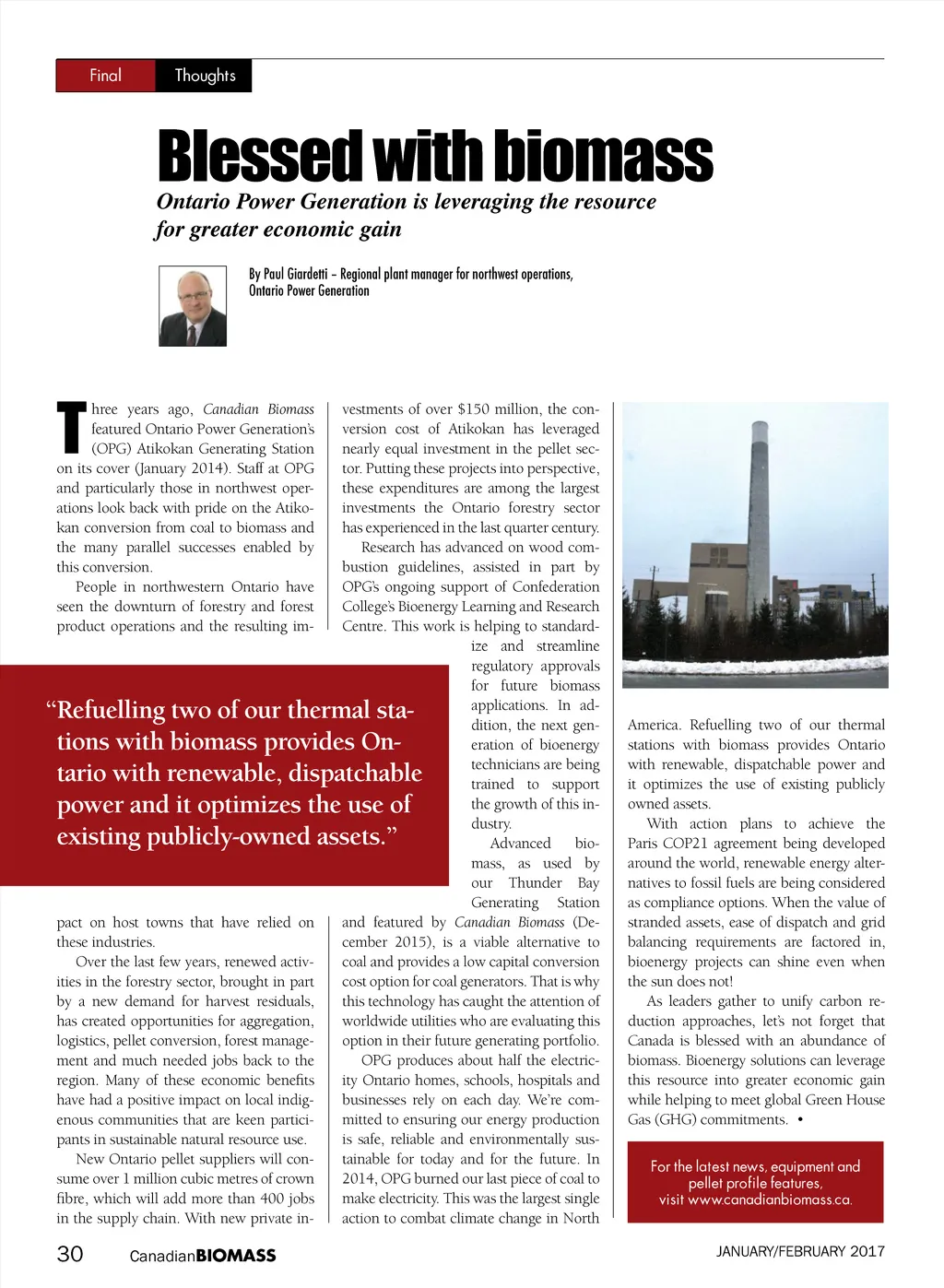
Final Thoughts Blessed with biomass Ontario Power Generation is leveraging the resource for greater economic gain By Paul Giardetti – Regional plant manager for northwest operations, Ontario Power Generation hree years ago, Canadian Biomass featured Ontario Power Generation’s (OPG) Atikokan Generating Station on its cover (January 2014). Staff at OPG and particularly those in northwest oper-ations look back with pride on the Atiko-kan conversion from coal to biomass and the many parallel successes enabled by this conversion. People in northwestern Ontario have seen the downturn of forestry and forest product operations and the resulting im-T “ Refuelling two of our thermal sta-tions with biomass provides On-tario with renewable, dispatchable power and it optimizes the use of existing publicly-owned assets.” pact on host towns that have relied on these industries. Over the last few years, renewed activ-ities in the forestry sector, brought in part by a new demand for harvest residuals, has created opportunities for aggregation, logistics, pellet conversion, forest manage-ment and much needed jobs back to the region. Many of these economic benefits have had a positive impact on local indig-enous communities that are keen partici-pants in sustainable natural resource use. New Ontario pellet suppliers will con-sume over 1 million cubic metres of crown fibre, which will add more than 400 jobs in the supply chain. With new private in-vestments of over $150 million, the con-version cost of Atikokan has leveraged nearly equal investment in the pellet sec-tor. Putting these projects into perspective, these expenditures are among the largest investments the Ontario forestry sector has experienced in the last quarter century. Research has advanced on wood com-bustion guidelines, assisted in part by OPG’s ongoing support of Confederation College’s Bioenergy Learning and Research Centre. This work is helping to standard-ize and streamline regulatory approvals for future biomass applications. In ad-dition, the next gen-eration of bioenergy technicians are being trained to support the growth of this in-dustry. Advanced bio-mass, as used by our Thunder Bay Generating Station and featured by Canadian Biomass (De-cember 2015), is a viable alternative to coal and provides a low capital conversion cost option for coal generators. That is why this technology has caught the attention of worldwide utilities who are evaluating this option in their future generating portfolio. OPG produces about half the electric-ity Ontario homes, schools, hospitals and businesses rely on each day. We’re com-mitted to ensuring our energy production is safe, reliable and environmentally sus-tainable for today and for the future. In 2014, OPG burned our last piece of coal to make electricity. This was the largest single action to combat climate change in North America. Refuelling two of our thermal stations with biomass provides Ontario with renewable, dispatchable power and it optimizes the use of existing publicly owned assets. With action plans to achieve the Paris COP21 agreement being developed around the world, renewable energy alter-natives to fossil fuels are being considered as compliance options. When the value of stranded assets, ease of dispatch and grid balancing requirements are factored in, bioenergy projects can shine even when the sun does not! As leaders gather to unify carbon re-duction approaches, let’s not forget that Canada is blessed with an abundance of biomass. Bioenergy solutions can leverage this resource into greater economic gain while helping to meet global Green House Gas (GHG) commitments. • For the latest news, equipment and pellet profile features, visit www.canadianbiomass.ca. JANUARY/FEBRUARY 2017 30 Canadian BIOMASS
Canadian Biomass January February 2017: Page 30