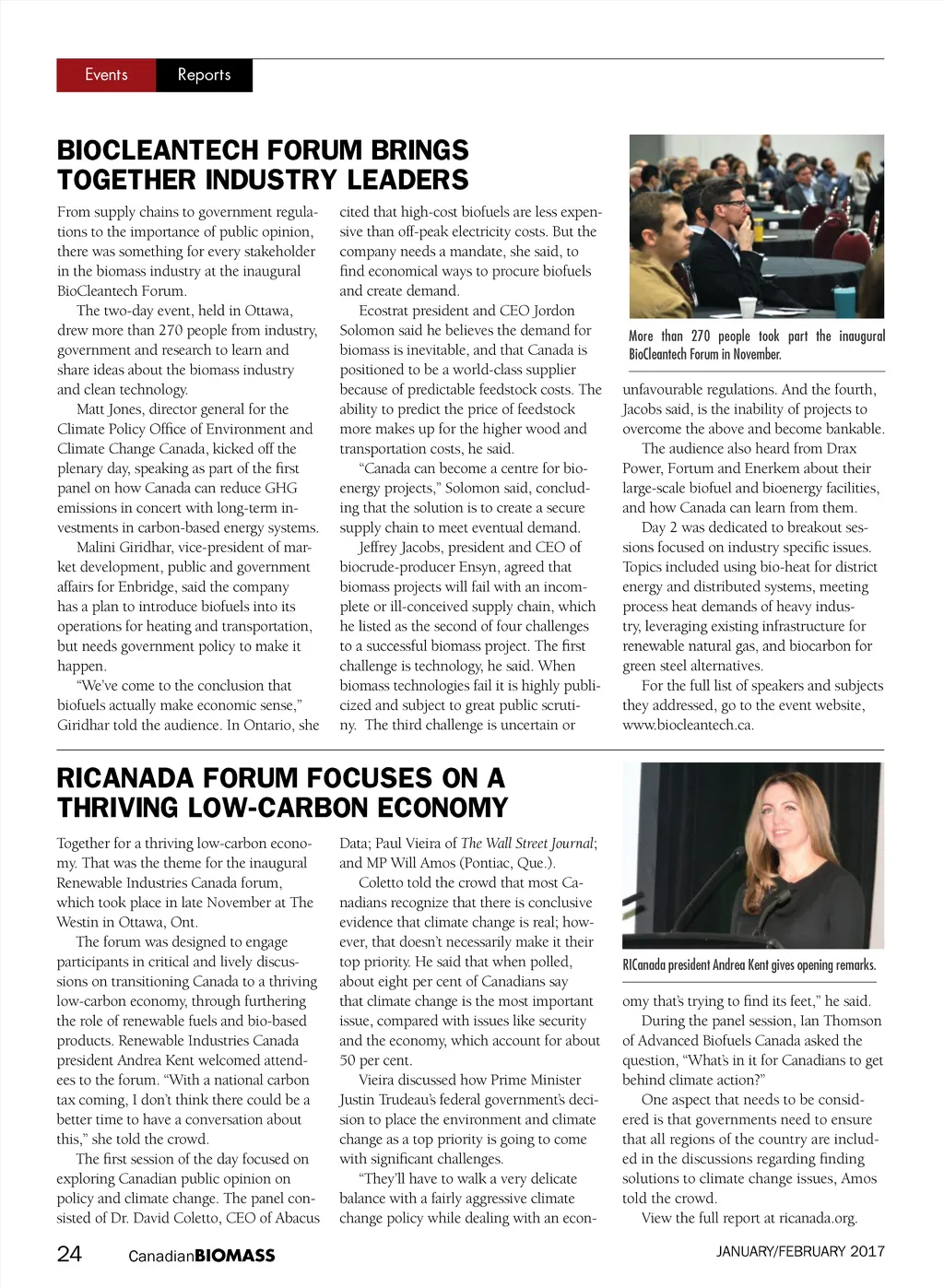
Events Reports BIOCLEANTECH FORUM BRINGS TOGETHER INDUSTRY LEADERS From supply chains to government regula-tions to the importance of public opinion, there was something for every stakeholder in the biomass industry at the inaugural BioCleantech Forum. The two-day event, held in Ottawa, drew more than 270 people from industry, government and research to learn and share ideas about the biomass industry and clean technology. Matt Jones, director general for the Climate Policy Office of Environment and Climate Change Canada, kicked off the plenary day, speaking as part of the first panel on how Canada can reduce GHG emissions in concert with long-term in-vestments in carbon-based energy systems. Malini Giridhar, vice-president of mar-ket development, public and government affairs for Enbridge, said the company has a plan to introduce biofuels into its operations for heating and transportation, but needs government policy to make it happen. “We’ve come to the conclusion that biofuels actually make economic sense,” Giridhar told the audience. In Ontario, she cited that high-cost biofuels are less expen-sive than off-peak electricity costs. But the company needs a mandate, she said, to find economical ways to procure biofuels and create demand. Ecostrat president and CEO Jordon Solomon said he believes the demand for biomass is inevitable, and that Canada is positioned to be a world-class supplier because of predictable feedstock costs. The ability to predict the price of feedstock more makes up for the higher wood and transportation costs, he said. “Canada can become a centre for bio-energy projects,” Solomon said, conclud-ing that the solution is to create a secure supply chain to meet eventual demand. Jeffrey Jacobs, president and CEO of biocrude-producer Ensyn, agreed that biomass projects will fail with an incom-plete or ill-conceived supply chain, which he listed as the second of four challenges to a successful biomass project. The first challenge is technology, he said. When biomass technologies fail it is highly publi-cized and subject to great public scruti-ny. The third challenge is uncertain or More than 270 people took part the inaugural BioCleantech Forum in November. unfavourable regulations. And the fourth, Jacobs said, is the inability of projects to overcome the above and become bankable. The audience also heard from Drax Power, Fortum and Enerkem about their large-scale biofuel and bioenergy facilities, and how Canada can learn from them. Day 2 was dedicated to breakout ses-sions focused on industry specific issues. Topics included using bio-heat for district energy and distributed systems, meeting process heat demands of heavy indus-try, leveraging existing infrastructure for renewable natural gas, and biocarbon for green steel alternatives. For the full list of speakers and subjects they addressed, go to the event website, www.biocleantech.ca. RICANADA FORUM FOCUSES ON A THRIVING LOW-CARBON ECONOMY Together for a thriving low-carbon econo-my. That was the theme for the inaugural Renewable Industries Canada forum, which took place in late November at The Westin in Ottawa, Ont. The forum was designed to engage participants in critical and lively discus-sions on transitioning Canada to a thriving low-carbon economy, through furthering the role of renewable fuels and bio-based products. Renewable Industries Canada president Andrea Kent welcomed attend-ees to the forum. “With a national carbon tax coming, I don’t think there could be a better time to have a conversation about this,” she told the crowd. The first session of the day focused on exploring Canadian public opinion on policy and climate change. The panel con-sisted of Dr. David Coletto, CEO of Abacus Data; Paul Vieira of The Wall Street Journal ; and MP Will Amos (Pontiac, Que.). Coletto told the crowd that most Ca-nadians recognize that there is conclusive evidence that climate change is real; how-ever, that doesn’t necessarily make it their top priority. He said that when polled, about eight per cent of Canadians say that climate change is the most important issue, compared with issues like security and the economy, which account for about 50 per cent. Vieira discussed how Prime Minister Justin Trudeau’s federal government’s deci-sion to place the environment and climate change as a top priority is going to come with significant challenges. “They’ll have to walk a very delicate balance with a fairly aggressive climate change policy while dealing with an econ-RICanada president Andrea Kent gives opening remarks. omy that’s trying to find its feet,” he said. During the panel session, Ian Thomson of Advanced Biofuels Canada asked the question, “What’s in it for Canadians to get behind climate action?” One aspect that needs to be consid-ered is that governments need to ensure that all regions of the country are includ-ed in the discussions regarding finding solutions to climate change issues, Amos told the crowd. View the full report at ricanada.org. JANUARY/FEBRUARY 2017 24 Canadian BIOMASS
Canadian Biomass January February 2017: Page 24