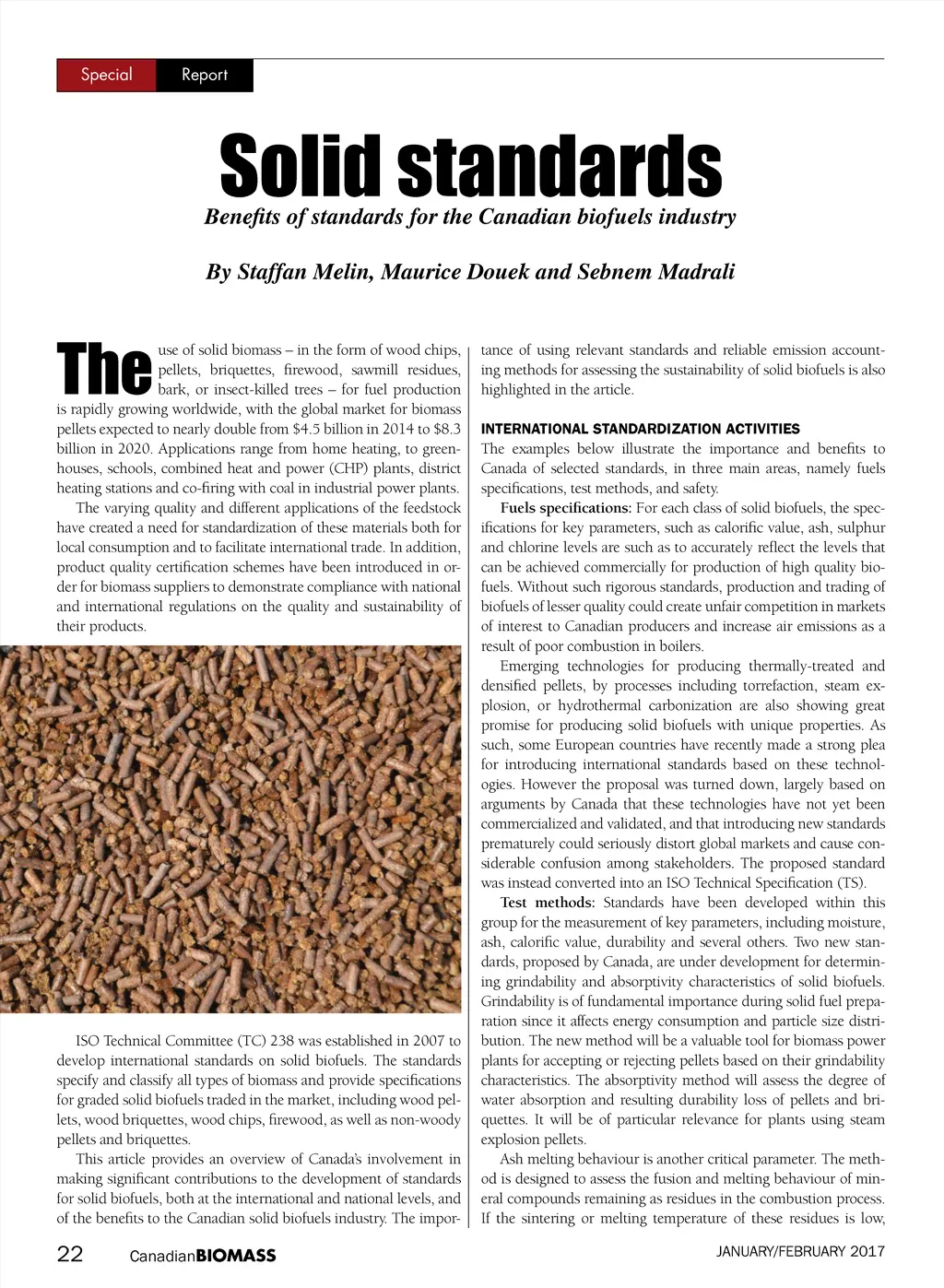
Special Report Benefits of standards for the Canadian biofuels industry By Staffan Melin, Maurice Douek and Sebnem Madrali Solid standards The use of solid biomass – in the form of wood chips, pellets, briquettes, firewood, sawmill residues, bark, or insect-killed trees – for fuel production is rapidly growing worldwide, with the global market for biomass pellets expected to nearly double from $4.5 billion in 2014 to $8.3 billion in 2020. Applications range from home heating, to green-houses, schools, combined heat and power (CHP) plants, district heating stations and co-firing with coal in industrial power plants. The varying quality and different applications of the feedstock have created a need for standardization of these materials both for local consumption and to facilitate international trade. In addition, product quality certification schemes have been introduced in or-der for biomass suppliers to demonstrate compliance with national and international regulations on the quality and sustainability of their products. tance of using relevant standards and reliable emission account-ing methods for assessing the sustainability of solid biofuels is also highlighted in the article. INTERNATIONAL STANDARDIZATION ACTIVITIES ISO Technical Committee (TC) 238 was established in 2007 to develop international standards on solid biofuels. The standards specify and classify all types of biomass and provide specifications for graded solid biofuels traded in the market, including wood pel-lets, wood briquettes, wood chips, firewood, as well as non-woody pellets and briquettes. This article provides an overview of Canada’s involvement in making significant contributions to the development of standards for solid biofuels, both at the international and national levels, and of the benefits to the Canadian solid biofuels industry. The impor-The examples below illustrate the importance and benefits to Canada of selected standards, in three main areas, namely fuels specifications, test methods, and safety. Fuels specifications: For each class of solid biofuels, the spec-ifications for key parameters, such as calorific value, ash, sulphur and chlorine levels are such as to accurately reflect the levels that can be achieved commercially for production of high quality bio-fuels. Without such rigorous standards, production and trading of biofuels of lesser quality could create unfair competition in markets of interest to Canadian producers and increase air emissions as a result of poor combustion in boilers. Emerging technologies for producing thermally-treated and densified pellets, by processes including torrefaction, steam ex-plosion, or hydrothermal carbonization are also showing great promise for producing solid biofuels with unique properties. As such, some European countries have recently made a strong plea for introducing international standards based on these technol-ogies. However the proposal was turned down, largely based on arguments by Canada that these technologies have not yet been commercialized and validated, and that introducing new standards prematurely could seriously distort global markets and cause con-siderable confusion among stakeholders. The proposed standard was instead converted into an ISO Technical Specification (TS). Test methods: Standards have been developed within this group for the measurement of key parameters, including moisture, ash, calorific value, durability and several others. Two new stan-dards, proposed by Canada, are under development for determin-ing grindability and absorptivity characteristics of solid biofuels. Grindability is of fundamental importance during solid fuel prepa-ration since it affects energy consumption and particle size distri-bution. The new method will be a valuable tool for biomass power plants for accepting or rejecting pellets based on their grindability characteristics. The absorptivity method will assess the degree of water absorption and resulting durability loss of pellets and bri-quettes. It will be of particular relevance for plants using steam explosion pellets. Ash melting behaviour is another critical parameter. The meth-od is designed to assess the fusion and melting behaviour of min-eral compounds remaining as residues in the combustion process. If the sintering or melting temperature of these residues is low, JANUARY/FEBRUARY 2017 22 Canadian BIOMASS
Canadian Biomass January February 2017: Page 22