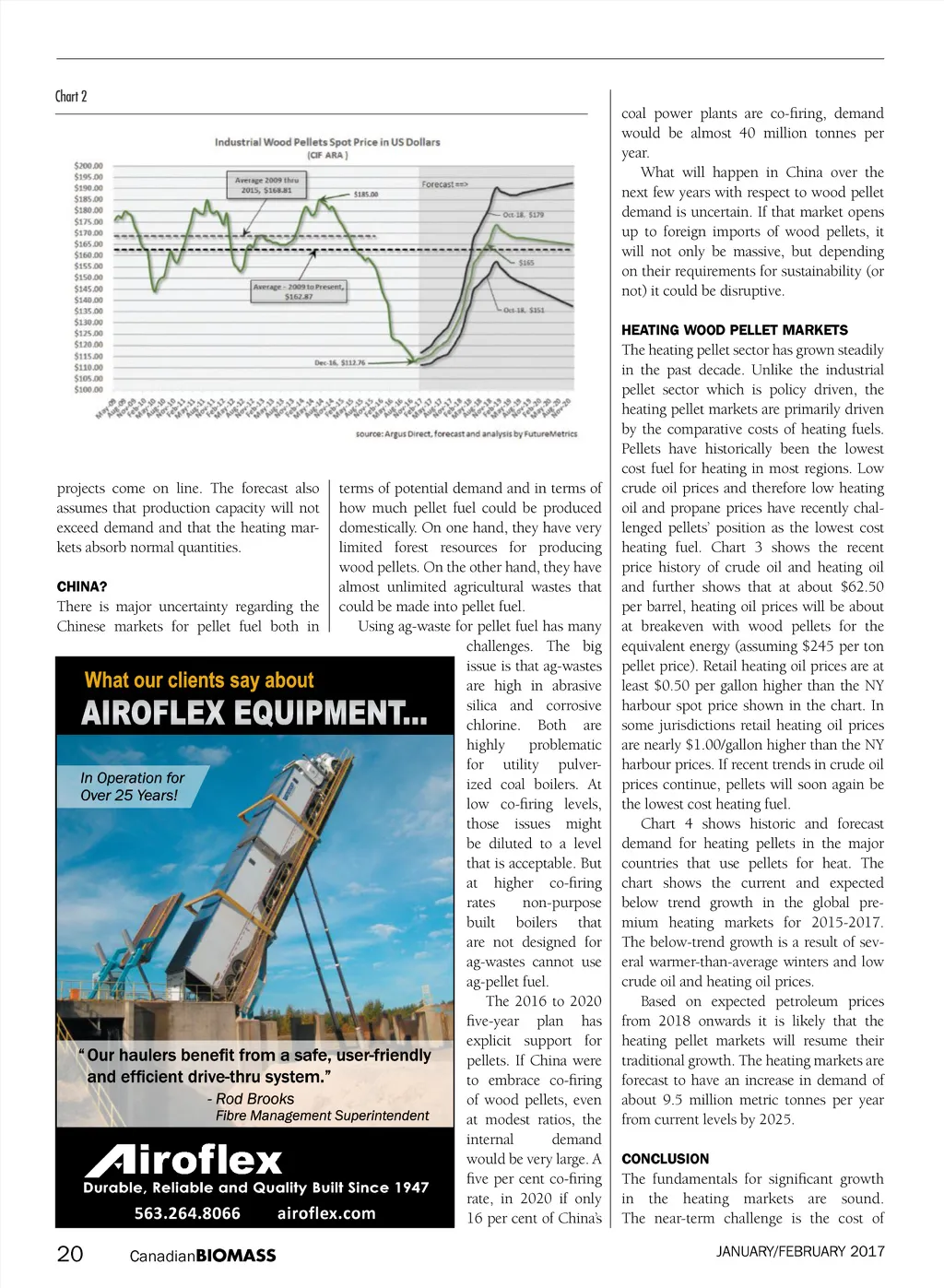
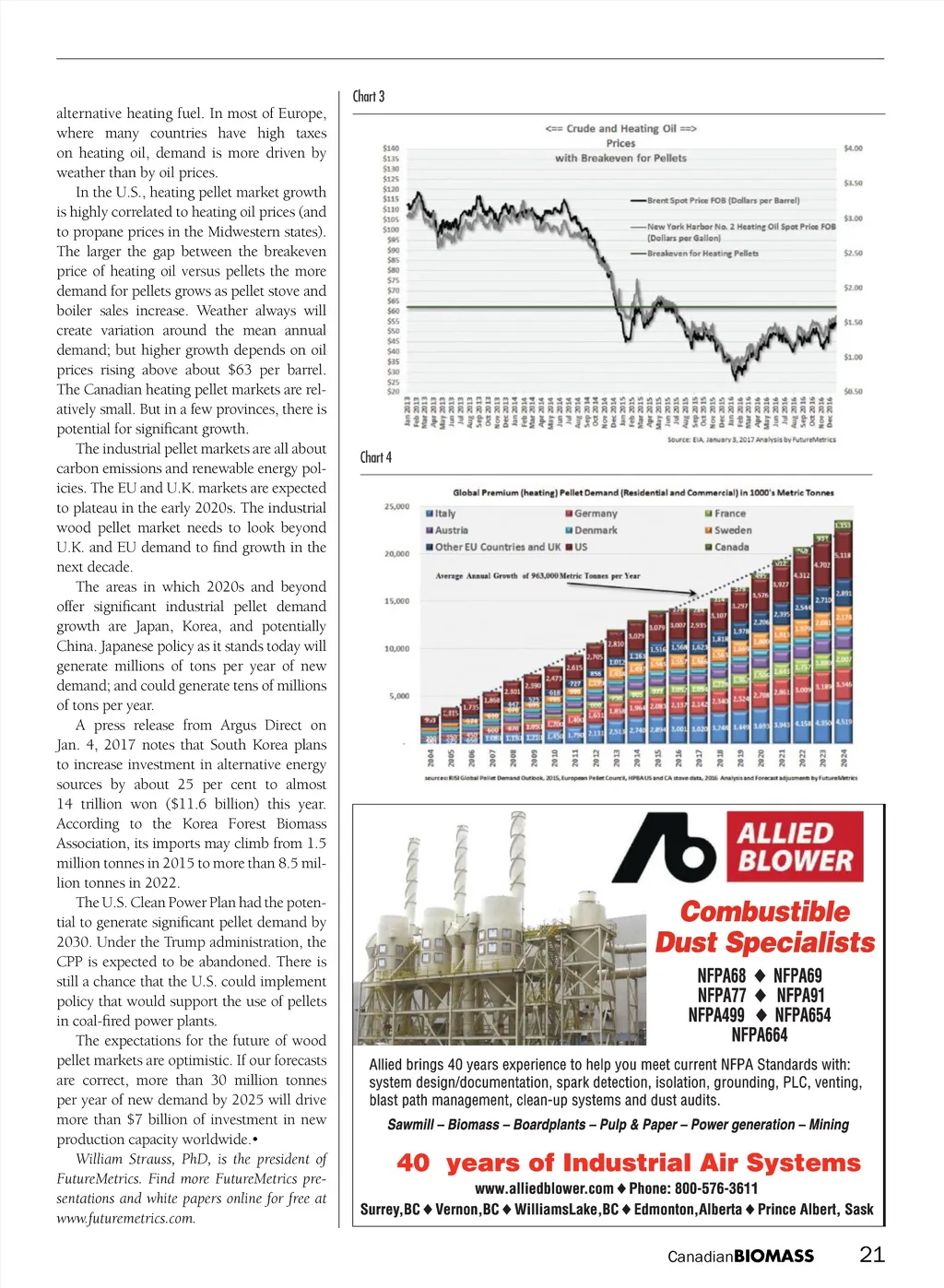
alternative heating fuel. In most of Europe, where many countries have high taxes on heating oil, demand is more driven by weather than by oil prices. In the U.S., heating pellet market growth is highly correlated to heating oil prices (and to propane prices in the Midwestern states). The larger the gap between the breakeven price of heating oil versus pellets the more demand for pellets grows as pellet stove and boiler sales increase. Weather always will create variation around the mean annual demand; but higher growth depends on oil prices rising above about $63 per barrel. The Canadian heating pellet markets are rel-atively small. But in a few provinces, there is potential for significant growth. The industrial pellet markets are all about carbon emissions and renewable energy pol-icies. The EU and U.K. markets are expected to plateau in the early 2020s. The industrial wood pellet market needs to look beyond U.K. and EU demand to find growth in the next decade. The areas in which 2020s and beyond offer significant industrial pellet demand growth are Japan, Korea, and potentially China. Japanese policy as it stands today will generate millions of tons per year of new demand; and could generate tens of millions of tons per year. A press release from Argus Direct on Jan. 4, 2017 notes that South Korea plans to increase investment in alternative energy sources by about 25 per cent to almost 14 trillion won ($11.6 billion) this year. According to the Korea Forest Biomass Association, its imports may climb from 1.5 million tonnes in 2015 to more than 8.5 mil-lion tonnes in 2022. The U.S. Clean Power Plan had the poten-tial to generate significant pellet demand by 2030. Under the Trump administration, the CPP is expected to be abandoned. There is still a chance that the U.S. could implement policy that would support the use of pellets in coal-fired power plants. The expectations for the future of wood pellet markets are optimistic. If our forecasts are correct, more than 30 million tonnes per year of new demand by 2025 will drive more than $7 billion of investment in new production capacity worldwide.• William Strauss, PhD, is the president of FutureMetrics. Find more FutureMetrics pre-sentations and white papers online for free at www.futuremetrics.com. Chart 3 Chart 4 Canadian BIOMASS 21
Canadian Biomass January February 2017: Page 21