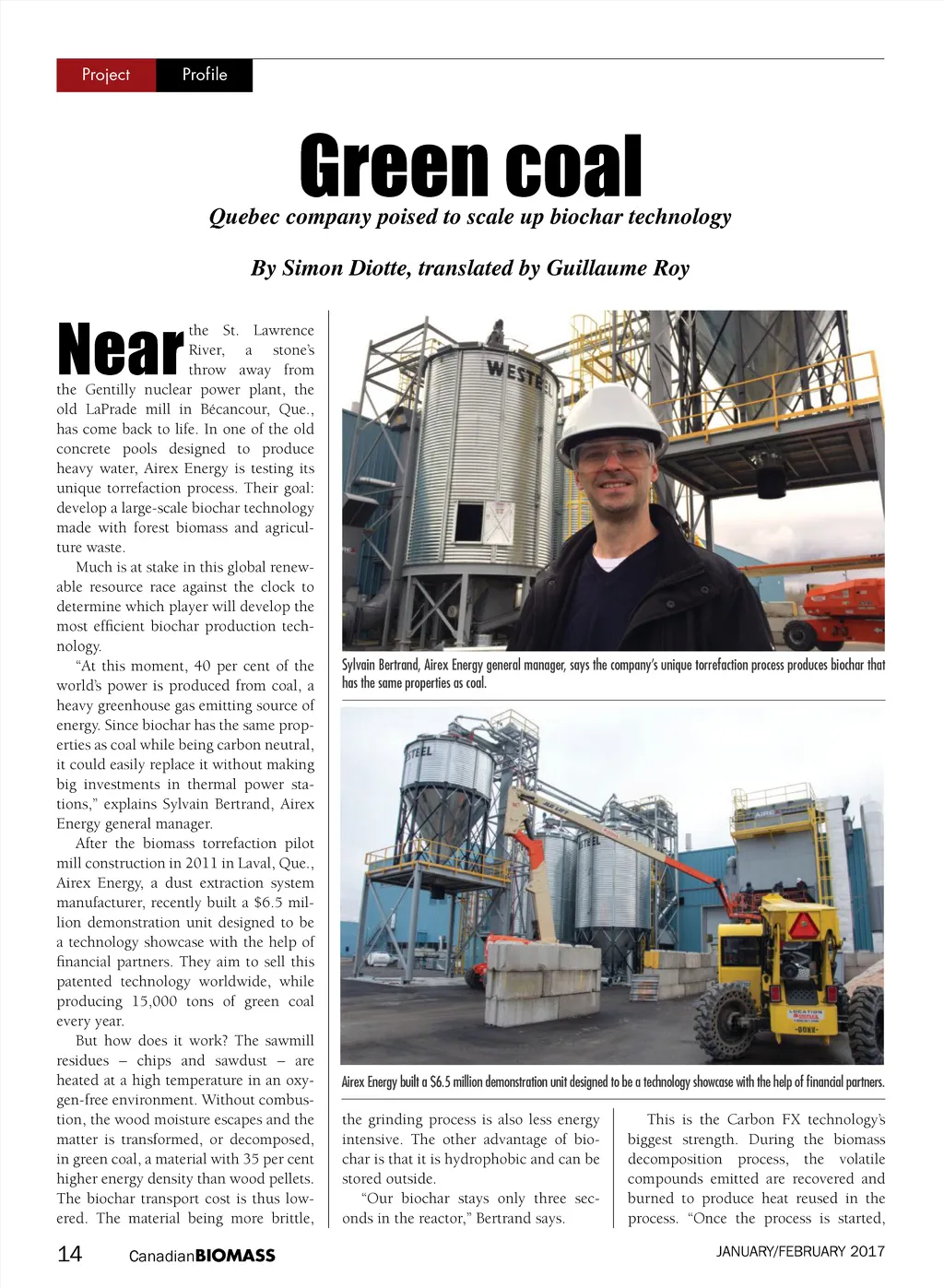
Project Profile Quebec company poised to scale up biochar technology By Simon Diotte, translated by Guillaume Roy the St. Lawrence River, a stone’s throw away from the Gentilly nuclear power plant, the old LaPrade mill in Bécancour, Que., has come back to life. In one of the old concrete pools designed to produce heavy water, Airex Energy is testing its unique torrefaction process. Their goal: develop a large-scale biochar technology made with forest biomass and agricul-ture waste. Much is at stake in this global renew-able resource race against the clock to determine which player will develop the most efficient biochar production tech-nology. “At this moment, 40 per cent of the world’s power is produced from coal, a heavy greenhouse gas emitting source of energy. Since biochar has the same prop-erties as coal while being carbon neutral, it could easily replace it without making big investments in thermal power sta-tions,” explains Sylvain Bertrand, Airex Energy general manager. After the biomass torrefaction pilot mill construction in 2011 in Laval, Que., Airex Energy, a dust extraction system manufacturer, recently built a $6.5 mil-lion demonstration unit designed to be a technology showcase with the help of financial partners. They aim to sell this patented technology worldwide, while producing 15,000 tons of green coal every year. But how does it work? The sawmill residues – chips and sawdust – are heated at a high temperature in an oxy-gen-free environment. Without combus-tion, the wood moisture escapes and the matter is transformed, or decomposed, in green coal, a material with 35 per cent higher energy density than wood pellets. The biochar transport cost is thus low-ered. The material being more brittle, Green coal Near Sylvain Bertrand, Airex Energy general manager, says the company’s unique torrefaction process produces biochar that has the same properties as coal. Airex Energy built a $6.5 million demonstration unit designed to be a technology showcase with the help of financial partners. the grinding process is also less energy intensive. The other advantage of bio-char is that it is hydrophobic and can be stored outside. “Our biochar stays only three sec-onds in the reactor,” Bertrand says. This is the Carbon FX technology’s biggest strength. During the biomass decomposition process, the volatile compounds emitted are recovered and burned to produce heat reused in the process. “Once the process is started, JANUARY/FEBRUARY 2017 14 Canadian BIOMASS
Canadian Biomass January February 2017: Page 14