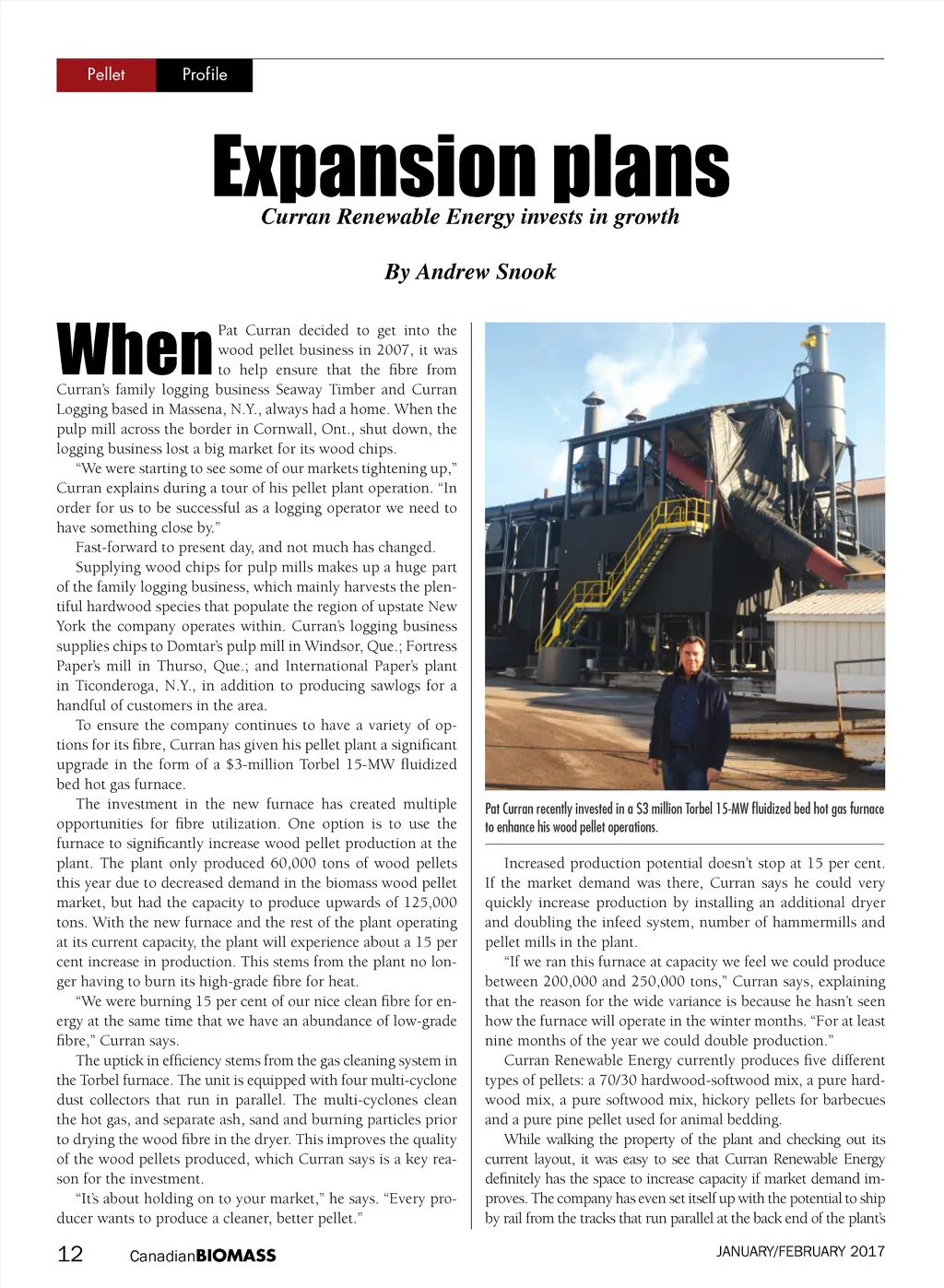
The new Torbel furnace offers the potential to increase the pellet plant’s annual capacity to between 200,000 and 250,000 tons. Timothy Curran Jr. shows off the company’s new Torbel furnace in the operations room. property; if the market picks up for bulk shipments. That said, Cur-ran isn’t about to invest the cash in increased pellet production. “Pellet market as it is, we won’t be doubling production right now,” he says, adding that there has been a perfect storm for de-creasing demand in the pellet market with the combination of warmer winters, a high U.S., dollar and low oil prices. “It’s hard to see a prosperous position right now.” STAYING DIVERSE Increasing wood pellet production wasn’t the only reason Cur-ran decided to invest in the Torbel system. He is also looking at using the furnace for co-generation if he can get a long-term agreement in place with a local utility pro-vider to generate excess energy that can be converted into electricity and be fed back into the grid. That way the pellet plant would have a steady stream of income com-ing in that isn’t sensitive to fluctuations in currency or oil prices. Another option Curran has for optimiz-ing his new furnace is to produce briquettes or use it for heating large greenhouses for drying sand – another resource he has an ample supply from his company’s local ag-gregate operations. CERTIFIED QUALITY By ensuring his wood pellets are produced at the highest levels of quality and continuing to invest in fibre diversification strat-egies, Curran Renewable Energy is positioning itself to weather the current economic storm and be well positioned for future opportunities for growth when demand in the wood pellet mar-ket resurfaces. “Even though we’re still in the start-up phase with the furnace, we like what we see and we are encouraged by the tremendous support and expertise given by the Torbel company, management and team,” Curran says. • Another way Curran holds onto his market share in the wood pellet sector is by paying for third-party certification, which is per-formed by Timber Product Inspections. It is part of the requirements for ensuring a company meets the standards for the Pellet Fuels Institute’s (PFI) certification program. “There’s a cost to this but it all comes back to quality,” Curran says, adding that third-party certification is extremely valu-able to have if a customer that comes back with an issue related to the quality of the wood pellets they have purchased. Canadian BIOMASS Detroit stoker biomass julyaug 14.indd 1 13 2014-07-02 1:23 PM
Canadian Biomass January February 2017: Page 13