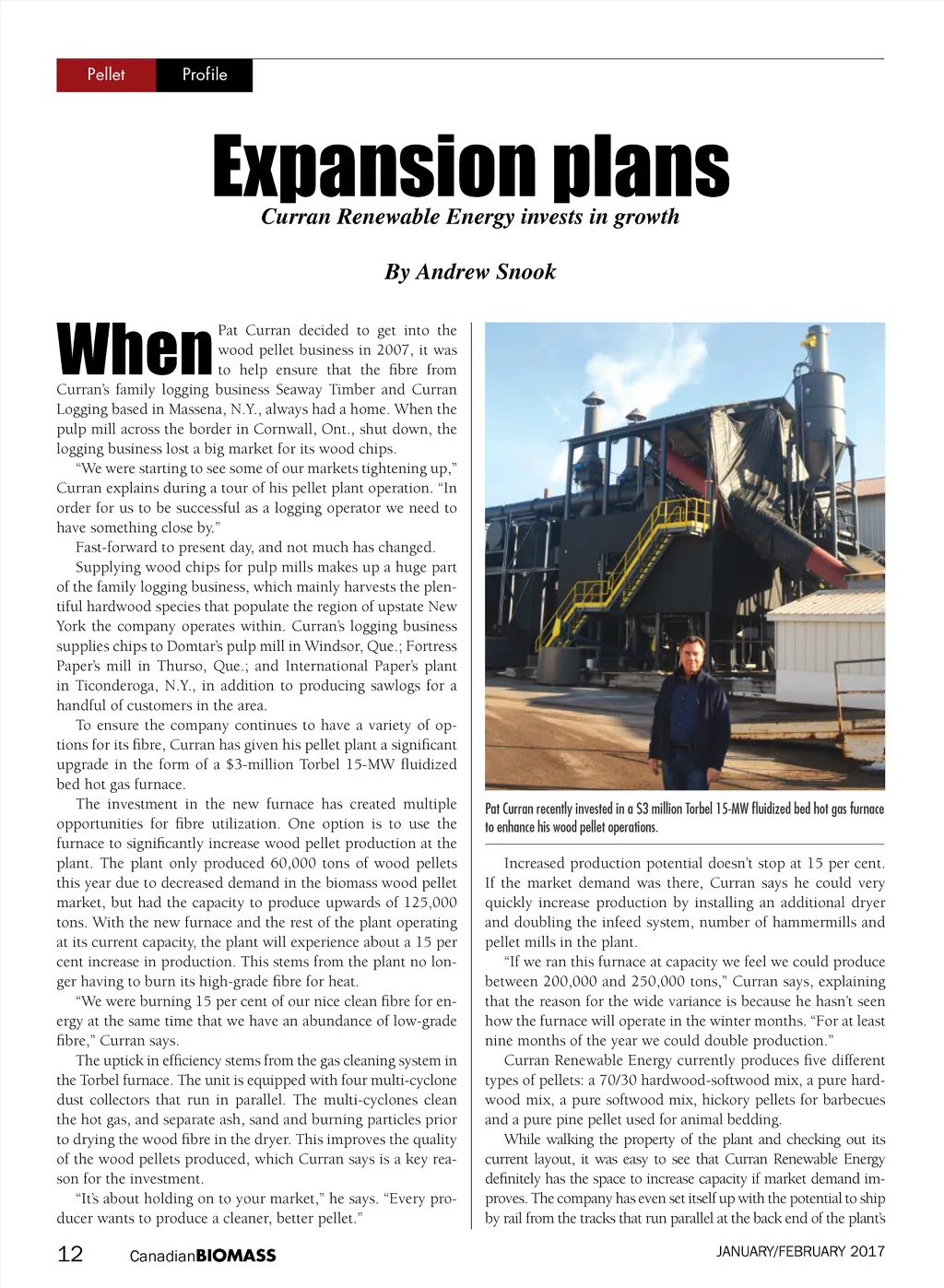
Pellet Profile Expansion plans Curran Renewable Energy invests in growth By Andrew Snook When Pat Curran decided to get into the wood pellet business in 2007, it was to help ensure that the fibre from Curran’s family logging business Seaway Timber and Curran Logging based in Massena, N.Y., always had a home. When the pulp mill across the border in Cornwall, Ont., shut down, the logging business lost a big market for its wood chips. “We were starting to see some of our markets tightening up,” Curran explains during a tour of his pellet plant operation. “In order for us to be successful as a logging operator we need to have something close by.” Fast-forward to present day, and not much has changed. Supplying wood chips for pulp mills makes up a huge part of the family logging business, which mainly harvests the plen-tiful hardwood species that populate the region of upstate New York the company operates within. Curran’s logging business supplies chips to Domtar’s pulp mill in Windsor, Que.; Fortress Paper’s mill in Thurso, Que.; and International Paper’s plant in Ticonderoga, N.Y., in addition to producing sawlogs for a handful of customers in the area. To ensure the company continues to have a variety of op-tions for its fibre, Curran has given his pellet plant a significant upgrade in the form of a $3-million Torbel 15-MW fluidized bed hot gas furnace. The investment in the new furnace has created multiple opportunities for fibre utilization. One option is to use the furnace to significantly increase wood pellet production at the plant. The plant only produced 60,000 tons of wood pellets this year due to decreased demand in the biomass wood pellet market, but had the capacity to produce upwards of 125,000 tons. With the new furnace and the rest of the plant operating at its current capacity, the plant will experience about a 15 per cent increase in production. This stems from the plant no lon-ger having to burn its high-grade fibre for heat. “We were burning 15 per cent of our nice clean fibre for en-ergy at the same time that we have an abundance of low-grade fibre,” Curran says. The uptick in efficiency stems from the gas cleaning system in the Torbel furnace. The unit is equipped with four multi-cyclone dust collectors that run in parallel. The multi-cyclones clean the hot gas, and separate ash, sand and burning particles prior to drying the wood fibre in the dryer. This improves the quality of the wood pellets produced, which Curran says is a key rea-son for the investment. “It’s about holding on to your market,” he says. “Every pro-ducer wants to produce a cleaner, better pellet.” Pat Curran recently invested in a $3 million Torbel 15-MW fluidized bed hot gas furnace to enhance his wood pellet operations. Increased production potential doesn’t stop at 15 per cent. If the market demand was there, Curran says he could very quickly increase production by installing an additional dryer and doubling the infeed system, number of hammermills and pellet mills in the plant. “If we ran this furnace at capacity we feel we could produce between 200,000 and 250,000 tons,” Curran says, explaining that the reason for the wide variance is because he hasn’t seen how the furnace will operate in the winter months. “For at least nine months of the year we could double production.” Curran Renewable Energy currently produces five different types of pellets: a 70/30 hardwood-softwood mix, a pure hard-wood mix, a pure softwood mix, hickory pellets for barbecues and a pure pine pellet used for animal bedding. While walking the property of the plant and checking out its current layout, it was easy to see that Curran Renewable Energy definitely has the space to increase capacity if market demand im-proves. The company has even set itself up with the potential to ship by rail from the tracks that run parallel at the back end of the plant’s JANUARY/FEBRUARY 2017 12 Canadian BIOMASS
Canadian Biomass January February 2017: Page 12