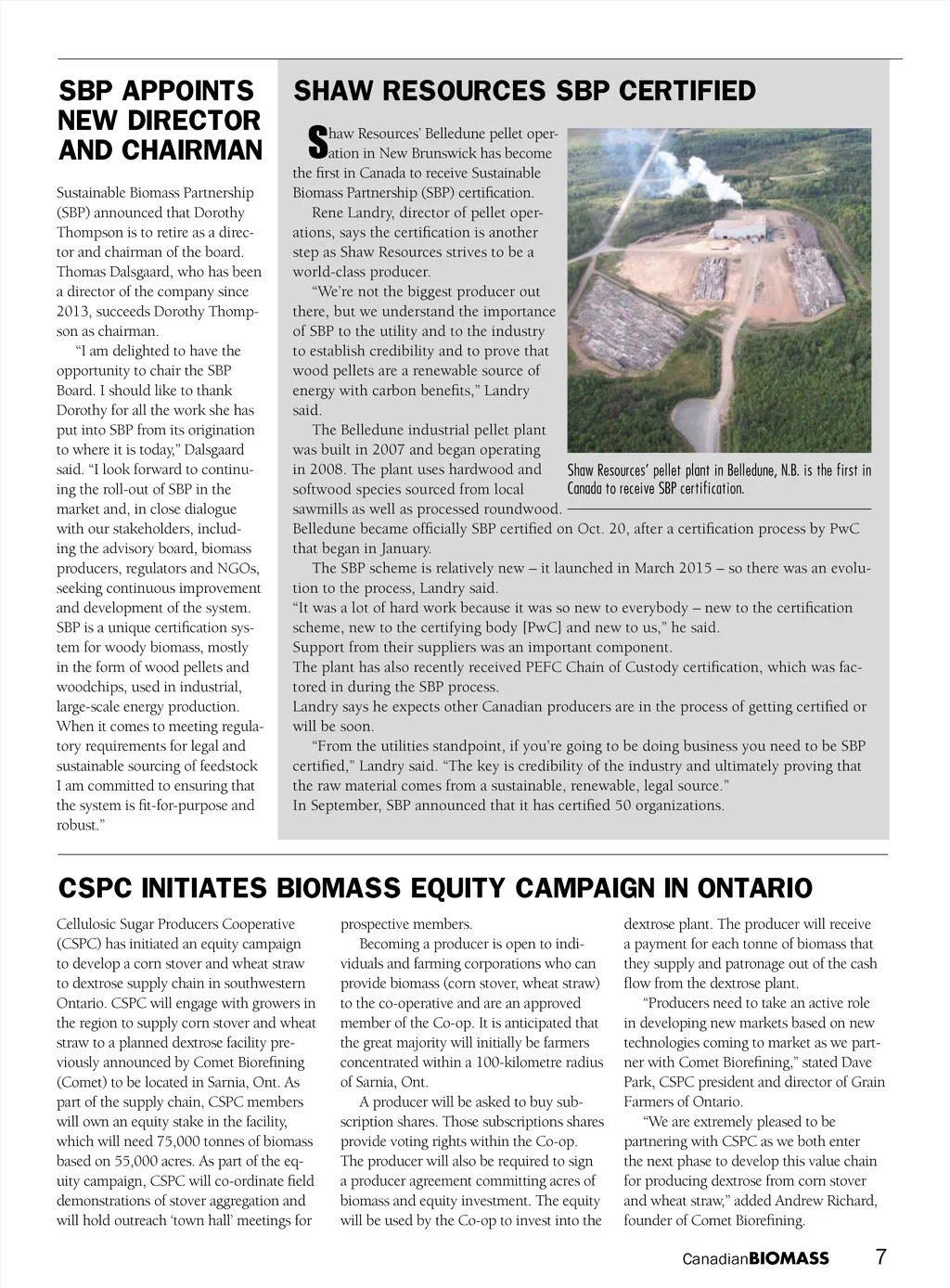
SBP APPOINTS NEW DIRECTOR AND CHAIRMAN Sustainable Biomass Partnership (SBP) announced that Dorothy Thompson is to retire as a direc-tor and chairman of the board. Thomas Dalsgaard, who has been a director of the company since 2013, succeeds Dorothy Thomp-son as chairman. “I am delighted to have the opportunity to chair the SBP Board. I should like to thank Dorothy for all the work she has put into SBP from its origination to where it is today,” Dalsgaard said. “I look forward to continu-ing the roll-out of SBP in the market and, in close dialogue with our stakeholders, includ-ing the advisory board, biomass producers, regulators and NGOs, seeking continuous improvement and development of the system. SBP is a unique certification sys-tem for woody biomass, mostly in the form of wood pellets and woodchips, used in industrial, large-scale energy production. When it comes to meeting regula-tory requirements for legal and sustainable sourcing of feedstock I am committed to ensuring that the system is fit-for-purpose and robust.” SHAW RESOURCES SBP CERTIFIED haw Resources’ Belledune pellet oper-ation in New Brunswick has become the first in Canada to receive Sustainable Biomass Partnership (SBP) certification. Rene Landry, director of pellet oper-ations, says the certification is another step as Shaw Resources strives to be a world-class producer. “We’re not the biggest producer out there, but we understand the importance of SBP to the utility and to the industry to establish credibility and to prove that wood pellets are a renewable source of energy with carbon benefits,” Landry said. The Belledune industrial pellet plant was built in 2007 and began operating in 2008. The plant uses hardwood and Shaw Resources’ pellet plant in Belledune, N.B. is the first in Canada to receive SBP certification. softwood species sourced from local sawmills as well as processed roundwood. Belledune became officially SBP certified on Oct. 20, after a certification process by PwC that began in January. The SBP scheme is relatively new – it launched in March 2015 – so there was an evolu-tion to the process, Landry said. “It was a lot of hard work because it was so new to everybody – new to the certification scheme, new to the certifying body [PwC] and new to us,” he said. Support from their suppliers was an important component. The plant has also recently received PEFC Chain of Custody certification, which was fac-tored in during the SBP process. Landry says he expects other Canadian producers are in the process of getting certified or will be soon. “From the utilities standpoint, if you’re going to be doing business you need to be SBP certified,” Landry said. “The key is credibility of the industry and ultimately proving that the raw material comes from a sustainable, renewable, legal source.” In September, SBP announced that it has certified 50 organizations. S CSPC INITIATES BIOMASS EQUITY CAMPAIGN IN ONTARIO Cellulosic Sugar Producers Cooperative (CSPC) has initiated an equity campaign to develop a corn stover and wheat straw to dextrose supply chain in southwestern Ontario. CSPC will engage with growers in the region to supply corn stover and wheat straw to a planned dextrose facility pre-viously announced by Comet Biorefining (Comet) to be located in Sarnia, Ont. As part of the supply chain, CSPC members will own an equity stake in the facility, which will need 75,000 tonnes of biomass based on 55,000 acres. As part of the eq-uity campaign, CSPC will co-ordinate field demonstrations of stover aggregation and will hold outreach ‘town hall’ meetings for prospective members. Becoming a producer is open to indi-viduals and farming corporations who can provide biomass (corn stover, wheat straw) to the co-operative and are an approved member of the Co-op. It is anticipated that the great majority will initially be farmers concentrated within a 100-kilometre radius of Sarnia, Ont. A producer will be asked to buy sub-scription shares. Those subscriptions shares provide voting rights within the Co-op. The producer will also be required to sign a producer agreement committing acres of biomass and equity investment. The equity will be used by the Co-op to invest into the dextrose plant. The producer will receive a payment for each tonne of biomass that they supply and patronage out of the cash flow from the dextrose plant. “Producers need to take an active role in developing new markets based on new technologies coming to market as we part-ner with Comet Biorefining,” stated Dave Park, CSPC president and director of Grain Farmers of Ontario. “We are extremely pleased to be partnering with CSPC as we both enter the next phase to develop this value chain for producing dextrose from corn stover and wheat straw,” added Andrew Richard, founder of Comet Biorefining. Canadian BIOMASS 7
Canadian Biomass November December 2016: Page 7