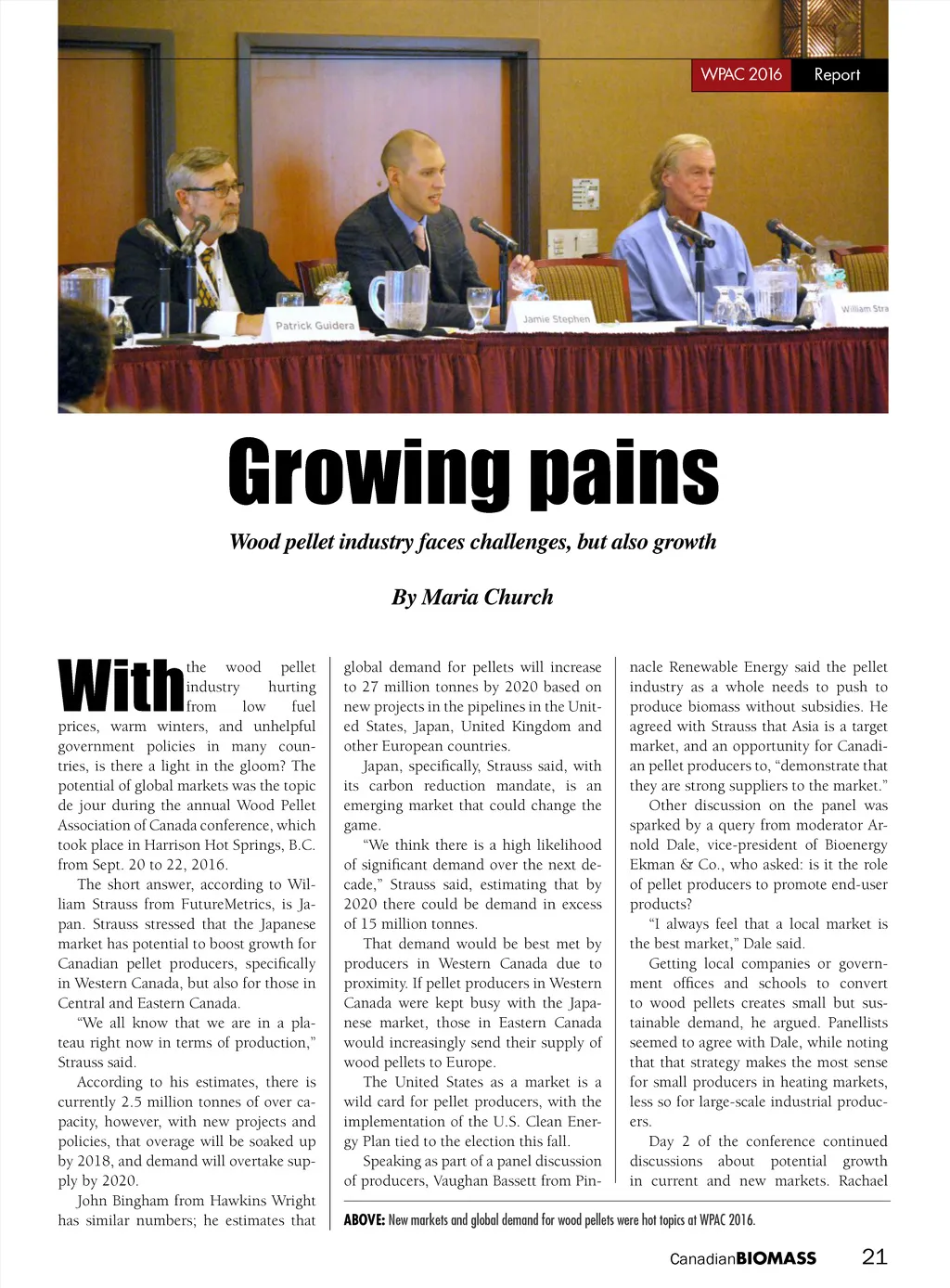
WPAC 2016 Report Growing pains Wood pellet industry faces challenges, but also growth By Maria Church the wood pellet industry hurting from low fuel prices, warm winters, and unhelpful government policies in many coun-tries, is there a light in the gloom? The potential of global markets was the topic de jour during the annual Wood Pellet Association of Canada conference, which took place in Harrison Hot Springs, B.C. from Sept. 20 to 22, 2016. The short answer, according to Wil-liam Strauss from FutureMetrics, is Ja-pan. Strauss stressed that the Japanese market has potential to boost growth for Canadian pellet producers, specifically in Western Canada, but also for those in Central and Eastern Canada. “We all know that we are in a pla-teau right now in terms of production,” Strauss said. According to his estimates, there is currently 2.5 million tonnes of over ca-pacity, however, with new projects and policies, that overage will be soaked up by 2018, and demand will overtake sup-ply by 2020. John Bingham from Hawkins Wright has similar numbers; he estimates that With global demand for pellets will increase to 27 million tonnes by 2020 based on new projects in the pipelines in the Unit-ed States, Japan, United Kingdom and other European countries. Japan, specifically, Strauss said, with its carbon reduction mandate, is an emerging market that could change the game. “We think there is a high likelihood of significant demand over the next de-cade,” Strauss said, estimating that by 2020 there could be demand in excess of 15 million tonnes. That demand would be best met by producers in Western Canada due to proximity. If pellet producers in Western Canada were kept busy with the Japa-nese market, those in Eastern Canada would increasingly send their supply of wood pellets to Europe. The United States as a market is a wild card for pellet producers, with the implementation of the U.S. Clean Ener-gy Plan tied to the election this fall. Speaking as part of a panel discussion of producers, Vaughan Bassett from Pin-nacle Renewable Energy said the pellet industry as a whole needs to push to produce biomass without subsidies. He agreed with Strauss that Asia is a target market, and an opportunity for Canadi-an pellet producers to, “demonstrate that they are strong suppliers to the market.” Other discussion on the panel was sparked by a query from moderator Ar-nold Dale, vice-president of Bioenergy Ekman & Co., who asked: is it the role of pellet producers to promote end-user products? “I always feel that a local market is the best market,” Dale said. Getting local companies or govern-ment offices and schools to convert to wood pellets creates small but sus-tainable demand, he argued. Panellists seemed to agree with Dale, while noting that that strategy makes the most sense for small producers in heating markets, less so for large-scale industrial produc-ers. Day 2 of the conference continued discussions about potential growth in current and new markets. Rachael ABOVE: New markets and global demand for wood pellets were hot topics at WPAC 2016. Canadian BIOMASS 21
Canadian Biomass November December 2016: Page 21