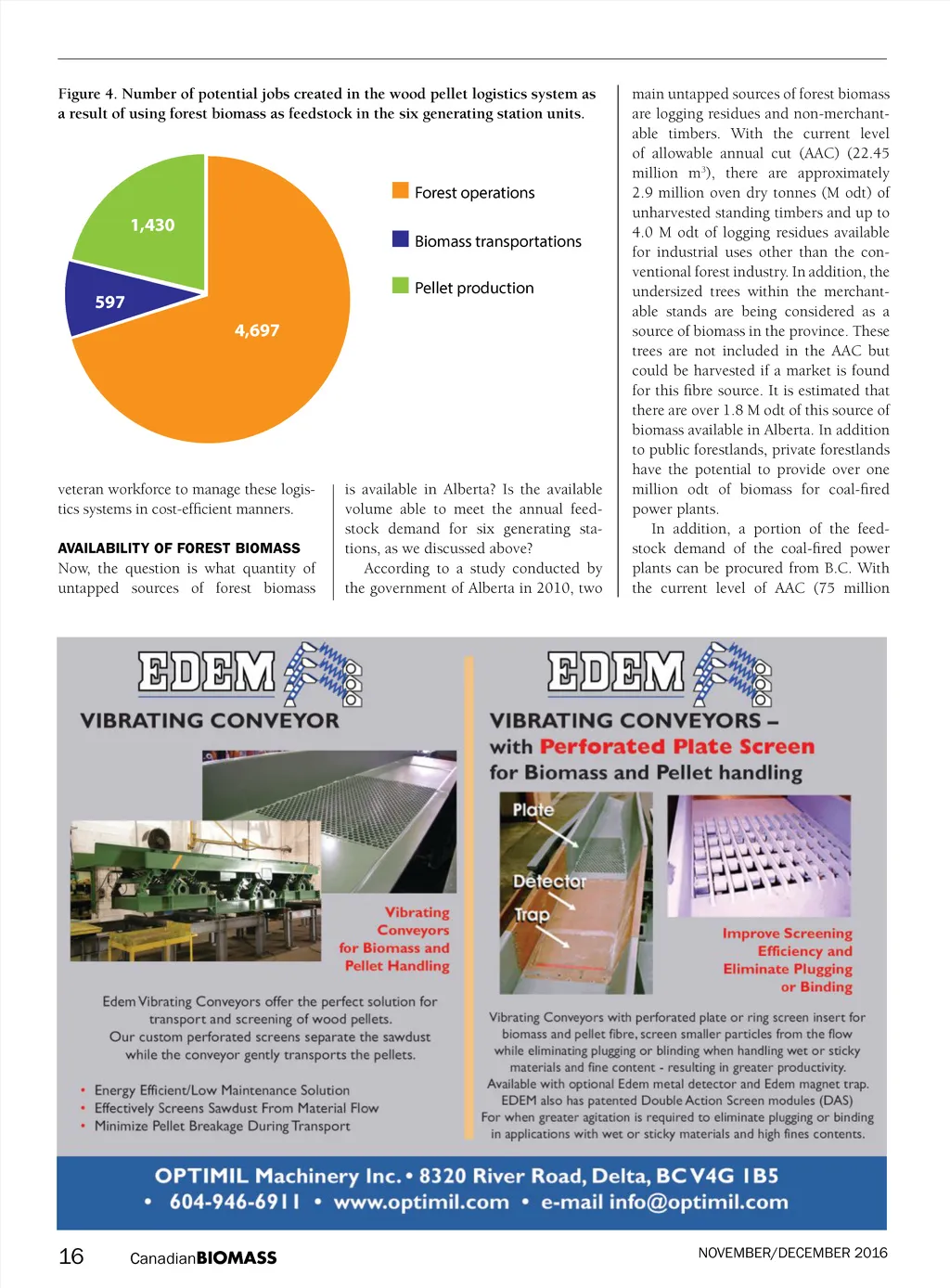
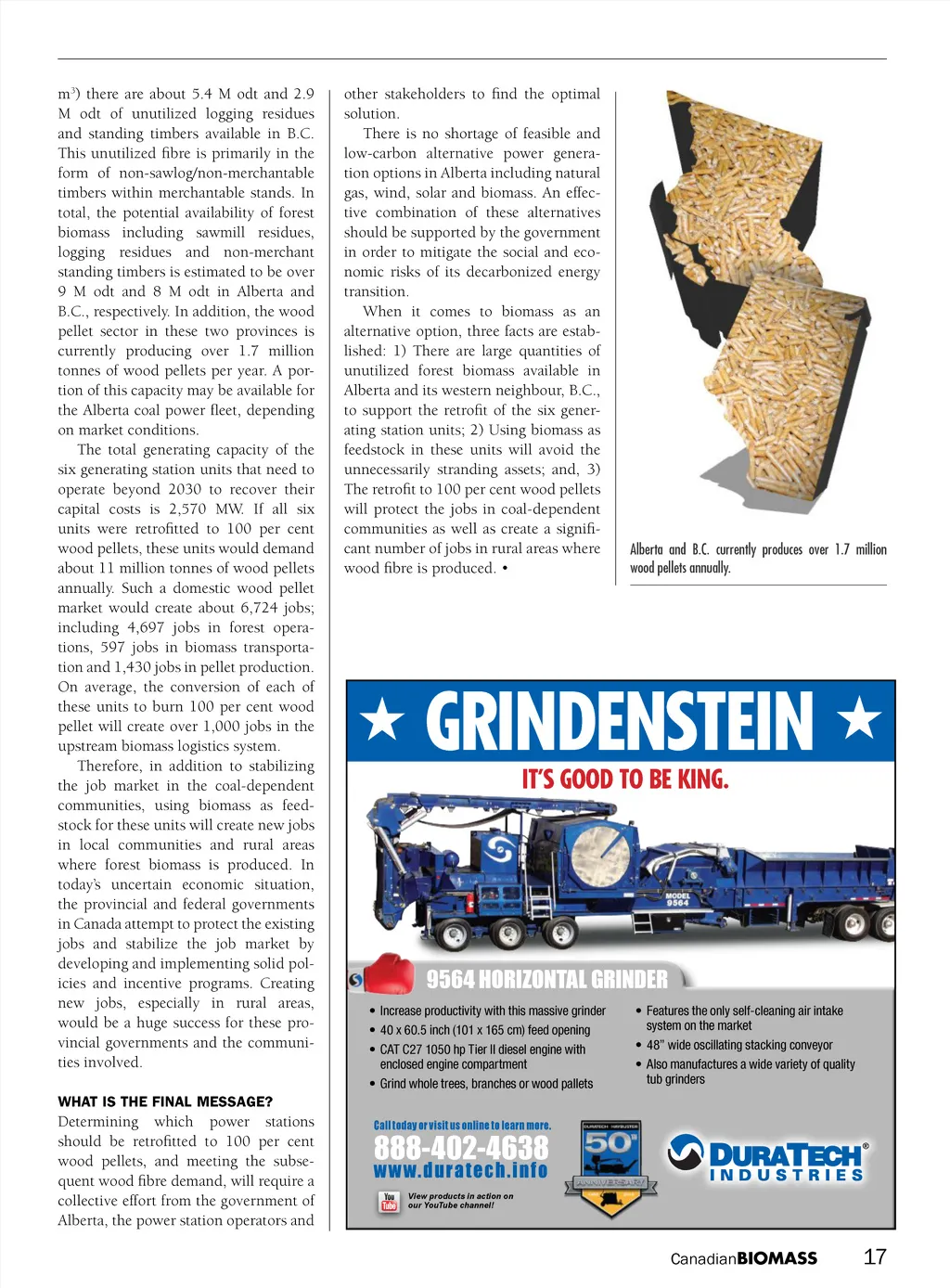
m 3 ) there are about 5.4 M odt and 2.9 M odt of unutilized logging residues and standing timbers available in B.C. This unutilized fibre is primarily in the form of non-sawlog/non-merchantable timbers within merchantable stands. In total, the potential availability of forest biomass including sawmill residues, logging residues and non-merchant standing timbers is estimated to be over 9 M odt and 8 M odt in Alberta and B.C., respectively. In addition, the wood pellet sector in these two provinces is currently producing over 1.7 million tonnes of wood pellets per year. A por-tion of this capacity may be available for the Alberta coal power fleet, depending on market conditions. The total generating capacity of the six generating station units that need to operate beyond 2030 to recover their capital costs is 2,570 MW. If all six units were retrofitted to 100 per cent wood pellets, these units would demand about 11 million tonnes of wood pellets annually. Such a domestic wood pellet market would create about 6,724 jobs; including 4,697 jobs in forest opera-tions, 597 jobs in biomass transporta-tion and 1,430 jobs in pellet production. On average, the conversion of each of these units to burn 100 per cent wood pellet will create over 1,000 jobs in the upstream biomass logistics system. Therefore, in addition to stabilizing the job market in the coal-dependent communities, using biomass as feed-stock for these units will create new jobs in local communities and rural areas where forest biomass is produced. In today’s uncertain economic situation, the provincial and federal governments in Canada attempt to protect the existing jobs and stabilize the job market by developing and implementing solid pol-icies and incentive programs. Creating new jobs, especially in rural areas, would be a huge success for these pro-vincial governments and the communi-ties involved. WHAT IS THE FINAL MESSAGE? other stakeholders to find the optimal solution. There is no shortage of feasible and low-carbon alternative power genera-tion options in Alberta including natural gas, wind, solar and biomass. An effec-tive combination of these alternatives should be supported by the government in order to mitigate the social and eco-nomic risks of its decarbonized energy transition. When it comes to biomass as an alternative option, three facts are estab-lished: 1) There are large quantities of unutilized forest biomass available in Alberta and its western neighbour, B.C., to support the retrofit of the six gener-ating station units; 2) Using biomass as feedstock in these units will avoid the unnecessarily stranding assets; and, 3) The retrofit to 100 per cent wood pellets will protect the jobs in coal-dependent communities as well as create a signifi-cant number of jobs in rural areas where wood fibre is produced. • Alberta and B.C. currently produces over 1.7 million wood pellets annually. GRINDENSTEIN IT’S GOOD TO BE KING. 9564 HORIZONTAL GRINDER • Increase productivity with this massive grinder • 40 x 60.5 inch (101 x 165 cm) feed opening • CAT C27 1050 hp Tier II diesel engine with enclosed engine compartment • Grind whole trees, branches or wood pallets Call today or visit us online to learn more. • Features the only self-cleaning air intake system on the market • 48” wide oscillating stacking conveyor • Also manufactures a wide variety of quality tub grinders Determining which power stations should be retrofitted to 100 per cent wood pellets, and meeting the subse-quent wood fibre demand, will require a collective effort from the government of Alberta, the power station operators and 888-402-4638 w w w.duratech.info View products in action on our YouTube channel! Canadian BIOMASS 17
Canadian Biomass November December 2016: Page 17