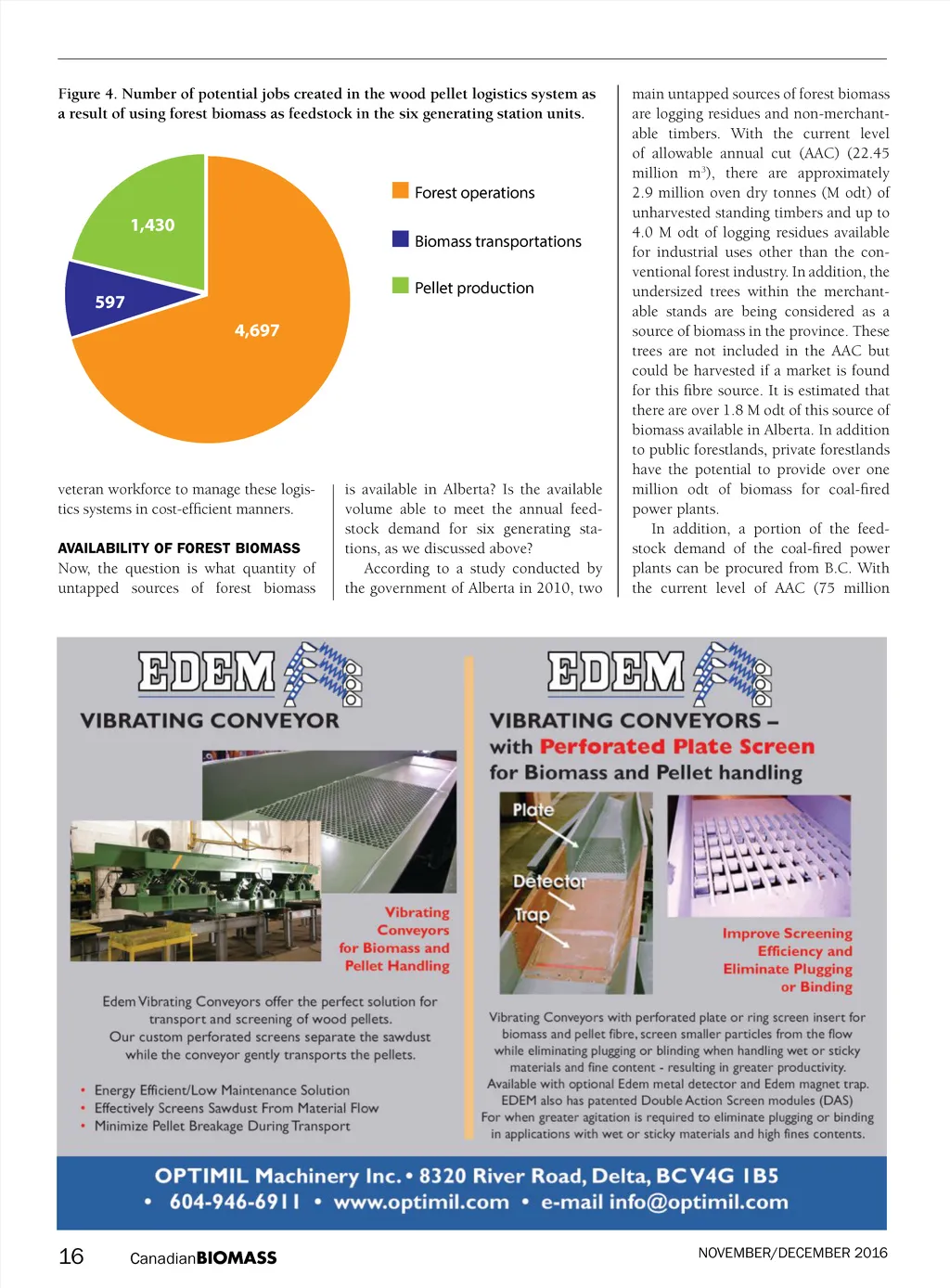
Remaining coal-based power generation capacity (MW) by 2030 Retiring coal-based power generation capacity (MW) by 2030 Figure 4. Number of potential jobs created in the wood pellet logistics system as a result of using forest biomass as feedstock in the six generating station units. main untapped sources of forest biomass are logging residues and non-merchant-able timbers. With the current level of allowable annual cut (AAC) (22.45 million m 3 ), there are approximately 2.9 million oven dry tonnes (M odt) of unharvested standing timbers and up to 4.0 M odt of logging residues available for industrial uses other than the con-ventional forest industry. In addition, the undersized trees within the merchant-able stands are being considered as a source of biomass in the province. These trees are not included in the AAC but could be harvested if a market is found for this fibre source. It is estimated that there are over 1.8 M odt of this source of biomass available in Alberta. In addition to public forestlands, private forestlands have the potential to provide over one million odt of biomass for coal-fired power plants. In addition, a portion of the feed-stock demand of the coal-fired power plants can be procured from B.C. With the current level of AAC (75 million Forest operations 1,430 Biomass transportations Pellet production 597 4,697 veteran workforce to manage these logis-tics systems in cost-efficient manners. AVAILABILITY OF FOREST BIOMASS Now, the question is what quantity of untapped sources of forest biomass is available in Alberta? Is the available volume able to meet the annual feed-stock demand for six generating sta-tions, as we discussed above? According to a study conducted by the government of Alberta in 2010, two 16 Canadian BIOMASS NOVEMBER/DECEMBER 2016
Canadian Biomass November December 2016: Page 16