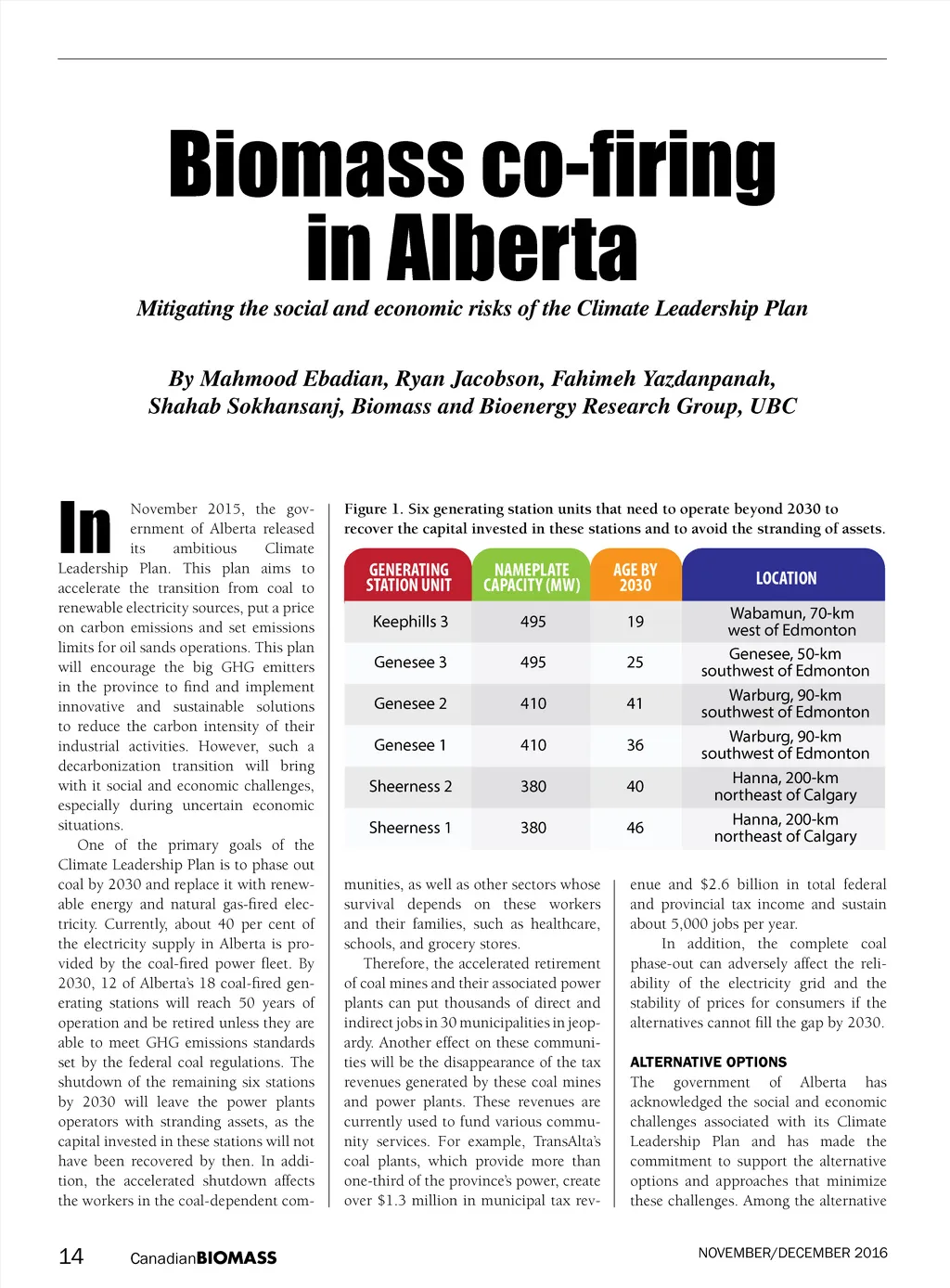
Mitigating the social and economic risks of the Climate Leadership Plan By Mahmood Ebadian, Ryan Jacobson, Fahimeh Yazdanpanah, Shahab Sokhansanj, Biomass and Bioenergy Research Group, UBC Biomass co-firing in Alberta In November 2015, the gov-ernment of Alberta released its ambitious Climate Leadership Plan. This plan aims to accelerate the transition from coal to renewable electricity sources, put a price on carbon emissions and set emissions limits for oil sands operations. This plan will encourage the big GHG emitters in the province to find and implement innovative and sustainable solutions to reduce the carbon intensity of their industrial activities. However, such a decarbonization transition will bring with it social and economic challenges, especially during uncertain economic situations. One of the primary goals of the Climate Leadership Plan is to phase out coal by 2030 and replace it with renew-able energy and natural gas-fired elec-tricity. Currently, about 40 per cent of the electricity supply in Alberta is pro-vided by the coal-fired power fleet. By 2030, 12 of Alberta’s 18 coal-fired gen-erating stations will reach 50 years of operation and be retired unless they are able to meet GHG emissions standards set by the federal coal regulations. The shutdown of the remaining six stations by 2030 will leave the power plants operators with stranding assets, as the capital invested in these stations will not have been recovered by then. In addi-tion, the accelerated shutdown affects the workers in the coal-dependent com-Figure 1. Six generating station units that need to operate beyond 2030 to recover the capital invested in these stations and to avoid the stranding of assets. GENERATING STATION UNIT Keephills 3 Genesee 3 Genesee 2 Genesee 1 Sheerness 2 Sheerness 1 NAMEPLATE CAPACITY (MW) 495 495 410 410 380 380 AGE BY 2030 19 25 41 36 40 46 LOCATION Wabamun, 70-km west of Edmonton Genesee, 50-km southwest of Edmonton Warburg, 90-km southwest of Edmonton Warburg, 90-km southwest of Edmonton Hanna, 200-km northeast of Calgary Hanna, 200-km northeast of Calgary munities, as well as other sectors whose survival depends on these workers and their families, such as healthcare, schools, and grocery stores. Therefore, the accelerated retirement of coal mines and their associated power plants can put thousands of direct and indirect jobs in 30 municipalities in jeop-ardy. Another effect on these communi-ties will be the disappearance of the tax revenues generated by these coal mines and power plants. These revenues are currently used to fund various commu-nity services. For example, TransAlta’s coal plants, which provide more than one-third of the province’s power, create over $1.3 million in municipal tax rev-enue and $2.6 billion in total federal and provincial tax income and sustain about 5,000 jobs per year. In addition, the complete coal phase-out can adversely affect the reli-ability of the electricity grid and the stability of prices for consumers if the alternatives cannot fill the gap by 2030. ALTERNATIVE OPTIONS The government of Alberta has acknowledged the social and economic challenges associated with its Climate Leadership Plan and has made the commitment to support the alternative options and approaches that minimize these challenges. Among the alternative NOVEMBER/DECEMBER 2016 14 Canadian BIOMASS
Canadian Biomass November December 2016: Page 14