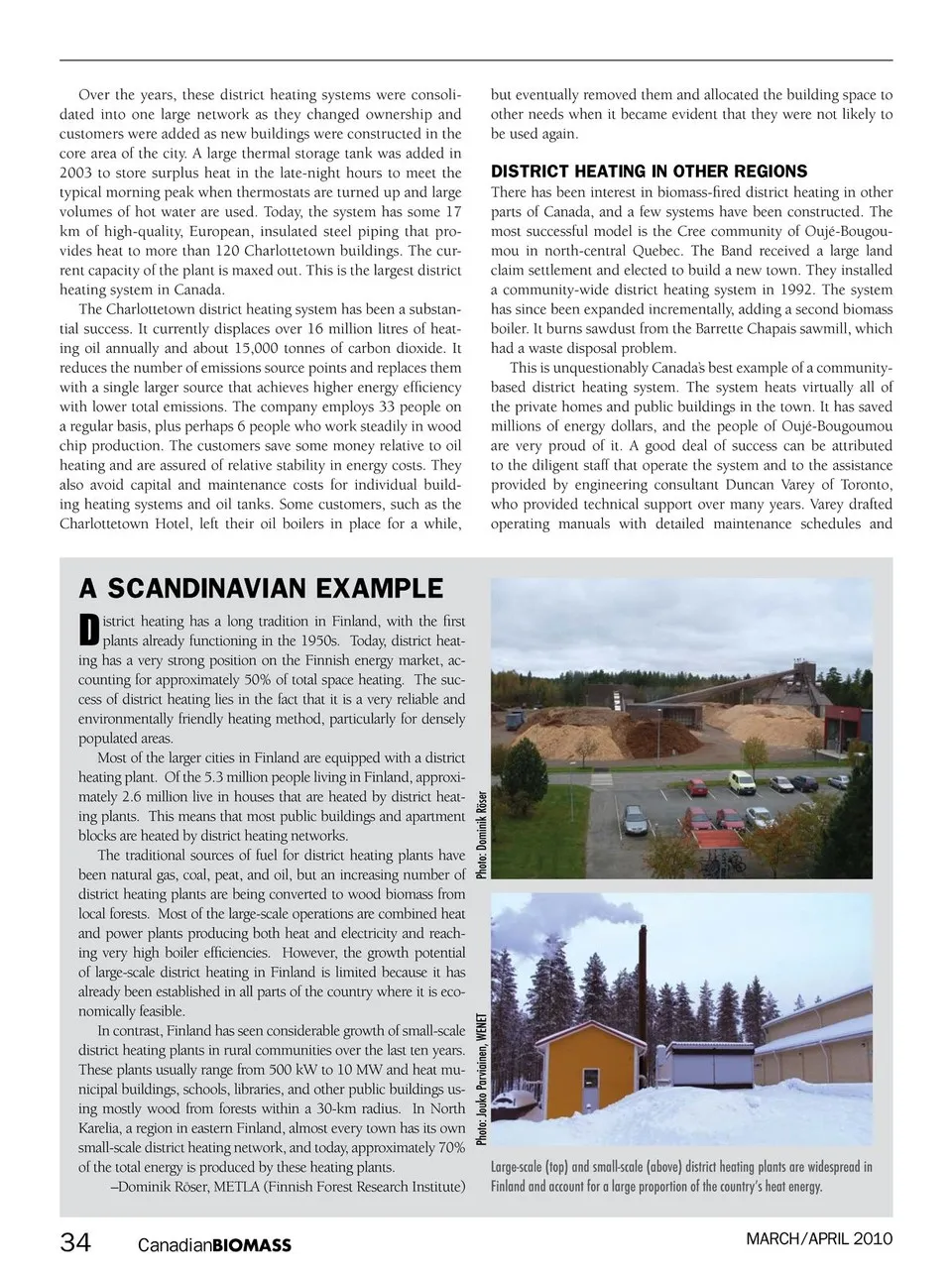
recommended that the plant stock a good assortment of spare parts so that it is never down for very long when pumps or gear- motors fail. This system serves as a model for remote communities. Not all remote communities have access to sawdust, but could produce wood chips, generating additional jobs. Two communities in British Columbia built biomass-fired dis- trict heating systems in the 2000s. After eight years of planning, the town of Revelstoke constructed a small district heating sys- tem that was commissioned in 2005. The 1.5-MW KMW biomass boiler burns sawmill residues from local Downie Street Sawmills and provides steam for the sawmill’s operations, as well as hot wa- ter for a school, a community centre, an aquatic centre, hotels, and other buildings. The system has a 1.75-MW backup propane boiler and has reduced the community’s reliance on propane and other fossil fuels. More recent is the Dockside Green harbourfront community under development in Victoria, British Columbia. This innovative community will involve district heating using a 2-MW Nexterra gasifier, fed with locally sourced wood waste. It will provide the 15-acre (6-ha) community with hot water and heat. The system will have backup and peaking supply from natural gas boilers. A similar community with wood biomass district heating is being planned for Quebec, called La Cité Verte. District heating has also been considered an option for the far north, where costs to bring in fossil fuels can be exorbitant. In 2008, the city of Yellowknife installed a pellet-fed district heating system for its arena, curling rink, and community pool. These fa- cilities previously used almost 300,000 litres/year of fuel oil. Hay CanadianBIOMASS 35
Canadian Biomass March/April 2010: Page 35