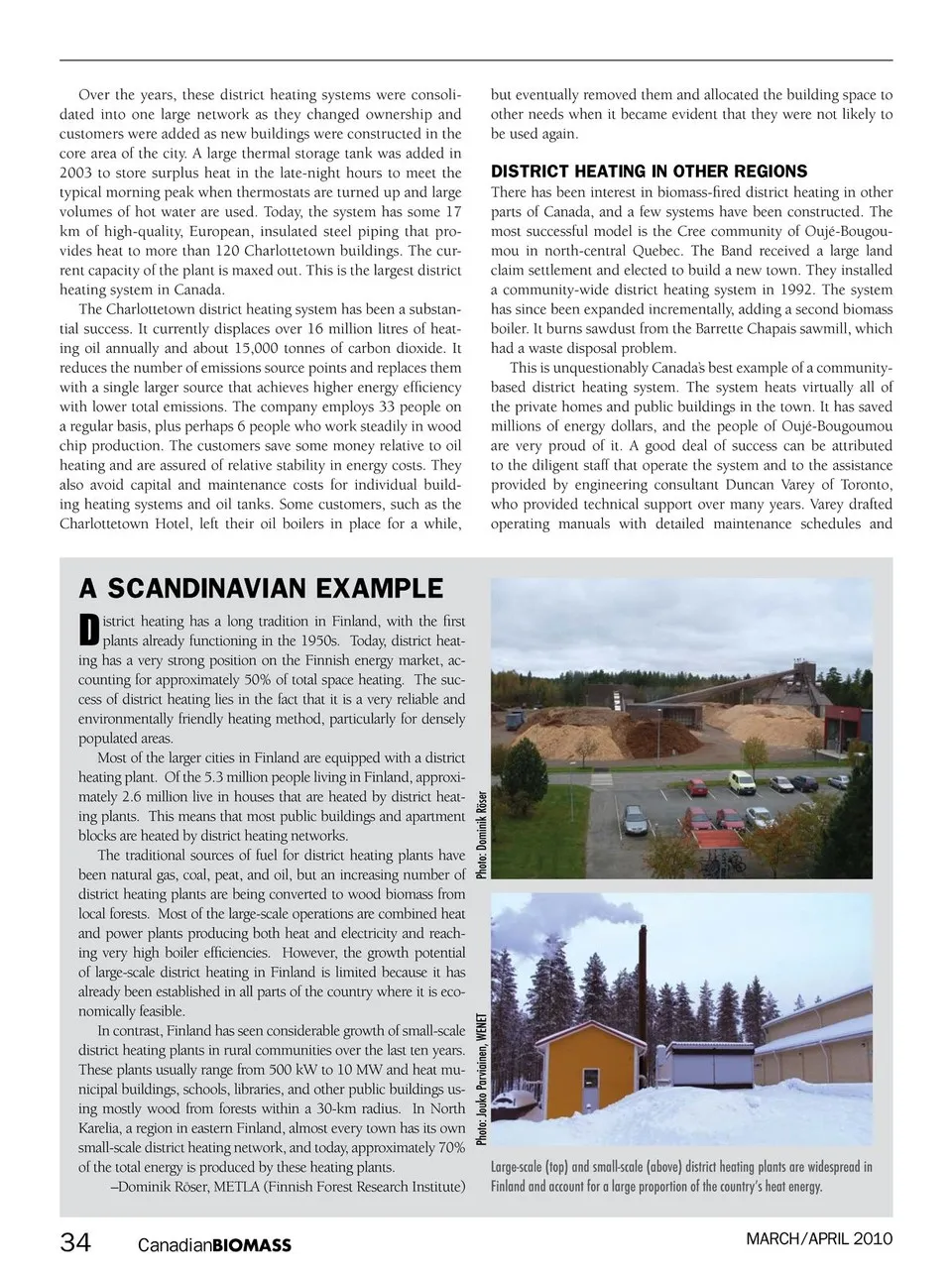
Over the years, these district heating systems were consoli- dated into one large network as they changed ownership and customers were added as new buildings were constructed in the core area of the city. A large thermal storage tank was added in 2003 to store surplus heat in the late-night hours to meet the typical morning peak when thermostats are turned up and large volumes of hot water are used. Today, the system has some 17 km of high-quality, European, insulated steel piping that pro- vides heat to more than 120 Charlottetown buildings. The cur- rent capacity of the plant is maxed out. This is the largest district heating system in Canada. The Charlottetown district heating system has been a substan- tial success. It currently displaces over 16 million litres of heat- ing oil annually and about 15,000 tonnes of carbon dioxide. It reduces the number of emissions source points and replaces them with a single larger source that achieves higher energy efficiency with lower total emissions. The company employs 33 people on a regular basis, plus perhaps 6 people who work steadily in wood chip production. The customers save some money relative to oil heating and are assured of relative stability in energy costs. They also avoid capital and maintenance costs for individual build- ing heating systems and oil tanks. Some customers, such as the Charlottetown Hotel, left their oil boilers in place for a while, A SCANDINAVIAN EXAMPLE istrict heating has a long tradition in Finland, with the first plants already functioning in the 1950s. Today, district heat- ing has a very strong position on the Finnish energy market, ac- counting for approximately 50% of total space heating. The suc- cess of district heating lies in the fact that it is a very reliable and environmentally friendly heating method, particularly for densely populated areas. Most of the larger cities in Finland are equipped with a district heating plant. Of the 5.3 million people living in Finland, approxi- mately 2.6 million live in houses that are heated by district heat- ing plants. This means that most public buildings and apartment blocks are heated by district heating networks. The traditional sources of fuel for district heating plants have been natural gas, coal, peat, and oil, but an increasing number of district heating plants are being converted to wood biomass from local forests. Most of the large-scale operations are combined heat and power plants producing both heat and electricity and reach- ing very high boiler efficiencies. However, the growth potential of large-scale district heating in Finland is limited because it has already been established in all parts of the country where it is eco- nomically feasible. In contrast, Finland has seen considerable growth of small-scale district heating plants in rural communities over the last ten years. These plants usually range from 500 kW to 10 MW and heat mu- nicipal buildings, schools, libraries, and other public buildings us- ing mostly wood from forests within a 30-km radius. In North Karelia, a region in eastern Finland, almost every town has its own small-scale district heating network, and today, approximately 70% of the total energy is produced by these heating plants. –Dominik Röser, METLA (Finnish Forest Research Institute) 34 CanadianBIOMASS but eventually removed them and allocated the building space to other needs when it became evident that they were not likely to be used again. DISTRICT HEATING IN OTHER REGIONS There has been interest in biomass-fired district heating in other parts of Canada, and a few systems have been constructed. The most successful model is the Cree community of Oujé-Bougou- mou in north-central Quebec. The Band received a large land claim settlement and elected to build a new town. They installed a community-wide district heating system in 1992. The system has since been expanded incrementally, adding a second biomass boiler. It burns sawdust from the Barrette Chapais sawmill, which had a waste disposal problem. This is unquestionably Canada’s best example of a community- based district heating system. The system heats virtually all of the private homes and public buildings in the town. It has saved millions of energy dollars, and the people of Oujé-Bougoumou are very proud of it. A good deal of success can be attributed to the diligent staff that operate the system and to the assistance provided by engineering consultant Duncan Varey of Toronto, who provided technical support over many years. Varey drafted operating manuals with detailed maintenance schedules and MARCH/APRIL 2010
Canadian Biomass March/April 2010: Page 34