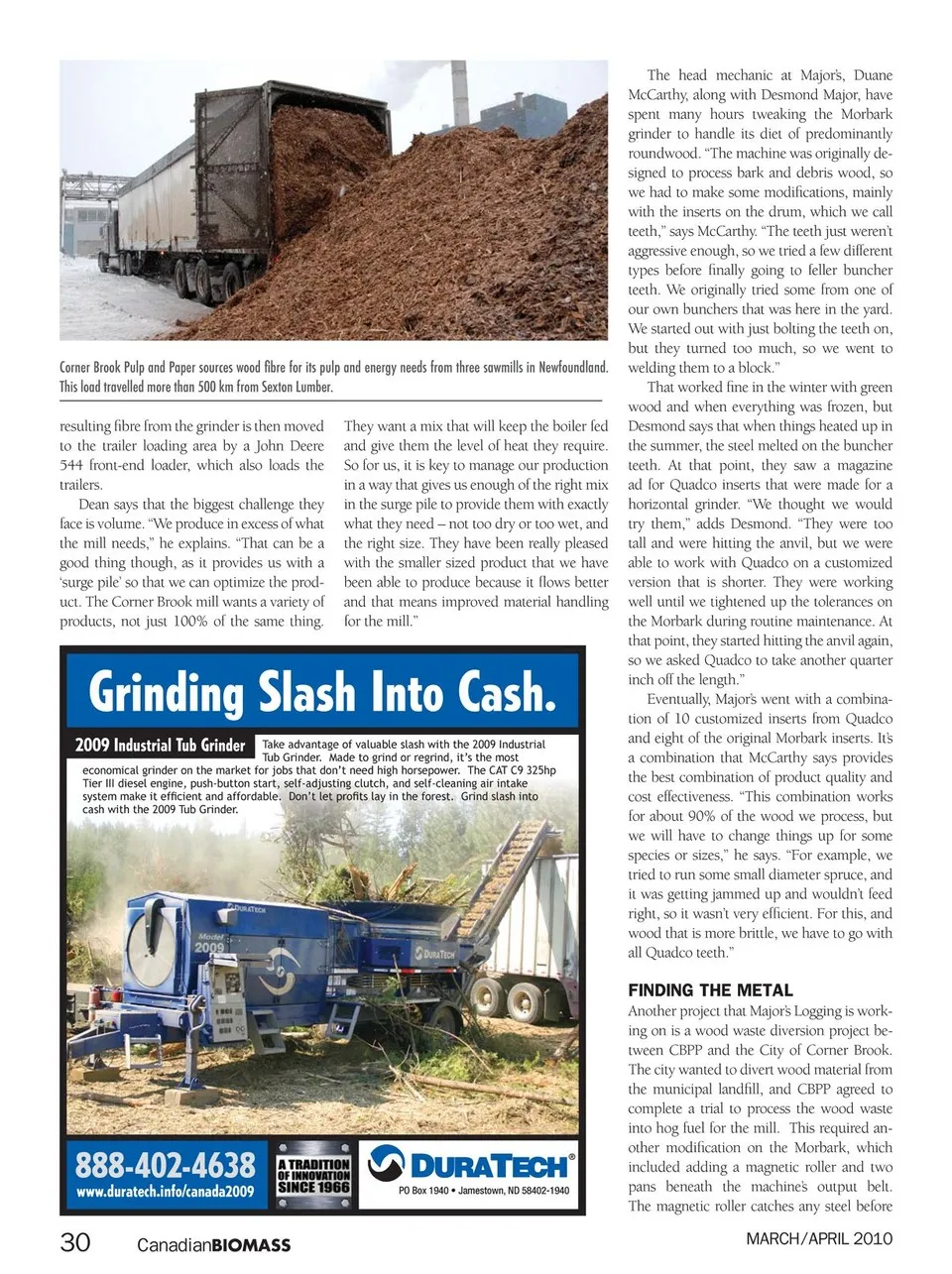
it reaches the fibre pile. The steel is then dropped to the trays. “It has worked well for us,” says Dean, adding that the system has re- moved all kinds of foreign matter, including nails, bolts, doorknobs, and other small met- al construction debris. The biggest piece of steel they have had go through the machine was a hammer head. “That did the most dam- age,” says Dean. “But the machine is designed for easy parts replacement, so we were able to get it up and running again fairly quickly.” As for the waste diversion project num- bers, they already know the Morbark is not as productive when processing urban waste as compared to roundwood. The main issue has been the lack of effective sorting of the waste wood and elimination of large metal contamination. “We have a Multi-dat box on the machine, which is tied into computers at the pulp mill,” says Dean. “It measures the machine’s uptime. We know when working in our yard on roundwood our utilization rate is at about 84%. When working at the landfill, we are generally at a utilization rate that sits just below 50% due to the problems with sorting and the larger pieces of metal.” CORE BUSINESS In addition to the grinding work Major’s completes for CBPP, it handles logging for the pulp and paper producer, which Dean says is typically within a 100 km radius of the mill. The wood is all on CBPP Limits, and the log- ging plans are provided to Major’s Logging by CBPP. Major’s sorts for pulp logs, saw logs, and biomass logs, but Dean says that 85% of what they harvest for CBPP is pulpwood that they deliver to the mill’s wood room as roundwood. Major’s has a complete fleet of logging gear for cut-to-length operations, including a John Deere 2054 with a LogMax 6000 head, a Timberjack 608 with a Waratah head, and a pair of Tigercat 845 models – one with a Log- Max 5000 head and the other with a Waratah 616 head. It also runs a Tigercat 822 feller buncher, a Tigercat 1065 18 tonne forwarder, and a Valmet 890 forwarder. Dean says that logging is still the main thrust of the business, but he has no com- plaints when it comes to processing bio- mass. “It has been really good for us dur- ing this downturn in the economy,” he says, adding that the biomass processing part of the business is probably here to stay as com- panies start to rely more on biomass to meet their power needs. CBPP’s Coombs couldn’t agree more. He says that with biomass, the pulp and paper mill is now only sourcing 10 to 15% of its thermal energy from fos- sil fuels. “We have drastically reduced the use of fossil fuel in our production process. For our entire mill operation, we have gone from using 42 million litres of oil annually in 2004 to under 7 million litres today,” he notes. “That has provided us with a dra- matic reduction in the litres of oil used per finished tonne of paper.” • ”TAKING YOU FROM KNOW-HOW TO SHOW-HOW” WORLD BIOENERGY 2010 25-27 MAY 2010 JÖNKÖPING, SWEDEN WWW.WORLDBIOENERGY.COM Your contact in Canada: Scott Jamieson, E-mail: sjamieson@ annexweb.com, Phone: 519-429-5180 CanadianBIOMASS 31
Canadian Biomass March/April 2010: Page 31