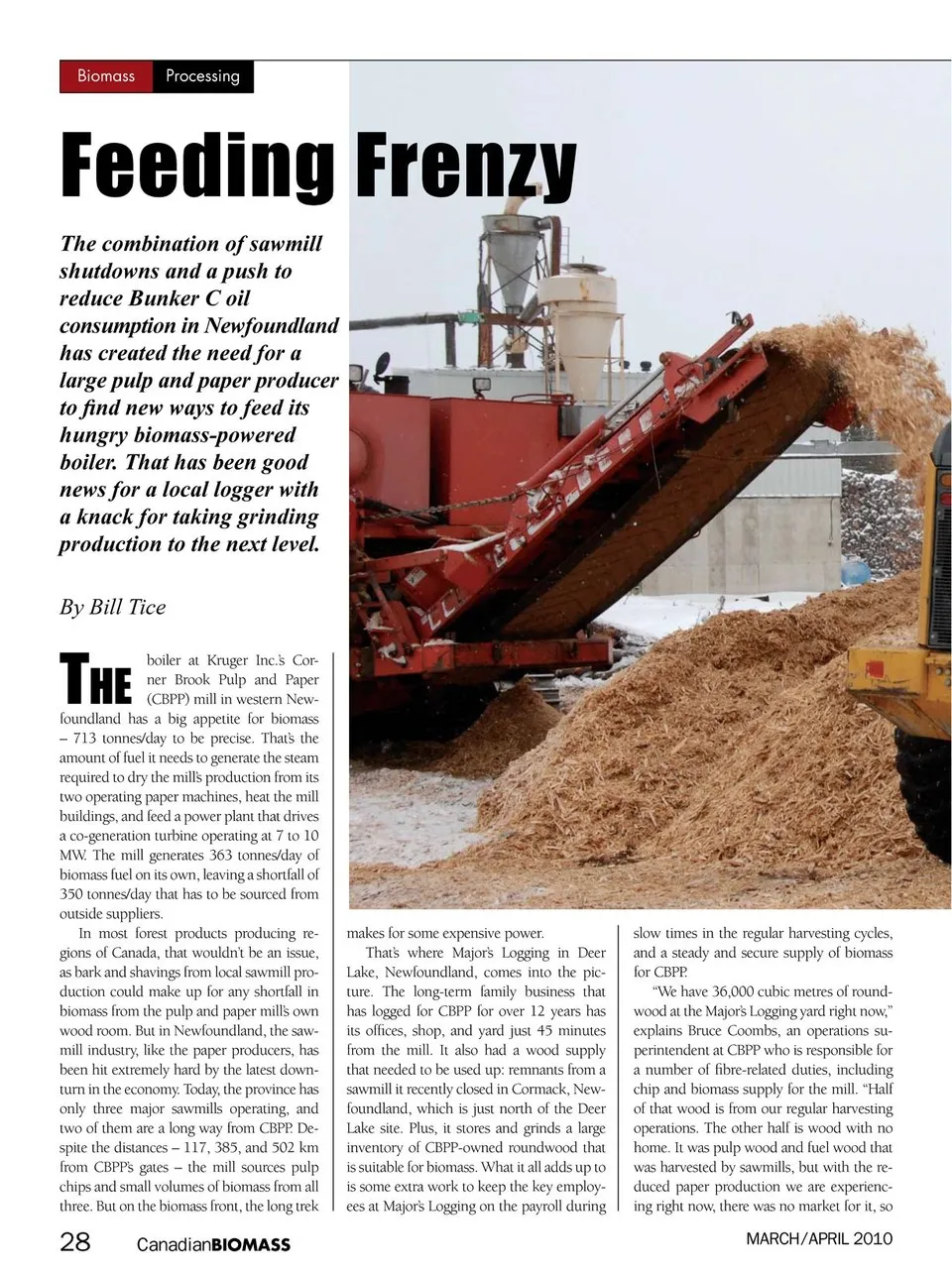
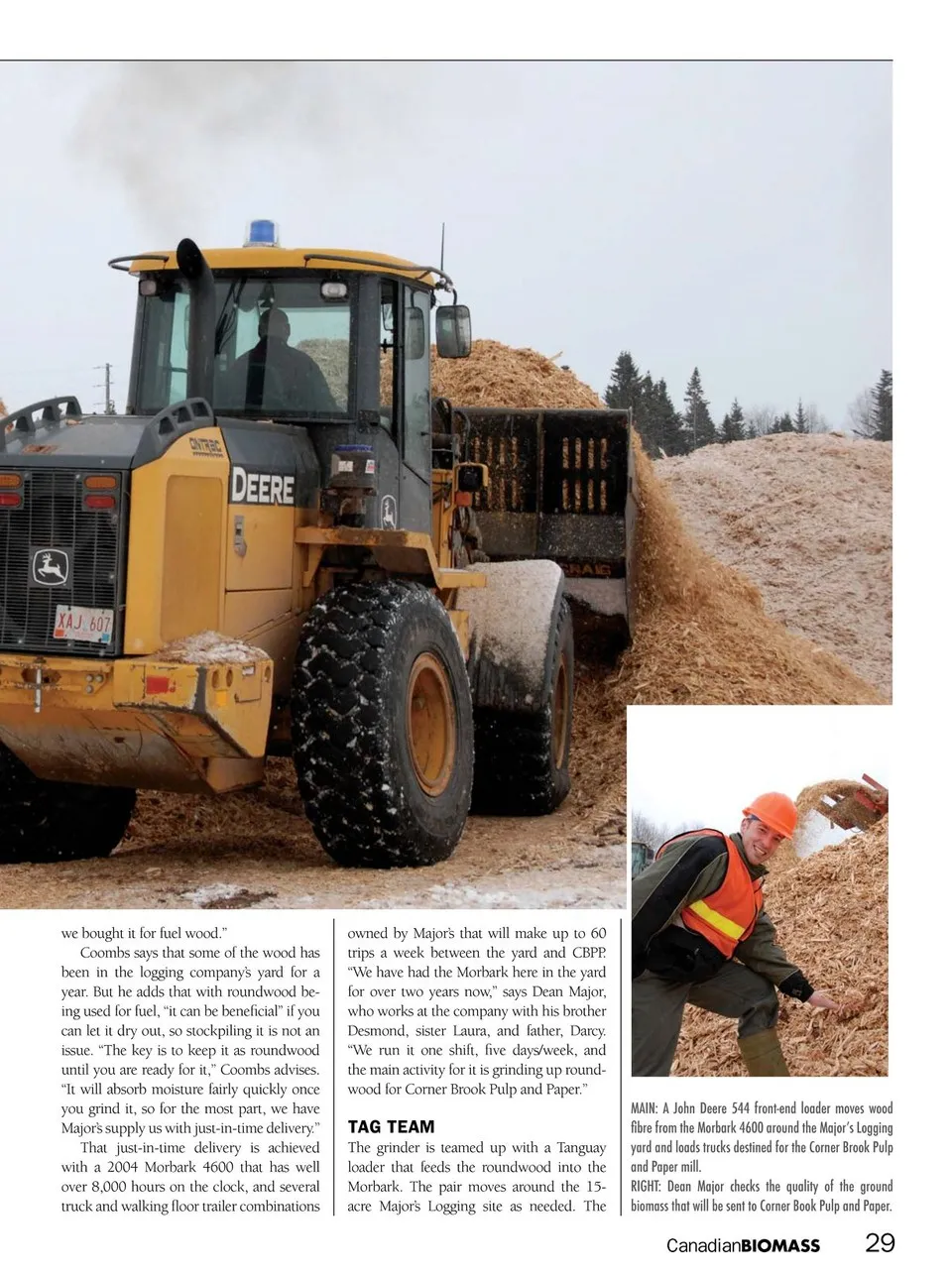
Biomass Processing foundland has a big appetite for biomass – 713 tonnes/day to be precise. That’s the amount of fuel it needs to generate the steam required to dry the mill’s production from its two operating paper machines, heat the mill buildings, and feed a power plant that drives a co-generation turbine operating at 7 to 10 MW. The mill generates 363 tonnes/day of biomass fuel on its own, leaving a shortfall of 350 tonnes/day that has to be sourced from outside suppliers. In most forest products producing re- gions of Canada, that wouldn’t be an issue, as bark and shavings from local sawmill pro- duction could make up for any shortfall in biomass from the pulp and paper mill’s own wood room. But in Newfoundland, the saw- mill industry, like the paper producers, has been hit extremely hard by the latest down- turn in the economy. Today, the province has only three major sawmills operating, and two of them are a long way from CBPP. De- spite the distances – 117, 385, and 502 km from CBPP’s gates – the mill sources pulp chips and small volumes of biomass from all three. But on the biomass front, the long trek 28 CanadianBIOMASS boiler at Kruger Inc.’s Cor- ner Brook Pulp and Paper (CBPP) mill in western New- makes for some expensive power. That’s where Major’s Logging in Deer Lake, Newfoundland, comes into the pic- ture. The long-term family business that has logged for CBPP for over 12 years has its offices, shop, and yard just 45 minutes from the mill. It also had a wood supply that needed to be used up: remnants from a sawmill it recently closed in Cormack, New- foundland, which is just north of the Deer Lake site. Plus, it stores and grinds a large inventory of CBPP-owned roundwood that is suitable for biomass. What it all adds up to is some extra work to keep the key employ- ees at Major’s Logging on the payroll during slow times in the regular harvesting cycles, and a steady and secure supply of biomass for CBPP. “We have 36,000 cubic metres of round- wood at the Major’s Logging yard right now,” explains Bruce Coombs, an operations su- perintendent at CBPP who is responsible for a number of fibre-related duties, including chip and biomass supply for the mill. “Half of that wood is from our regular harvesting operations. The other half is wood with no home. It was pulp wood and fuel wood that was harvested by sawmills, but with the re- duced paper production we are experienc- ing right now, there was no market for it, so MARCH/APRIL 2010
Canadian Biomass March/April 2010: Page 28