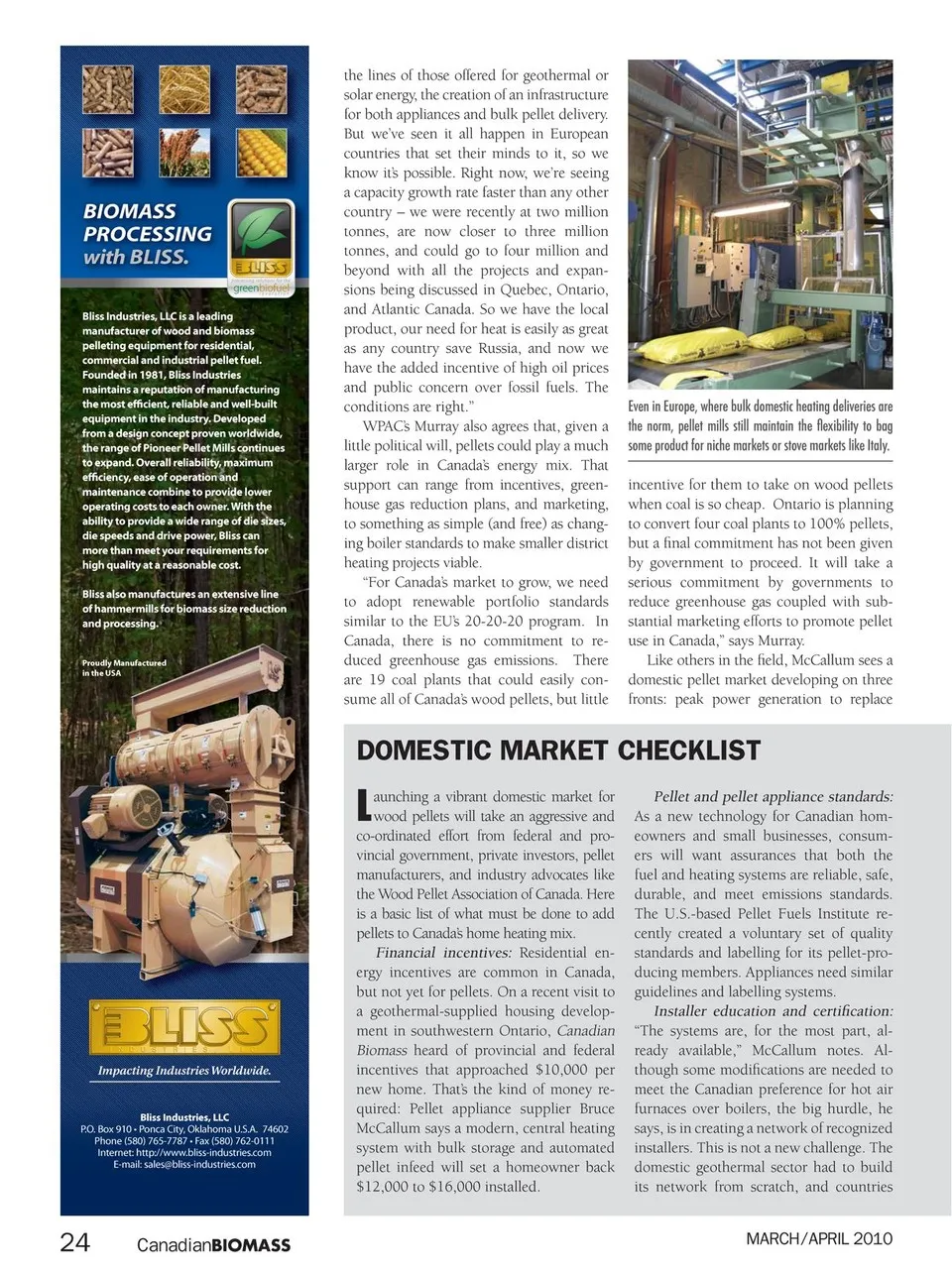
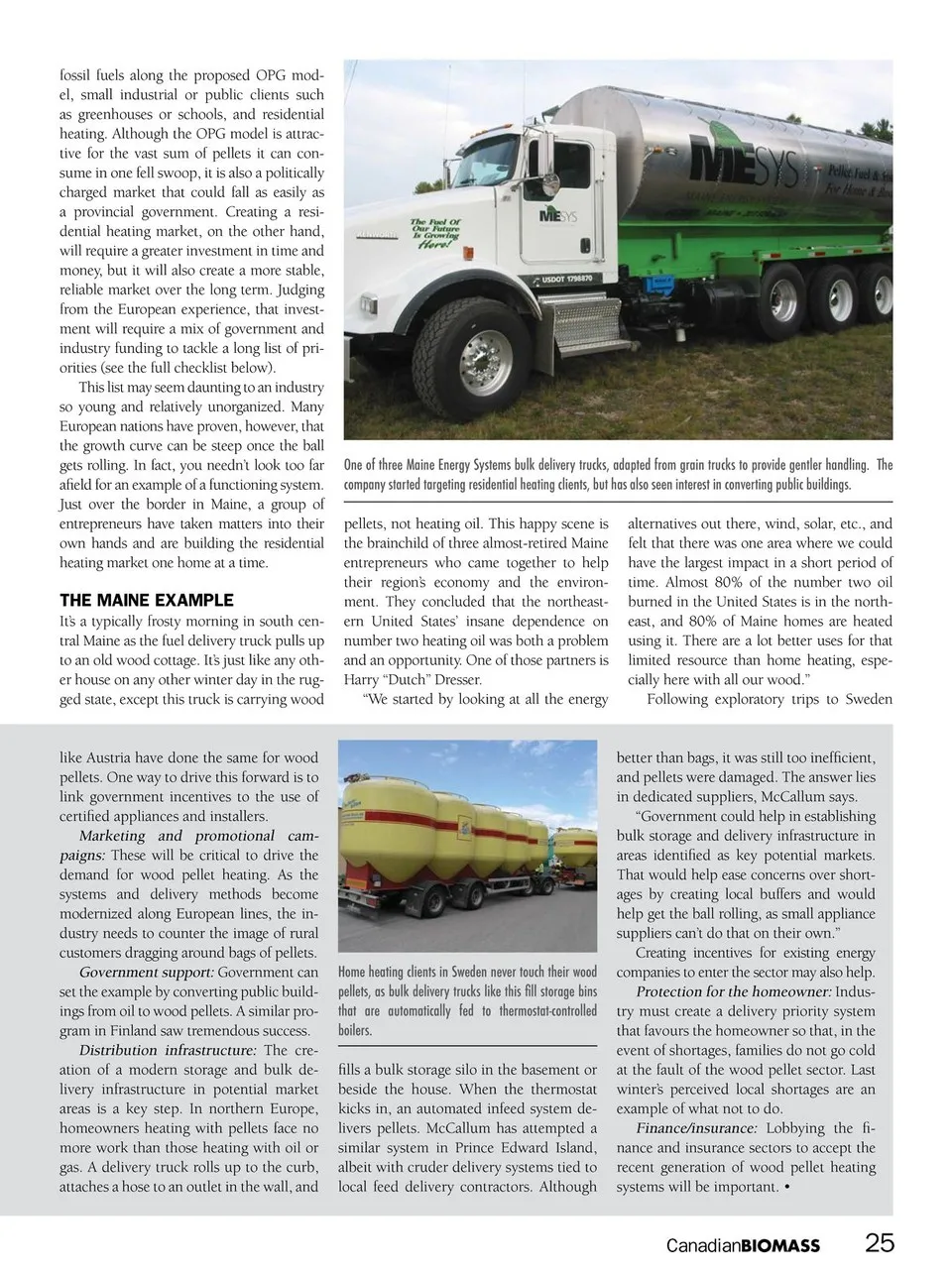
fossil fuels along the proposed OPG mod- el, small industrial or public clients such as greenhouses or schools, and residential heating. Although the OPG model is attrac- tive for the vast sum of pellets it can con- sume in one fell swoop, it is also a politically charged market that could fall as easily as a provincial government. Creating a resi- dential heating market, on the other hand, will require a greater investment in time and money, but it will also create a more stable, reliable market over the long term. Judging from the European experience, that invest- ment will require a mix of government and industry funding to tackle a long list of pri- orities (see the full checklist below). This list may seem daunting to an industry so young and relatively unorganized. Many European nations have proven, however, that the growth curve can be steep once the ball gets rolling. In fact, you needn’t look too far afield for an example of a functioning system. Just over the border in Maine, a group of entrepreneurs have taken matters into their own hands and are building the residential heating market one home at a time. THE MAINE EXAMPLE It’s a typically frosty morning in south cen- tral Maine as the fuel delivery truck pulls up to an old wood cottage. It’s just like any oth- er house on any other winter day in the rug- ged state, except this truck is carrying wood like Austria have done the same for wood pellets. One way to drive this forward is to link government incentives to the use of certified appliances and installers. Marketing and promotional cam- paigns: These will be critical to drive the demand for wood pellet heating. As the systems and delivery methods become modernized along European lines, the in- dustry needs to counter the image of rural customers dragging around bags of pellets. Government support:Government can set the example by converting public build- ings from oil to wood pellets. A similar pro- gram in Finland saw tremendous success. Distribution infrastructure: The cre- ation of a modern storage and bulk de- livery infrastructure in potential market areas is a key step. In northern Europe, homeowners heating with pellets face no more work than those heating with oil or gas. A delivery truck rolls up to the curb, attaches a hose to an outlet in the wall, and pellets, not heating oil. This happy scene is the brainchild of three almost-retired Maine entrepreneurs who came together to help their region’s economy and the environ- ment. They concluded that the northeast- ern United States’ insane dependence on number two heating oil was both a problem and an opportunity. One of those partners is Harry “Dutch” Dresser. “We started by looking at all the energy alternatives out there, wind, solar, etc., and felt that there was one area where we could have the largest impact in a short period of time. Almost 80% of the number two oil burned in the United States is in the north- east, and 80% of Maine homes are heated using it. There are a lot better uses for that limited resource than home heating, espe- cially here with all our wood.” Following exploratory trips to Sweden fills a bulk storage silo in the basement or beside the house. When the thermostat kicks in, an automated infeed system de- livers pellets. McCallum has attempted a similar system in Prince Edward Island, albeit with cruder delivery systems tied to local feed delivery contractors. Although better than bags, it was still too inefficient, and pellets were damaged. The answer lies in dedicated suppliers, McCallum says. “Government could help in establishing bulk storage and delivery infrastructure in areas identified as key potential markets. That would help ease concerns over short- ages by creating local buffers and would help get the ball rolling, as small appliance suppliers can’t do that on their own.” Creating incentives for existing energy companies to enter the sector may also help. Protection for the homeowner:Indus- try must create a delivery priority system that favours the homeowner so that, in the event of shortages, families do not go cold at the fault of the wood pellet sector. Last winter’s perceived local shortages are an example of what not to do. Finance/insurance: Lobbying the fi- nance and insurance sectors to accept the recent generation of wood pellet heating systems will be important. • CanadianBIOMASS 25
Canadian Biomass March/April 2010: Page 25