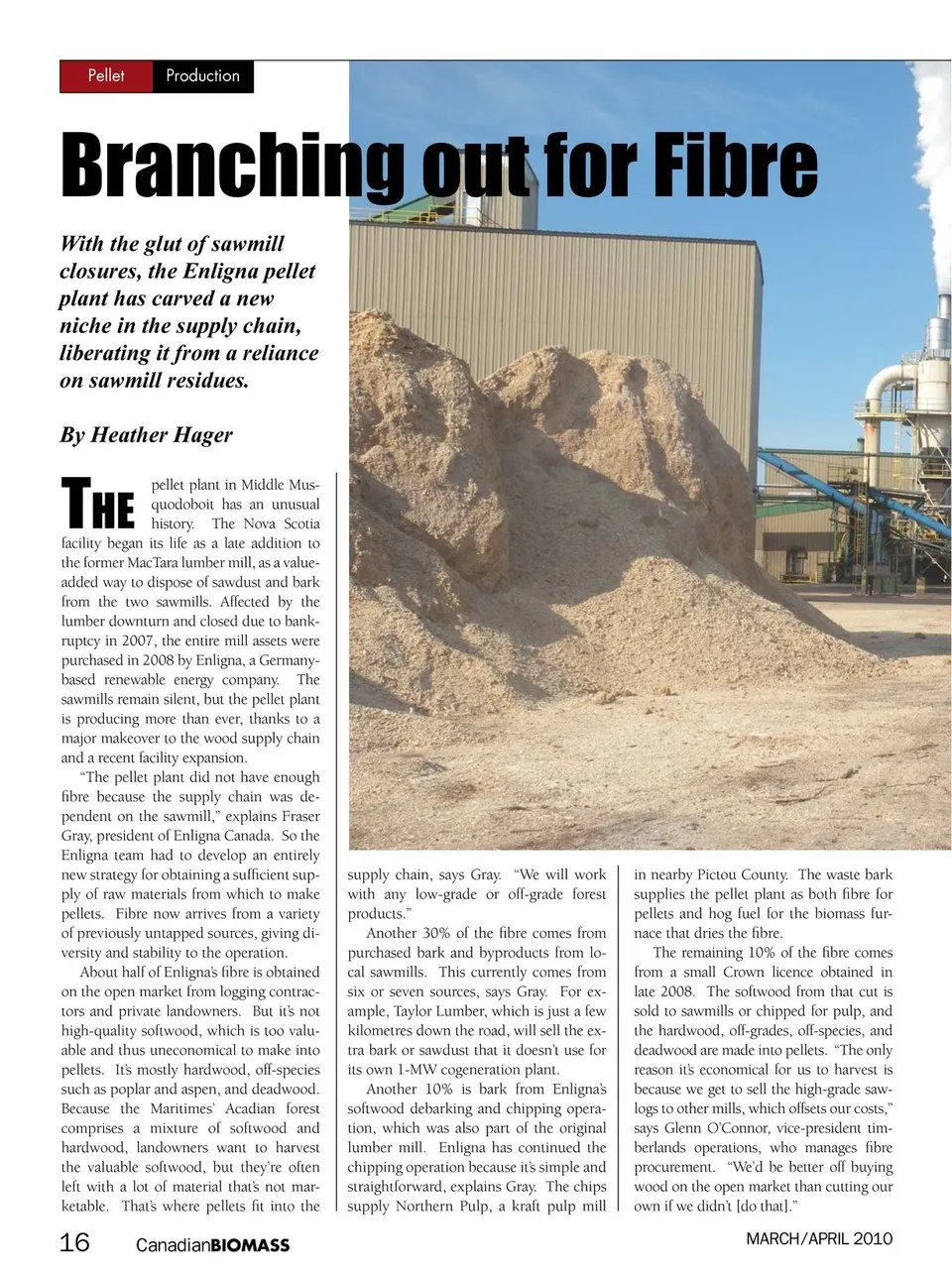
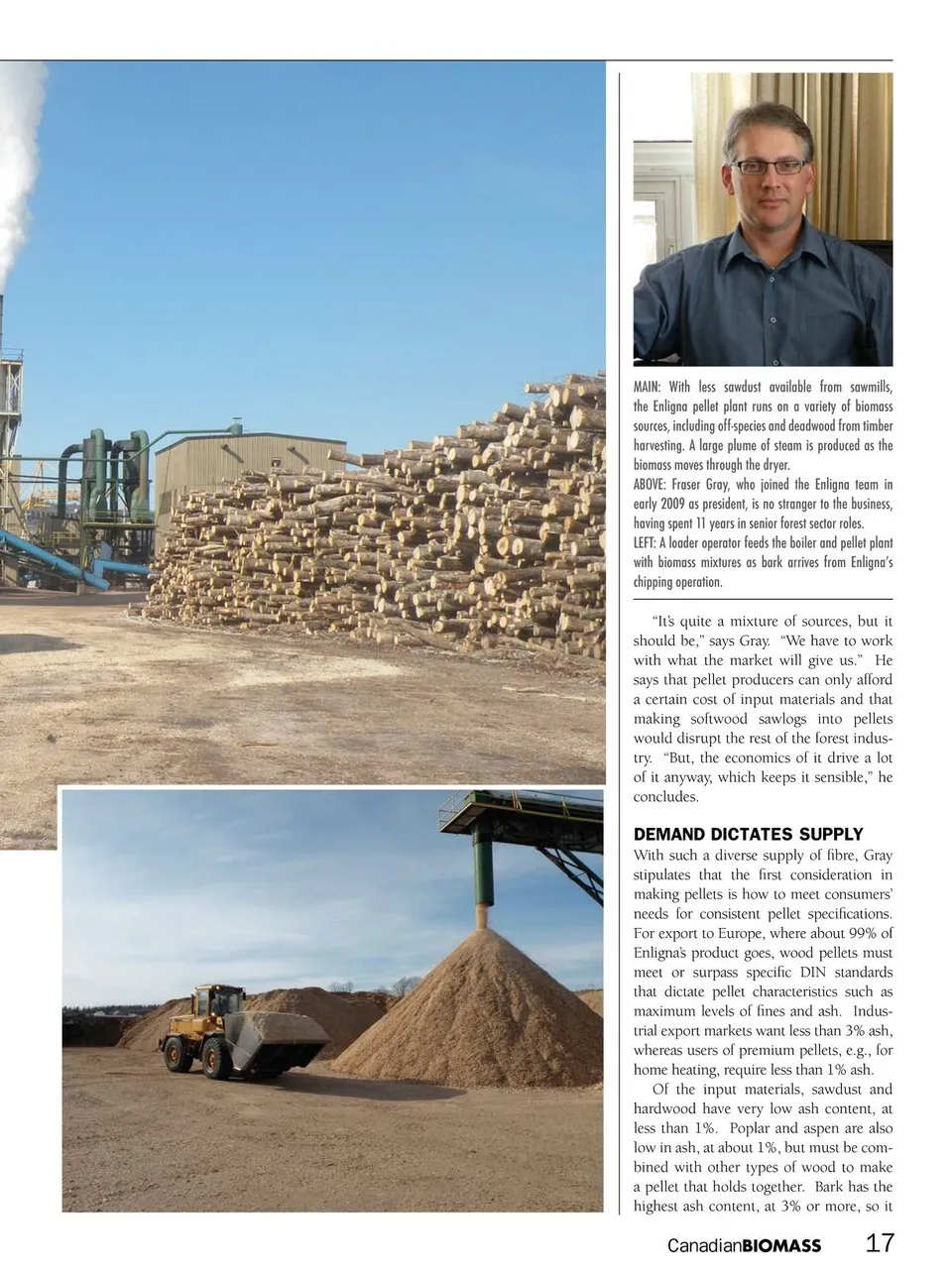
Pellet Production facility began its life as a late addition to the former MacTara lumber mill, as a value- added way to dispose of sawdust and bark from the two sawmills. Affected by the lumber downturn and closed due to bank- ruptcy in 2007, the entire mill assets were purchased in 2008 by Enligna, a Germany- based renewable energy company. The sawmills remain silent, but the pellet plant is producing more than ever, thanks to a major makeover to the wood supply chain and a recent facility expansion. “The pellet plant did not have enough fibre because the supply chain was de- pendent on the sawmill,” explains Fraser Gray, president of Enligna Canada. So the Enligna team had to develop an entirely new strategy for obtaining a sufficient sup- ply of raw materials from which to make pellets. Fibre now arrives from a variety of previously untapped sources, giving di- versity and stability to the operation. About half of Enligna’s fibre is obtained on the open market from logging contrac- tors and private landowners. But it’s not high-quality softwood, which is too valu- able and thus uneconomical to make into pellets. It’s mostly hardwood, off-species such as poplar and aspen, and deadwood. Because the Maritimes’ Acadian forest comprises a mixture of softwood and hardwood, landowners want to harvest the valuable softwood, but they’re often left with a lot of material that’s not mar- ketable. That’s where pellets fit into the 16 CanadianBIOMASS pellet plant in Middle Mus- quodoboit has an unusual history. The Nova Scotia supply chain, says Gray. “We will work with any low-grade or off-grade forest products.” Another 30% of the fibre comes from purchased bark and byproducts from lo- cal sawmills. This currently comes from six or seven sources, says Gray. For ex- ample, Taylor Lumber, which is just a few kilometres down the road, will sell the ex- tra bark or sawdust that it doesn’t use for its own 1-MW cogeneration plant. Another 10% is bark from Enligna’s softwood debarking and chipping opera- tion, which was also part of the original lumber mill. Enligna has continued the chipping operation because it’s simple and straightforward, explains Gray. The chips supply Northern Pulp, a kraft pulp mill in nearby Pictou County. The waste bark supplies the pellet plant as both fibre for pellets and hog fuel for the biomass fur- nace that dries the fibre. The remaining 10% of the fibre comes from a small Crown licence obtained in late 2008. The softwood from that cut is sold to sawmills or chipped for pulp, and the hardwood, off-grades, off-species, and deadwood are made into pellets. “The only reason it’s economical for us to harvest is because we get to sell the high-grade saw- logs to other mills, which offsets our costs,” says Glenn O’Connor, vice-president tim- berlands operations, who manages fibre procurement. “We’d be better off buying wood on the open market than cutting our own if we didn’t [do that].” MARCH/APRIL 2010
Canadian Biomass March/April 2010: Page 16