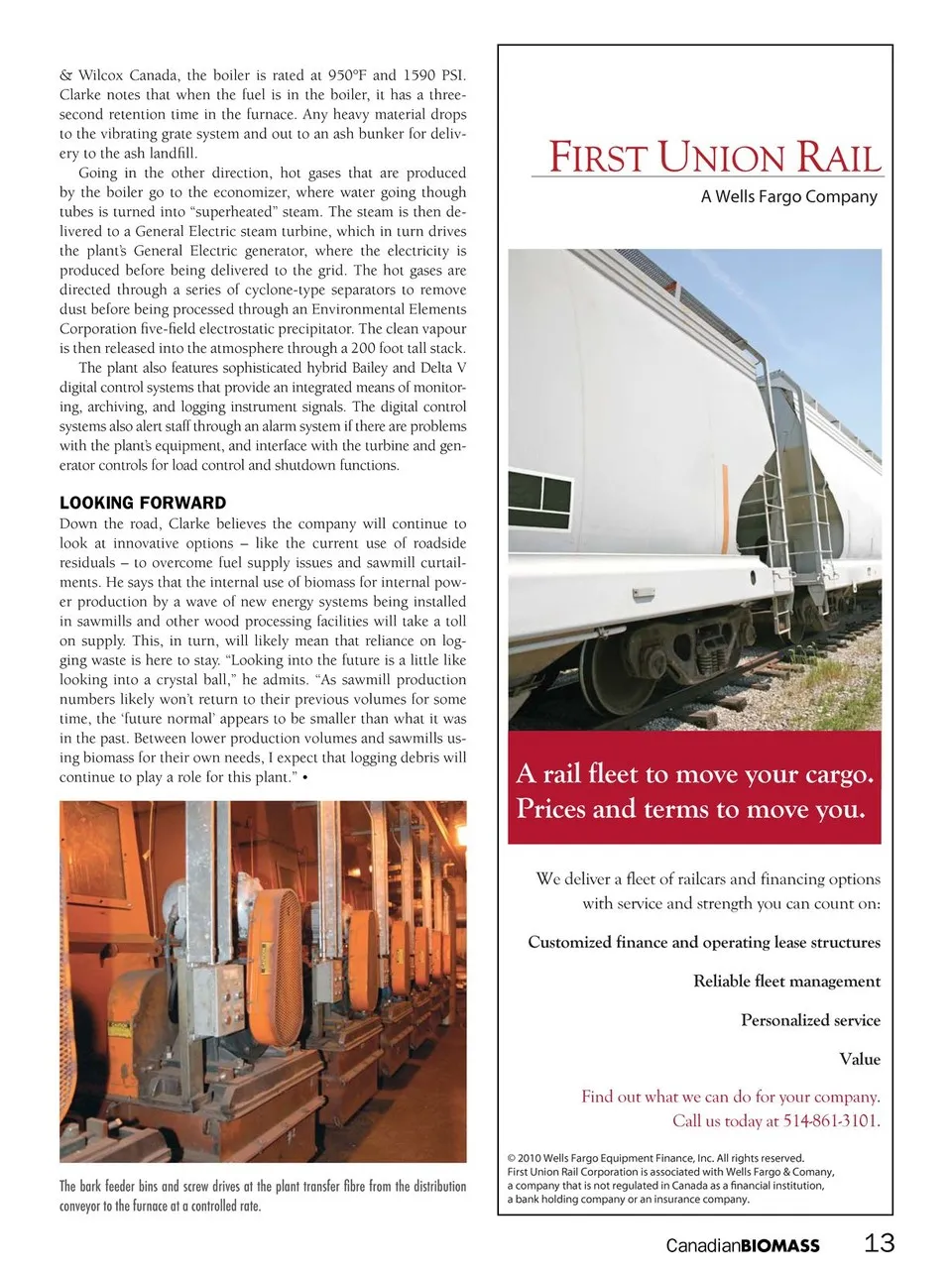
& Wilcox Canada, the boiler is rated at 950°F and 1590 PSI. Clarke notes that when the fuel is in the boiler, it has a three- second retention time in the furnace. Any heavy material drops to the vibrating grate system and out to an ash bunker for deliv- ery to the ash landfill. Going in the other direction, hot gases that are produced by the boiler go to the economizer, where water going though tubes is turned into “superheated” steam. The steam is then de- livered to a General Electric steam turbine, which in turn drives the plant’s General Electric generator, where the electricity is produced before being delivered to the grid. The hot gases are directed through a series of cyclone-type separators to remove dust before being processed through an Environmental Elements Corporation five-field electrostatic precipitator. The clean vapour is then released into the atmosphere through a 200 foot tall stack. The plant also features sophisticated hybrid Bailey and Delta V digital control systems that provide an integrated means of monitor- ing, archiving, and logging instrument signals. The digital control systems also alert staff through an alarm system if there are problems with the plant’s equipment, and interface with the turbine and gen- erator controls for load control and shutdown functions. LOOKING FORWARD Down the road, Clarke believes the company will continue to look at innovative options – like the current use of roadside residuals – to overcome fuel supply issues and sawmill curtail- ments. He says that the internal use of biomass for internal pow- er production by a wave of new energy systems being installed in sawmills and other wood processing facilities will take a toll on supply. This, in turn, will likely mean that reliance on log- ging waste is here to stay. “Looking into the future is a little like looking into a crystal ball,” he admits. “As sawmill production numbers likely won’t return to their previous volumes for some time, the ‘future normal’ appears to be smaller than what it was in the past. Between lower production volumes and sawmills us- ing biomass for their own needs, I expect that logging debris will continue to play a role for this plant.” • A Wells Fargo Company © 2010 Wells Fargo Equipment Finance, Inc. All rights reserved. First Union Rail Corporation is associated with Wells Fargo & Comany, a company that is not regulated in Canada as a financial institution, a bank holding company or an insurance company. CanadianBIOMASS 13
Canadian Biomass March/April 2010: Page 13