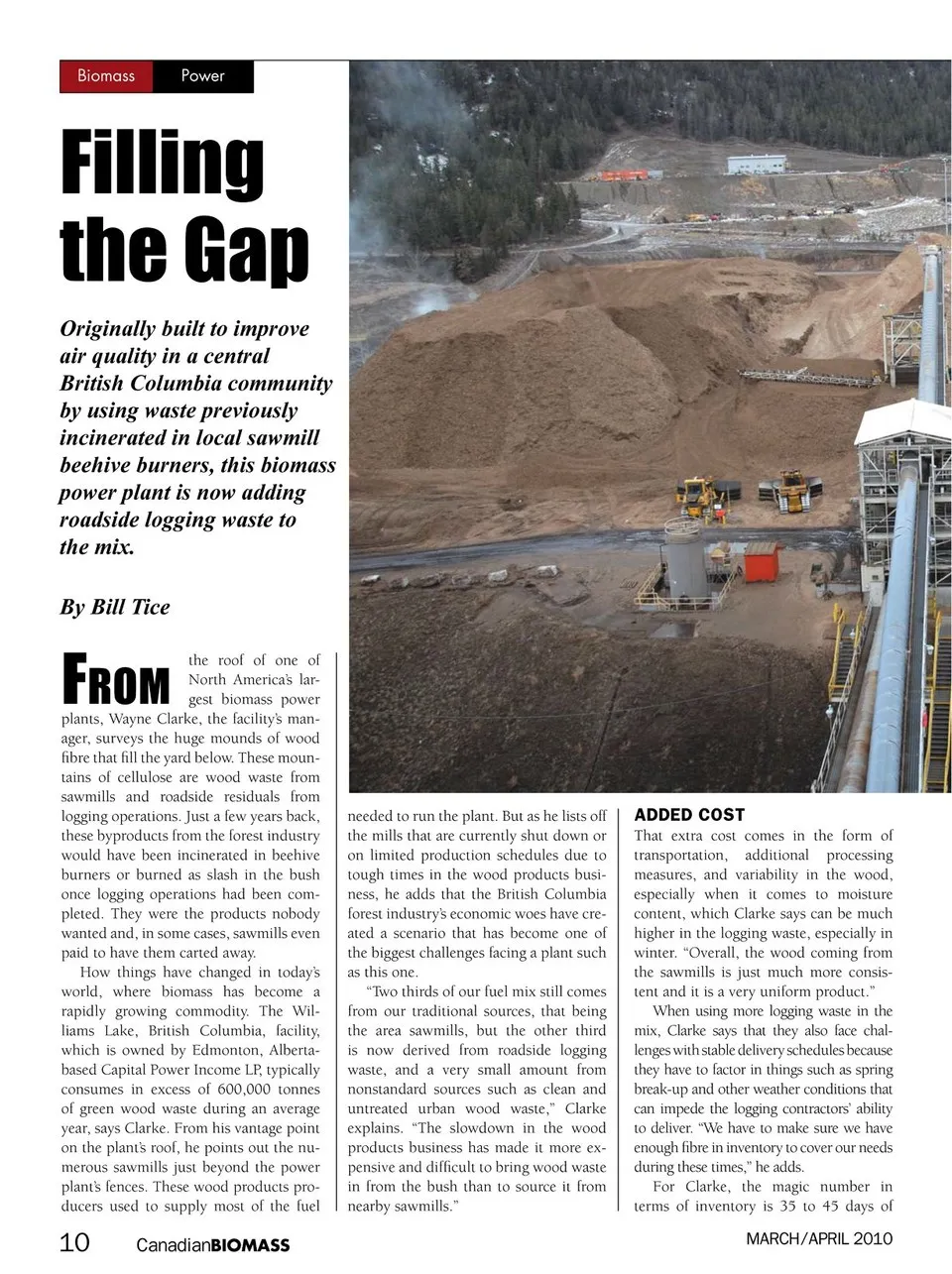
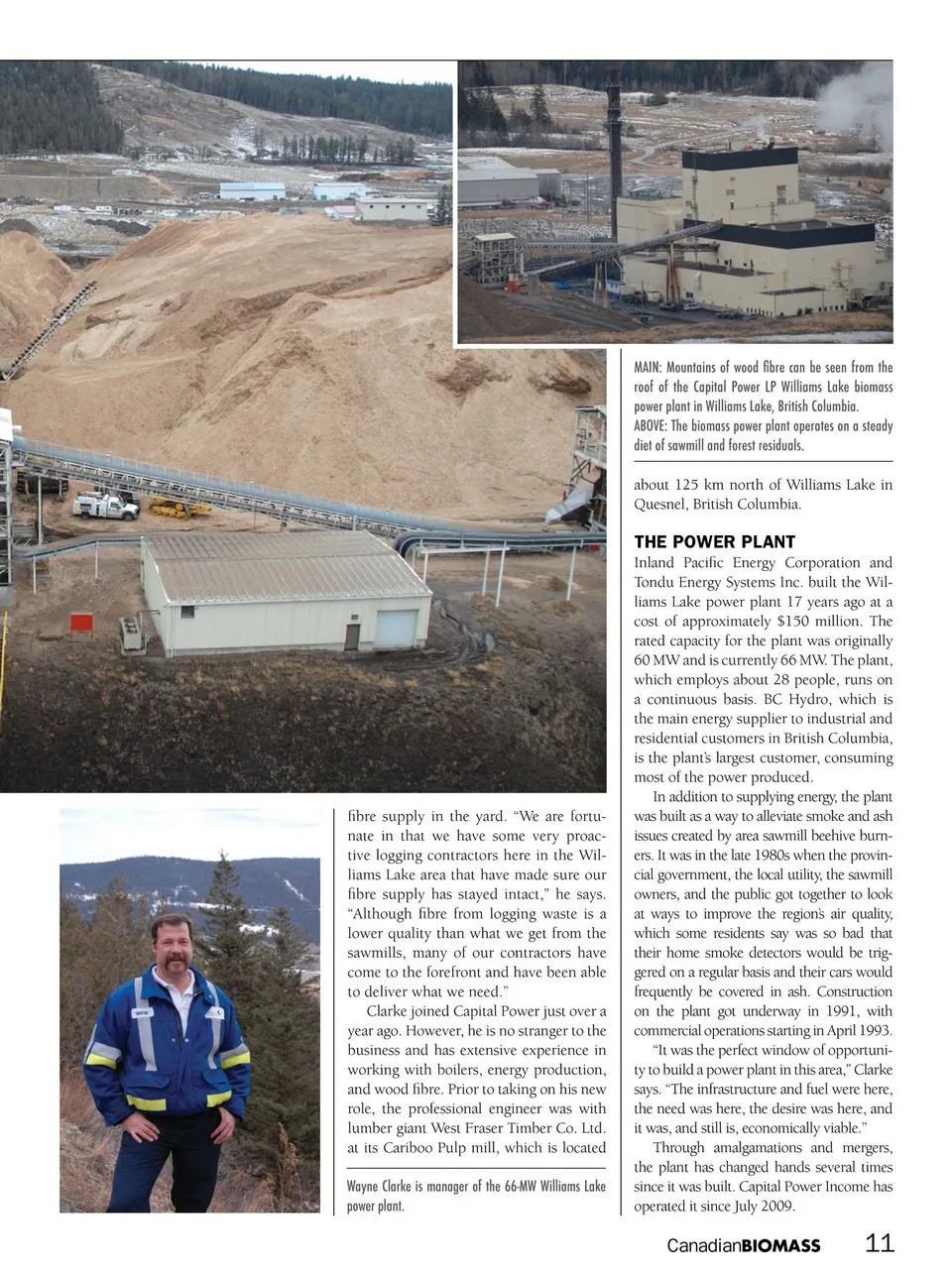
about 125 km north of Williams Lake in Quesnel, British Columbia. fibre supply in the yard. “We are fortu- nate in that we have some very proac- tive logging contractors here in the Wil- liams Lake area that have made sure our fibre supply has stayed intact,” he says. “Although fibre from logging waste is a lower quality than what we get from the sawmills, many of our contractors have come to the forefront and have been able to deliver what we need.” Clarke joined Capital Power just over a year ago. However, he is no stranger to the business and has extensive experience in working with boilers, energy production, and wood fibre. Prior to taking on his new role, the professional engineer was with lumber giant West Fraser Timber Co. Ltd. at its Cariboo Pulp mill, which is located THE POWER PLANT Inland Pacific Energy Corporation and Tondu Energy Systems Inc. built the Wil- liams Lake power plant 17 years ago at a cost of approximately $150 million. The rated capacity for the plant was originally 60 MW and is currently 66 MW. The plant, which employs about 28 people, runs on a continuous basis. BC Hydro, which is the main energy supplier to industrial and residential customers in British Columbia, is the plant’s largest customer, consuming most of the power produced. In addition to supplying energy, the plant was built as a way to alleviate smoke and ash issues created by area sawmill beehive burn- ers. It was in the late 1980s when the provin- cial government, the local utility, the sawmill owners, and the public got together to look at ways to improve the region’s air quality, which some residents say was so bad that their home smoke detectors would be trig- gered on a regular basis and their cars would frequently be covered in ash. Construction on the plant got underway in 1991, with commercial operations starting in April 1993. “It was the perfect window of opportuni- ty to build a power plant in this area,” Clarke says. “The infrastructure and fuel were here, the need was here, the desire was here, and it was, and still is, economically viable.” Through amalgamations and mergers, the plant has changed hands several times since it was built. Capital Power Income has operated it since July 2009. CanadianBIOMASS 11
Canadian Biomass March/April 2010: Page 11