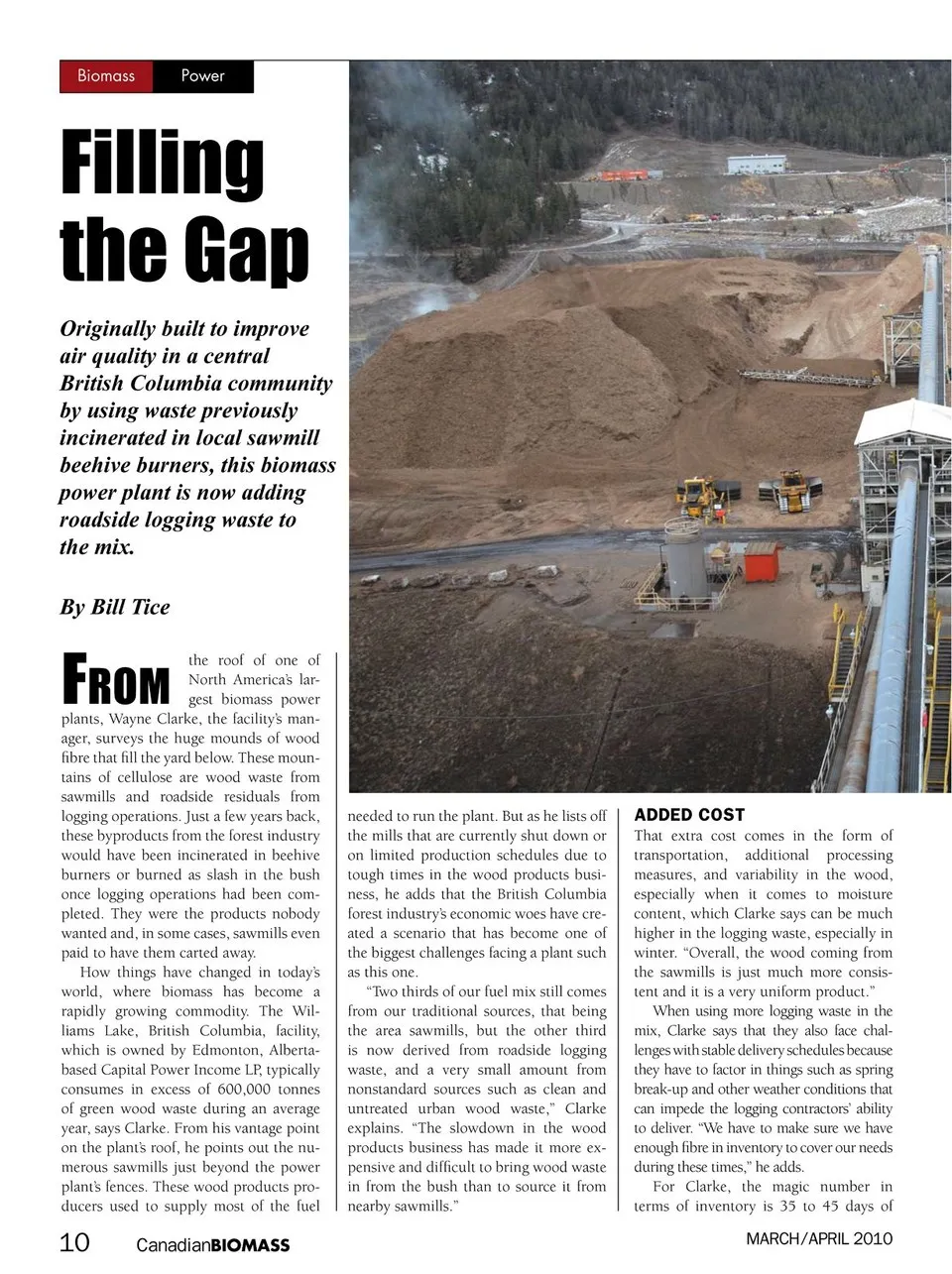
Biomass Power plants, Wayne Clarke, the facility’s man- ager, surveys the huge mounds of wood fibre that fill the yard below. These moun- tains of cellulose are wood waste from sawmills and roadside residuals from logging operations. Just a few years back, these byproducts from the forest industry would have been incinerated in beehive burners or burned as slash in the bush once logging operations had been com- pleted. They were the products nobody wanted and, in some cases, sawmills even paid to have them carted away. How things have changed in today’s world, where biomass has become a rapidly growing commodity. The Wil- liams Lake, British Columbia, facility, which is owned by Edmonton, Alberta- based Capital Power Income LP, typically consumes in excess of 600,000 tonnes of green wood waste during an average year, says Clarke. From his vantage point on the plant’s roof, he points out the nu- merous sawmills just beyond the power plant’s fences. These wood products pro- ducers used to supply most of the fuel 10 CanadianBIOMASS the roof of one of North America’s lar- gest biomass power needed to run the plant. But as he lists off the mills that are currently shut down or on limited production schedules due to tough times in the wood products busi- ness, he adds that the British Columbia forest industry’s economic woes have cre- ated a scenario that has become one of the biggest challenges facing a plant such as this one. “Two thirds of our fuel mix still comes from our traditional sources, that being the area sawmills, but the other third is now derived from roadside logging waste, and a very small amount from nonstandard sources such as clean and untreated urban wood waste,” Clarke explains. “The slowdown in the wood products business has made it more ex- pensive and difficult to bring wood waste in from the bush than to source it from nearby sawmills.” ADDED COST That extra cost comes in the form of transportation, additional processing measures, and variability in the wood, especially when it comes to moisture content, which Clarke says can be much higher in the logging waste, especially in winter. “Overall, the wood coming from the sawmills is just much more consis- tent and it is a very uniform product.” When using more logging waste in the mix, Clarke says that they also face chal- lenges with stable delivery schedules because they have to factor in things such as spring break-up and other weather conditions that can impede the logging contractors’ ability to deliver. “We have to make sure we have enough fibre in inventory to cover our needs during these times,” he adds. For Clarke, the magic number in terms of inventory is 35 to 45 days of MARCH/APRIL 2010
Canadian Biomass March/April 2010: Page 10