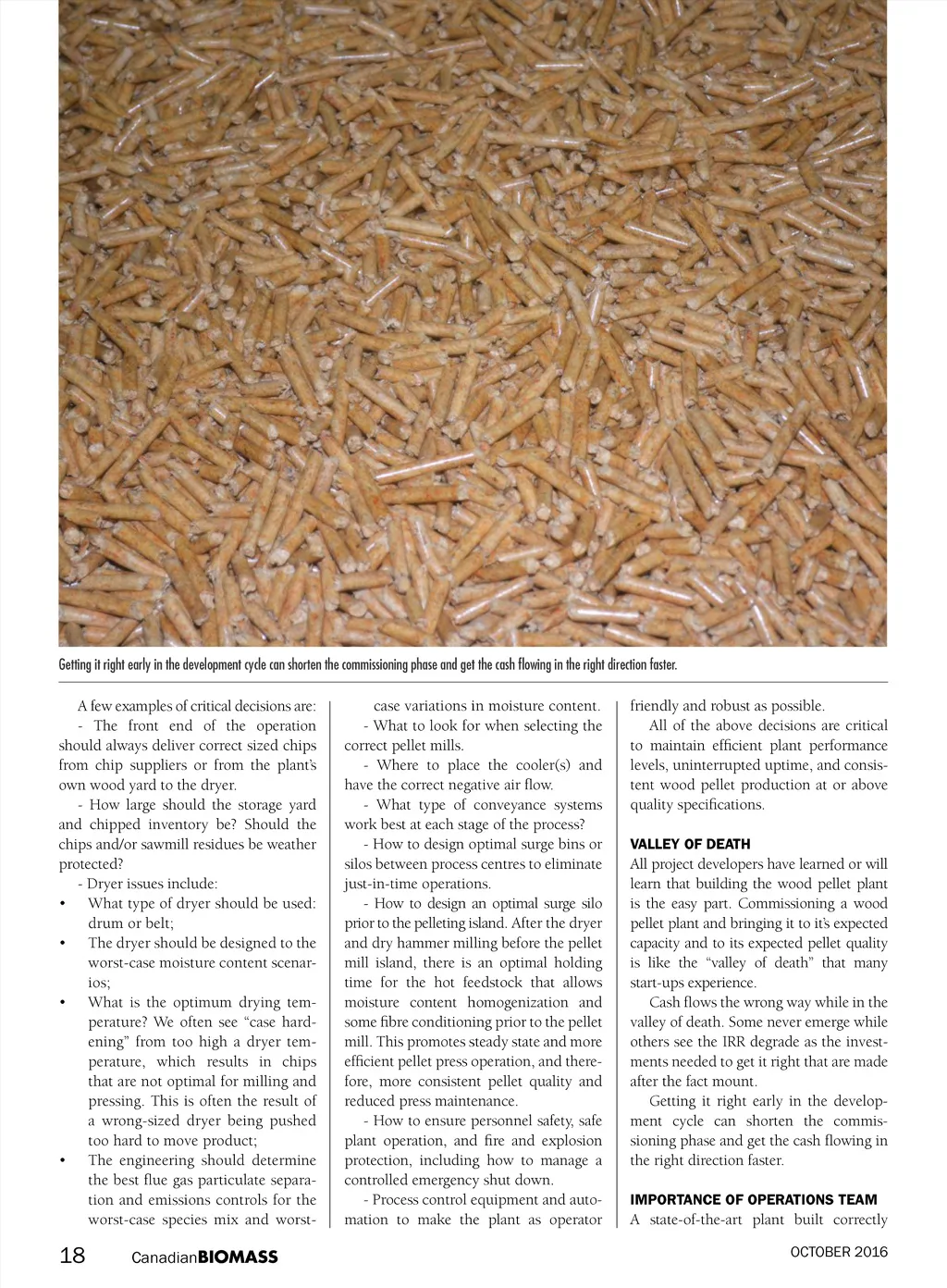
Getting it right early in the development cycle can shorten the commissioning phase and get the cash flowing in the right direction faster. A few examples of critical decisions are: -The front end of the operation should always deliver correct sized chips from chip suppliers or from the plant’s own wood yard to the dryer. -How large should the storage yard and chipped inventory be? Should the chips and/or sawmill residues be weather protected? -Dryer issues include: • What type of dryer should be used: drum or belt; • The dryer should be designed to the worst-case moisture content scenar-ios; • What is the optimum drying tem-perature? We often see “case hard-ening” from too high a dryer tem-perature, which results in chips that are not optimal for milling and pressing. This is often the result of a wrong-sized dryer being pushed too hard to move product; • The engineering should determine the best flue gas particulate separa-tion and emissions controls for the worst-case species mix and worst-case variations in moisture content. -What to look for when selecting the correct pellet mills. -Where to place the cooler(s) and have the correct negative air flow. -What type of conveyance systems work best at each stage of the process? -How to design optimal surge bins or silos between process centres to eliminate just-in-time operations. -How to design an optimal surge silo prior to the pelleting island. After the dryer and dry hammer milling before the pellet mill island, there is an optimal holding time for the hot feedstock that allows moisture content homogenization and some fibre conditioning prior to the pellet mill. This promotes steady state and more efficient pellet press operation, and there-fore, more consistent pellet quality and reduced press maintenance. -How to ensure personnel safety, safe plant operation, and fire and explosion protection, including how to manage a controlled emergency shut down. -Process control equipment and auto-mation to make the plant as operator friendly and robust as possible. All of the above decisions are critical to maintain efficient plant performance levels, uninterrupted uptime, and consis-tent wood pellet production at or above quality specifications. VALLEY OF DEATH All project developers have learned or will learn that building the wood pellet plant is the easy part. Commissioning a wood pellet plant and bringing it to it’s expected capacity and to its expected pellet quality is like the “valley of death” that many start-ups experience. Cash flows the wrong way while in the valley of death. Some never emerge while others see the IRR degrade as the invest-ments needed to get it right that are made after the fact mount. Getting it right early in the develop-ment cycle can shorten the commis-sioning phase and get the cash flowing in the right direction faster. IMPORTANCE OF OPERATIONS TEAM A state-of-the-art plant built correctly OCTOBER 2016 18 Canadian BIOMASS
Canadian Biomass October 2016: Page 18