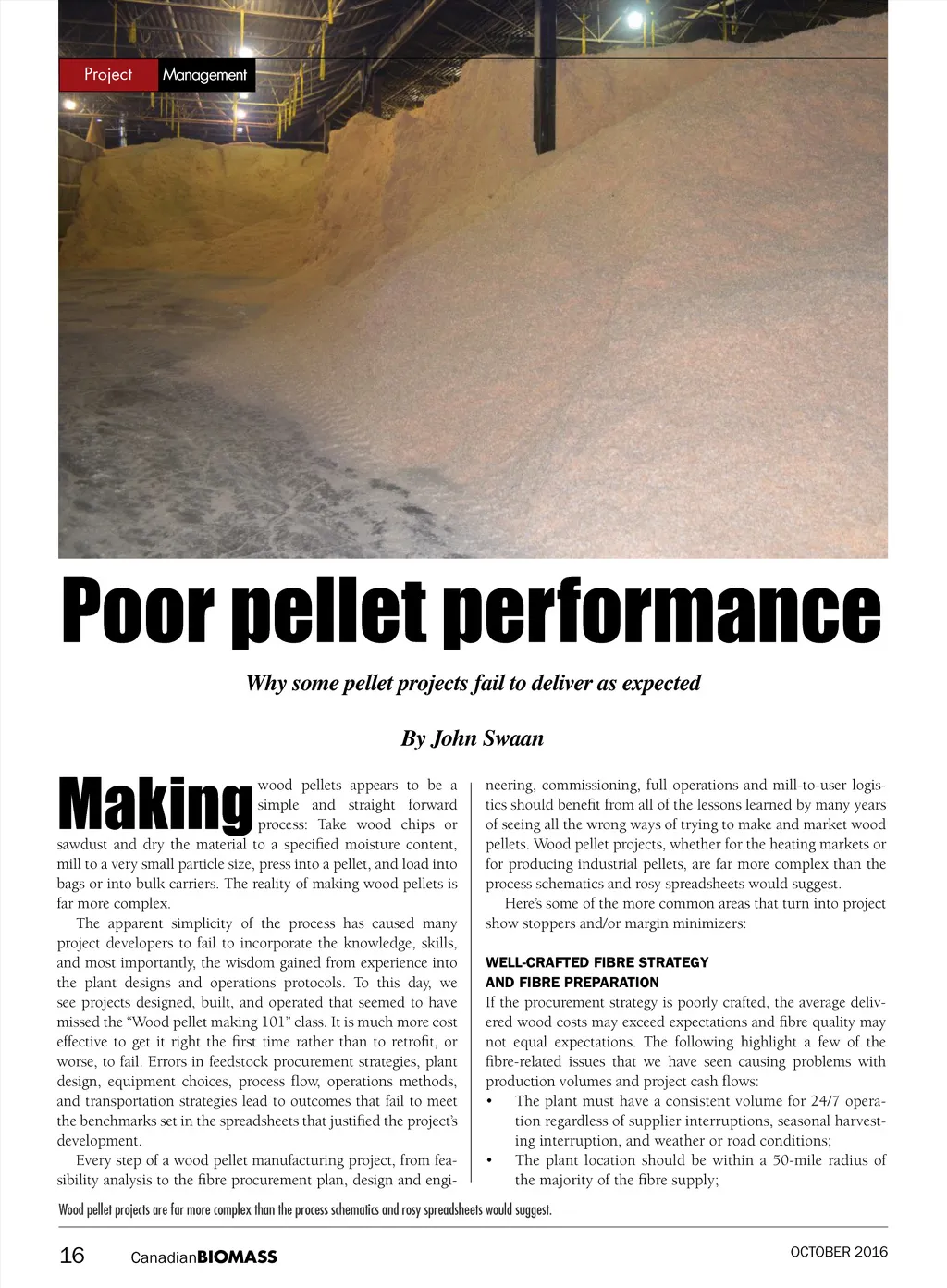
Project Management Poor pellet performance Why some pellet projects fail to deliver as expected By John Swaan Making wood pellets appears to be a simple and straight forward process: Take wood chips or sawdust and dry the material to a specified moisture content, mill to a very small particle size, press into a pellet, and load into bags or into bulk carriers. The reality of making wood pellets is far more complex. The apparent simplicity of the process has caused many project developers to fail to incorporate the knowledge, skills, and most importantly, the wisdom gained from experience into the plant designs and operations protocols. To this day, we see projects designed, built, and operated that seemed to have missed the “Wood pellet making 101” class. It is much more cost effective to get it right the first time rather than to retrofit, or worse, to fail. Errors in feedstock procurement strategies, plant design, equipment choices, process flow, operations methods, and transportation strategies lead to outcomes that fail to meet the benchmarks set in the spreadsheets that justified the project’s development. Every step of a wood pellet manufacturing project, from fea-sibility analysis to the fibre procurement plan, design and engi-neering, commissioning, full operations and mill-to-user logis-tics should benefit from all of the lessons learned by many years of seeing all the wrong ways of trying to make and market wood pellets. Wood pellet projects, whether for the heating markets or for producing industrial pellets, are far more complex than the process schematics and rosy spreadsheets would suggest. Here’s some of the more common areas that turn into project show stoppers and/or margin minimizers: WELL-CRAFTED FIBRE STRATEGY AND FIBRE PREPARATION If the procurement strategy is poorly crafted, the average deliv-ered wood costs may exceed expectations and fibre quality may not equal expectations. The following highlight a few of the fibre-related issues that we have seen causing problems with production volumes and project cash flows: • The plant must have a consistent volume for 24/7 opera-tion regardless of supplier interruptions, seasonal harvest-ing interruption, and weather or road conditions; • The plant location should be within a 50-mile radius of the majority of the fibre supply; Wood pellet projects are far more complex than the process schematics and rosy spreadsheets would suggest. 16 Canadian BIOMASS OCTOBER 2016
Canadian Biomass October 2016: Page 16