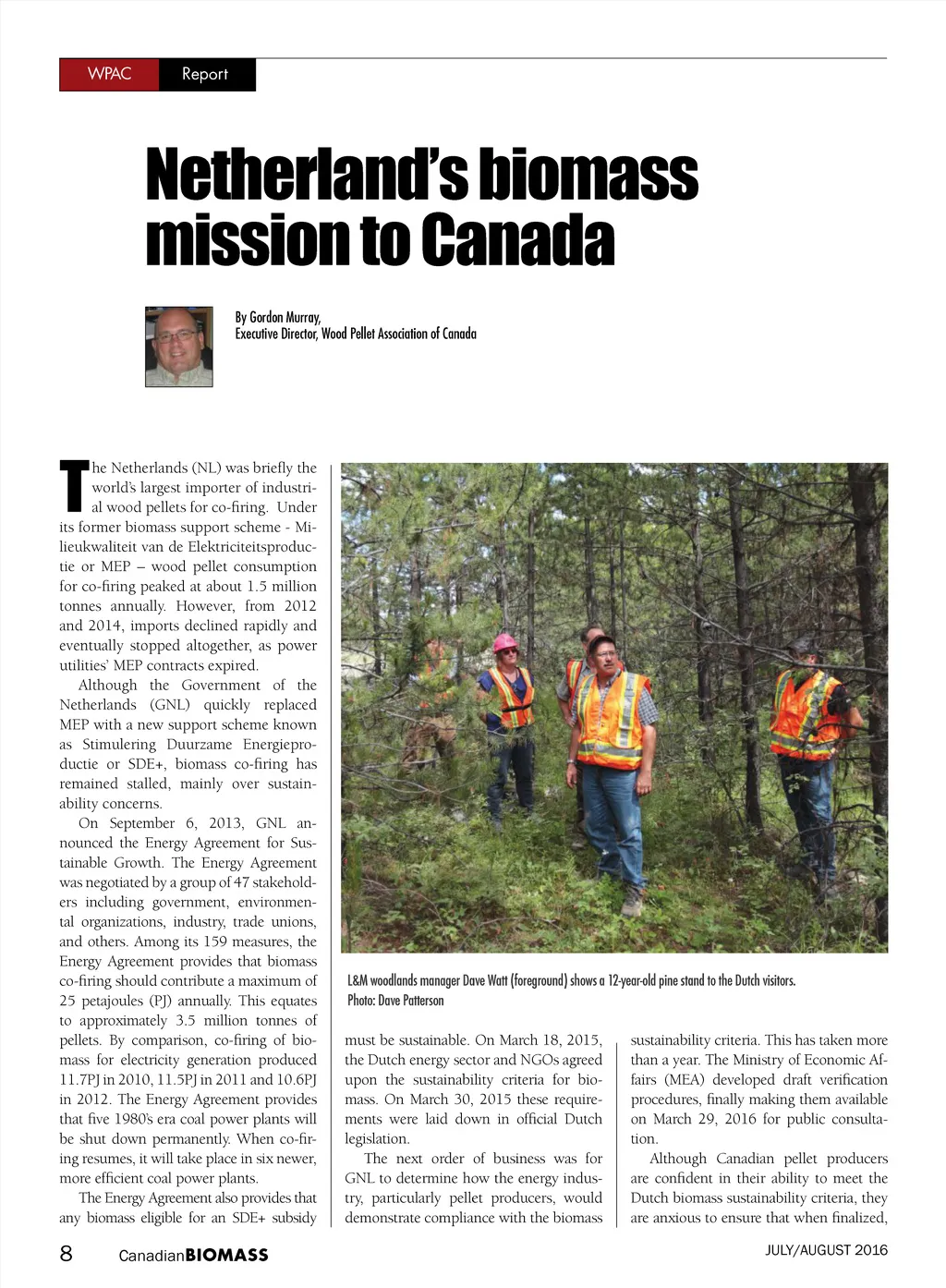
WPAC Report Netherland’s biomass mission to Canada By Gordon Murray, Executive Director, Wood Pellet Association of Canada T he Netherlands (NL) was briefly the world’s largest importer of industri-al wood pellets for co-firing. Under its former biomass support scheme -Mi-lieukwaliteit van de Elektriciteitsproduc-tie or MEP – wood pellet consumption for co-firing peaked at about 1.5 million tonnes annually. However, from 2012 and 2014, imports declined rapidly and eventually stopped altogether, as power utilities’ MEP contracts expired. Although the Government of the Netherlands (GNL) quickly replaced MEP with a new support scheme known as Stimulering Duurzame Energiepro-ductie or SDE+, biomass co-firing has remained stalled, mainly over sustain-ability concerns. On September 6, 2013, GNL an-nounced the Energy Agreement for Sus-tainable Growth. The Energy Agreement was negotiated by a group of 47 stakehold-ers including government, environmen-tal organizations, industry, trade unions, and others. Among its 159 measures, the Energy Agreement provides that biomass co-firing should contribute a maximum of 25 petajoules (PJ) annually. This equates to approximately 3.5 million tonnes of pellets. By comparison, co-firing of bio-mass for electricity generation produced 11.7PJ in 2010, 11.5PJ in 2011 and 10.6PJ in 2012. The Energy Agreement provides that five 1980’s era coal power plants will be shut down permanently. When co-fir-ing resumes, it will take place in six newer, more efficient coal power plants. The Energy Agreement also provides that any biomass eligible for an SDE+ subsidy L&M woodlands manager Dave Watt (foreground) shows a 12-year-old pine stand to the Dutch visitors. Photo: Dave Patterson must be sustainable. On March 18, 2015, the Dutch energy sector and NGOs agreed upon the sustainability criteria for bio-mass. On March 30, 2015 these require-ments were laid down in official Dutch legislation. The next order of business was for GNL to determine how the energy indus-try, particularly pellet producers, would demonstrate compliance with the biomass sustainability criteria. This has taken more than a year. The Ministry of Economic Af-fairs (MEA) developed draft verification procedures, finally making them available on March 29, 2016 for public consulta-tion. Although Canadian pellet producers are confident in their ability to meet the Dutch biomass sustainability criteria, they are anxious to ensure that when finalized, JULY/AUGUST 2016 8 Canadian BIOMASS
Canadian Biomass July August 2016: Page 8