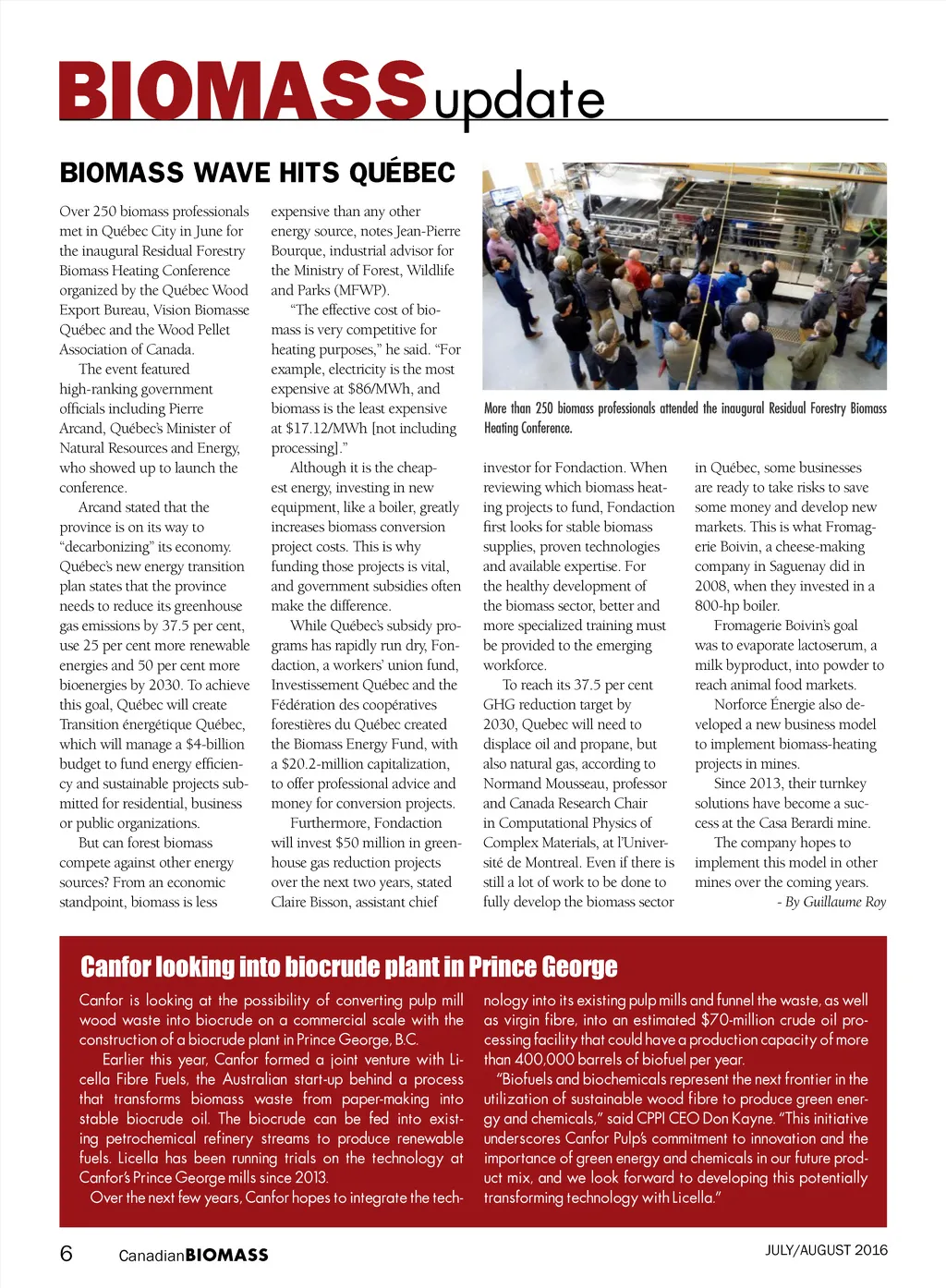
PINNACLE TEMPORARILY HALTS PELLET PRODUCTION IN QUESNEL, B.C. Pinnacle Renewable Energy Inc. has curtailed operations at its Quesnel, B.C., pellet plant. Several factors contributed to the decision to close the plant. One key element was that the plant, first opened in 1988, was designed to process a diet of dry residuals from the local sawmills. “That source of fibre is no longer available,” said Leroy Re-itsma, president of Pinnacle. “As a result, there is currently no secure, sustainable, economically available fibre to support the operation of the Quesnel mill.” The Mountain Pine Beetle infestation has created an in-ventory of standing timber that, while useless as sawlogs, is suitable for wood pellet manufacturing. Pinnacle will continue to work with tenure holders and the provincial government to determine whether secure access to non-sawlog standing timber can be achieved within an eco-nomically viable framework. However, significant capital upgrades are also necessary at the Quesnel plant in order to be able to economically, efficient-ly and safely process this new fibre source into wood pellets. “We believe it makes sense right now to take the time to do the analysis required to determine the scope and feasibility of making those upgrades. This period of curtailment is neces-sary to do that work,” Reitsma said. “We share our employees’ desire for certainty. We have not come to this decision lightly and will be working to minimize the duration of this decision to nine to 10 months.” Pinnacle Renewable Energy Inc. is the longest-established wood pellet producer in Western Canada. Founded in Quesnel in 1988, Pinnacle runs seven pellet plants throughout B.C., producing more than one-and-a-half million tonnes annually, and employing more than 250 people. NEW EXECUTIVE DIRECTOR NAMED FOR BIC Murray McLaughlin has stepped down as the execu-tive director of Bioindustrial Innovation Canada (BIC), but will continue on in the role of government and partner relations. Effective July 1, Sandy Marshall took over the po-sition of executive director. Marshall brings a strong industry background to the role, having spent 30 years in various capacities with Polysar, Bayer, and Lanxess. Marshall has been a member of the BIC board since 2008 and the chairperson for the last three years. Marshall has a strong understanding of the organization and its role. “I am very excited about this opportunity to grow BIC into the future,” Marshall said. “Murray has done an outstanding job as executive director building BIC and I look forward to his contin-ued support and mentor-ship.” Bill White will replace Marshall as chairperson of the BIC board. White is the retired president of Du-Pont Canada and has held a variety of global business unit leadership roles in his 34 years with E.I. DuPont de Nemours. With the recently announced funding for BIC from the province of Ontario, McLaughlin felt it was time for fresh leadership to continue to grow BIC and the portfolio for the Sus-tainable Chemistry Alliance Investment Fund. $76.5M IN FUNDING FOR RENEWABLE FUEL OIL PROJECT The Governments of Canada and Quebec will provide $76.5 million in funding to AE Côte-Nord Canada Bioenergy Inc. for the production of renewable fuel oil from forest residues. Canada’s Minister of Natural Resources, the Honourable Jim Carr, and Laurent Lessard, Quebec’s Minister of Forests, Wildlife and Parks, made the announcement on July 13 in Port-Cartier, Que. The Port-Cartier plant will be the first commercial-scale facil-ity of this kind in Quebec. The goal of the project is to convert forest residues into 40 million litres of renewable fuel oil per year. When upgraded into transportation fuels, this will remove up to 70,000 tonnes of CO 2 -equivalent emissions per year. Pro-duction of renewable fuel oil is set to begin in 2017. The Government of Canada is providing $44.5 million for this project, through a $27-million investment from Sustainable Development Technology Canada and $17.5 million from Natu-ral Resources Canada’s Investments in Forest Industry Transfor-mation program. The Government of Quebec is contributing $32 million to the project, including $10 million from Investissement Québec. To ensure the fibre supply for the project, in March the Quebec Ministry of Forests, Wildlife and Parks reserved 170,000 green tonnes of residues from government forests for the plant. Through an alliance of three companies — Ensyn Bioener-gy Canada, Arbec Forest Products and Rémabec Group — the private sector is demonstrating its substantial involvement with the confirmation of a $27.4-million investment. The project’s renewable fuel oil is a cleaner alternative to con-ventional fossil fuels; it reduces greenhouse gas emissions by 70 to 90 per cent compared with fossil fuels and has a multitude of uses, including for heating and the production of transportation fuels. Source: Natural Resources Canada. Canadian BIOMASS 7
Canadian Biomass July August 2016: Page 7