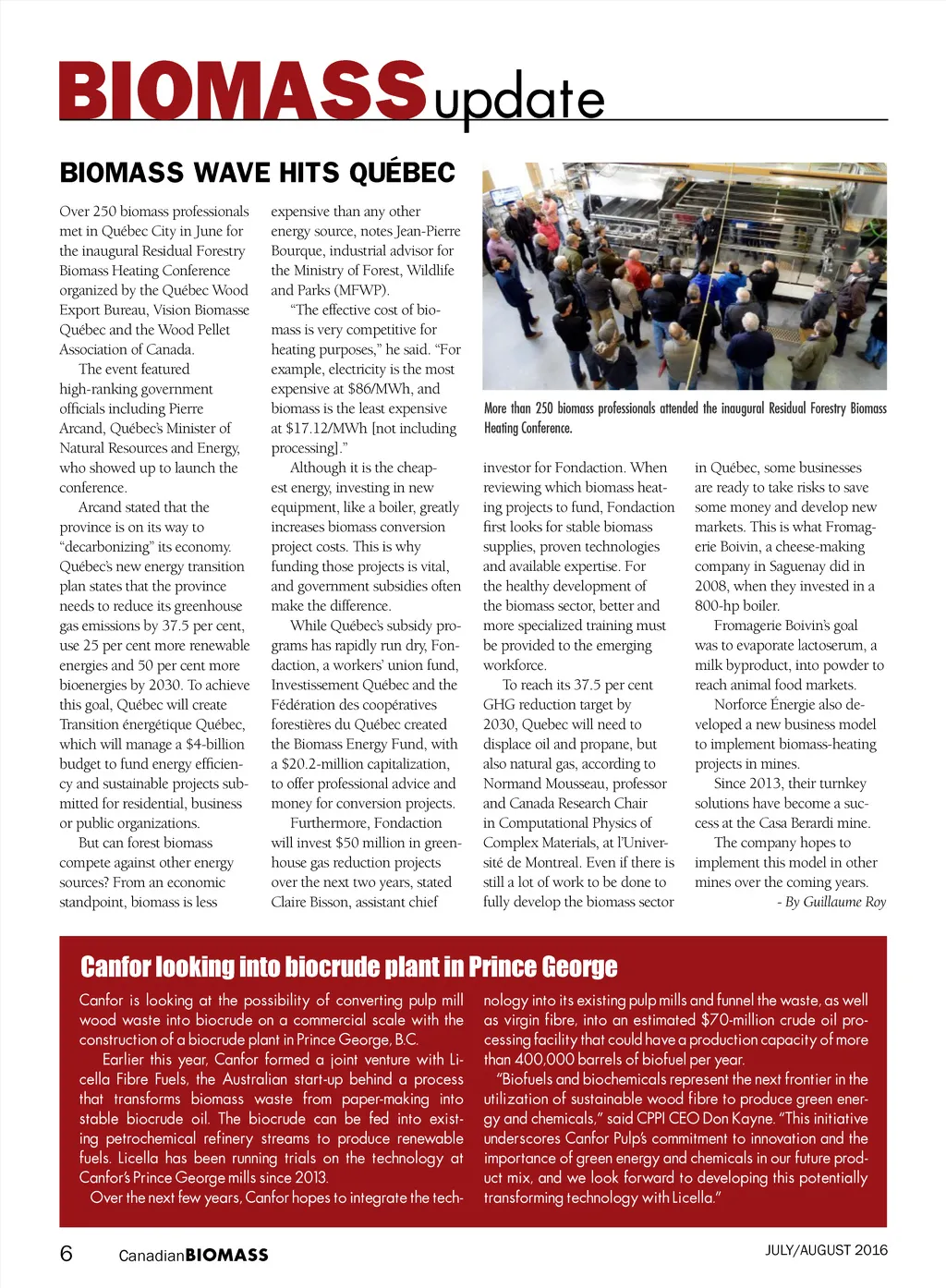
BIOMASS update BIOMASS WAVE HITS QUÉBEC Over 250 biomass professionals met in Québec City in June for the inaugural Residual Forestry Biomass Heating Conference organized by the Québec Wood Export Bureau, Vision Biomasse Québec and the Wood Pellet Association of Canada. The event featured high-ranking government officials including Pierre Arcand, Québec’s Minister of Natural Resources and Energy, who showed up to launch the conference. Arcand stated that the province is on its way to “decarbonizing” its economy. Québec’s new energy transition plan states that the province needs to reduce its greenhouse gas emissions by 37.5 per cent, use 25 per cent more renewable energies and 50 per cent more bioenergies by 2030. To achieve this goal, Québec will create Transition énergétique Québec, which will manage a $4-billion budget to fund energy efficien-cy and sustainable projects sub-mitted for residential, business or public organizations. But can forest biomass compete against other energy sources? From an economic standpoint, biomass is less expensive than any other energy source, notes Jean-Pierre Bourque, industrial advisor for the Ministry of Forest, Wildlife and Parks (MFWP). “The effective cost of bio-mass is very competitive for heating purposes,” he said. “For example, electricity is the most expensive at $86/MWh, and biomass is the least expensive at $17.12/MWh [not including processing].” Although it is the cheap-est energy, investing in new equipment, like a boiler, greatly increases biomass conversion project costs. This is why funding those projects is vital, and government subsidies often make the difference. While Québec’s subsidy pro-grams has rapidly run dry, Fon-daction, a workers’ union fund, Investissement Québec and the Fédération des coopératives forestières du Québec created the Biomass Energy Fund, with a $20.2-million capitalization, to offer professional advice and money for conversion projects. Furthermore, Fondaction will invest $50 million in green-house gas reduction projects over the next two years, stated Claire Bisson, assistant chief More than 250 biomass professionals attended the inaugural Residual Forestry Biomass Heating Conference. investor for Fondaction. When reviewing which biomass heat-ing projects to fund, Fondaction first looks for stable biomass supplies, proven technologies and available expertise. For the healthy development of the biomass sector, better and more specialized training must be provided to the emerging workforce. To reach its 37.5 per cent GHG reduction target by 2030, Quebec will need to displace oil and propane, but also natural gas, according to Normand Mousseau, professor and Canada Research Chair in Computational Physics of Complex Materials, at l’Univer-sité de Montreal. Even if there is still a lot of work to be done to fully develop the biomass sector in Québec, some businesses are ready to take risks to save some money and develop new markets. This is what Fromag-erie Boivin, a cheese-making company in Saguenay did in 2008, when they invested in a 800-hp boiler. Fromagerie Boivin’s goal was to evaporate lactoserum, a milk byproduct, into powder to reach animal food markets. Norforce Énergie also de-veloped a new business model to implement biomass-heating projects in mines. Since 2013, their turnkey solutions have become a suc-cess at the Casa Berardi mine. The company hopes to implement this model in other mines over the coming years. -By Guillaume Roy Canfor looking into biocrude plant in Prince George Canfor is looking at the possibility of converting pulp mill wood waste into biocrude on a commercial scale with the construction of a biocrude plant in Prince George, B.C. Earlier this year, Canfor formed a joint venture with Li-cella Fibre Fuels, the Australian start-up behind a process that transforms biomass waste from paper-making into stable biocrude oil. The biocrude can be fed into exist-ing petrochemical refinery streams to produce renewable fuels. Licella has been running trials on the technology at Canfor’ s Prince George mills since 2013. Over the next few years, Canfor hopes to integrate the tech-nology into its existing pulp mills and funnel the waste, as well as virgin fibre, into an estimated $70-million crude oil pro-cessing facility that could have a production capacity of more than 400,000 barrels of biofuel per year. “Biofuels and biochemicals represent the next frontier in the utilization of sustainable wood fibre to produce green ener-gy and chemicals,” said CPPI CEO Don Kayne. “This initiative underscores Canfor Pulp’ s commitment to innovation and the importance of green energy and chemicals in our future prod-uct mix, and we look forward to developing this potentially transforming technology with Licella.” JULY/AUGUST 2016 6 Canadian BIOMASS
Canadian Biomass July August 2016: Page 6