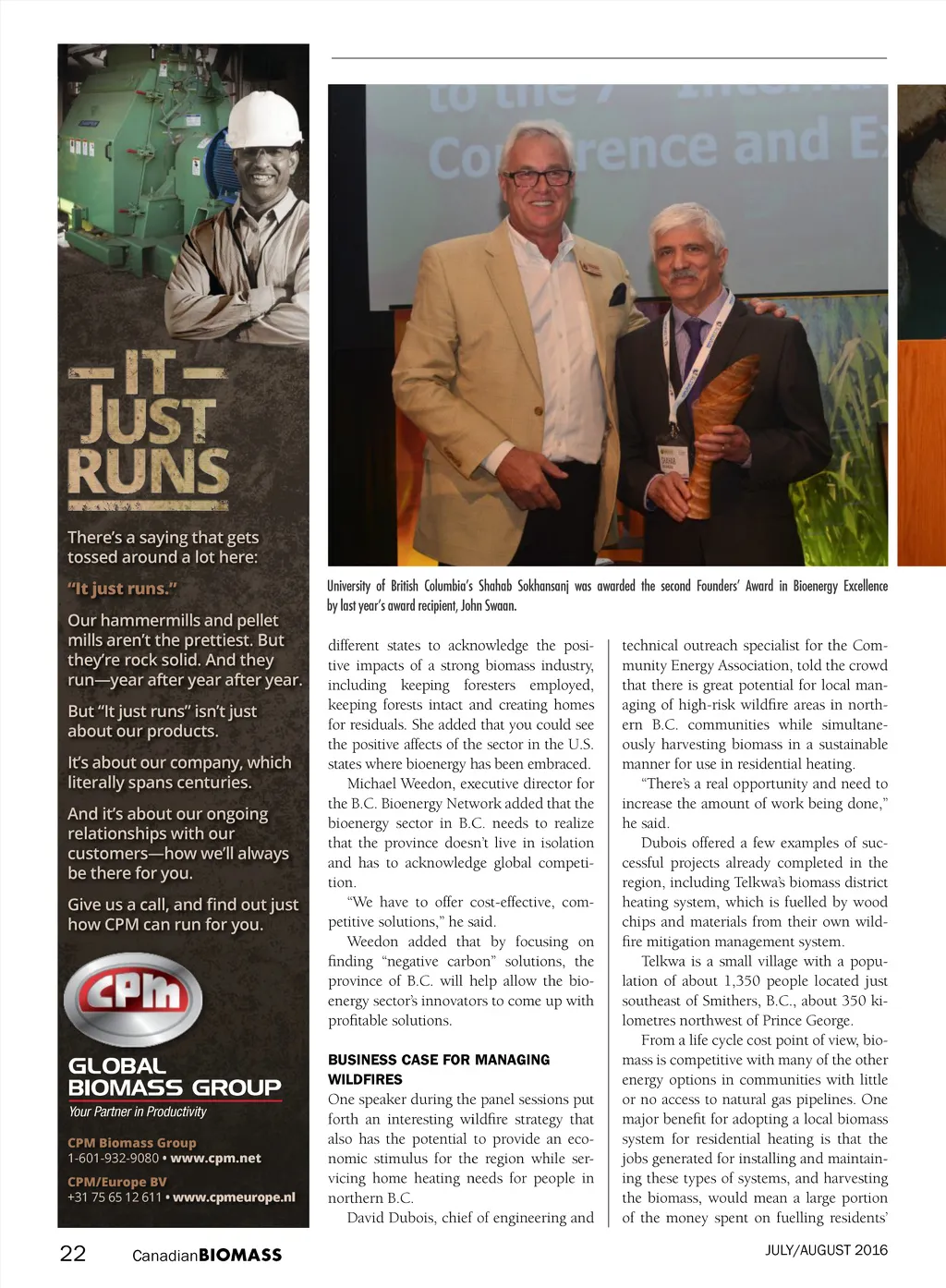
Slant Disc Chippers . . . Industry -preferred design with stable infeed across spout width. Rechippers . . . High capacity and high performance. David Dubois, chief of engineering and technical outreach specialist for the Community Energy Association, discussed the potential for local managing of high-risk wildfire areas in northern B.C. while harvesting biomass for use in residential heating. Whole Log Chippers . . . Robust and long -lived. home heating needs would stay in the local economy. “I think biomass can be a real benefit to rural and remote communities,” he said. Another example of a town that could benefit from this type of system is Sicamous, B.C., which has a high risk of wildfire. DuBois said that after the initial thin-ning for wildfire prevention is performed, the Sicamous area could manage the re-growth of those areas through harvesting for residential heating. He said that area has anywhere from 26,000 to 32,000 tons of biomass available from managing regrowth that could be used as a base case for fuel for a district energy system to supply 80 to 90 per cent of the total heat load with other fuels used for meeting peak heat demand. He added that putting these types of systems in place in remote communities aren’t without their challenges. “The biggest challenge for small com-munities is capacity,” he told the crowd, adding that sorting out ownership of fibre is another issue that needs to be addressed for these types of systems to be successful. PRINCE GEORGE EXPANDS DES Another highlight of the conference was the announcement that Prince George is expanding its district energy system (DES), which fuels many of its downtown build-ings. The expansion will include heating of two more provincial buildings – the province’s courthouse and the Plaza 400 building. The DES, which was fully commis-sioned in 2012, currently reduces annual CO 2 emissions by 1,820 tons a year. Fu-elled mainly by sawmill residuals from the Lakeland Mills sawmill, the DES already generates hot water used for domestic hot water and space heating in the Prince George Civic Centre, City Hall, Prince George Coliseum community arena, Four Seasons Leisure Pool, Prince George Pub-lic Library, Two Rivers Art Gallery, RCMP building and the Wood Innovation and Design Centre. Ninety-six per cent of the energy used in the DES system is supplied by waste heat generated by burning hog fuel from Lakeland Mills, with the remaining power coming from two 2.5MW natural gas back-up boilers that are used when the mill shuts down for maintenance, or if the sys-tem requires additional heat during harsh winter months. For more coverage of IBCE 2016, visit www.canadianbiomassmagazine.ca. • Look to us for chippers that produce: more than 90% acceptable chips few pin chips and overthick chips an increased ratio of large to small accepts chips Web Site: www.acrowood.com Phone: (425) 258 -3555 Fax: (425) 252 -7622 E -mail: [email protected] Excellence in Chip Processing Canadian BIOMASS CBM_Acrowood_JulyAug16_CSA.indd 1 23 2016-07-18 8:35 AM
Canadian Biomass July August 2016: Page 23