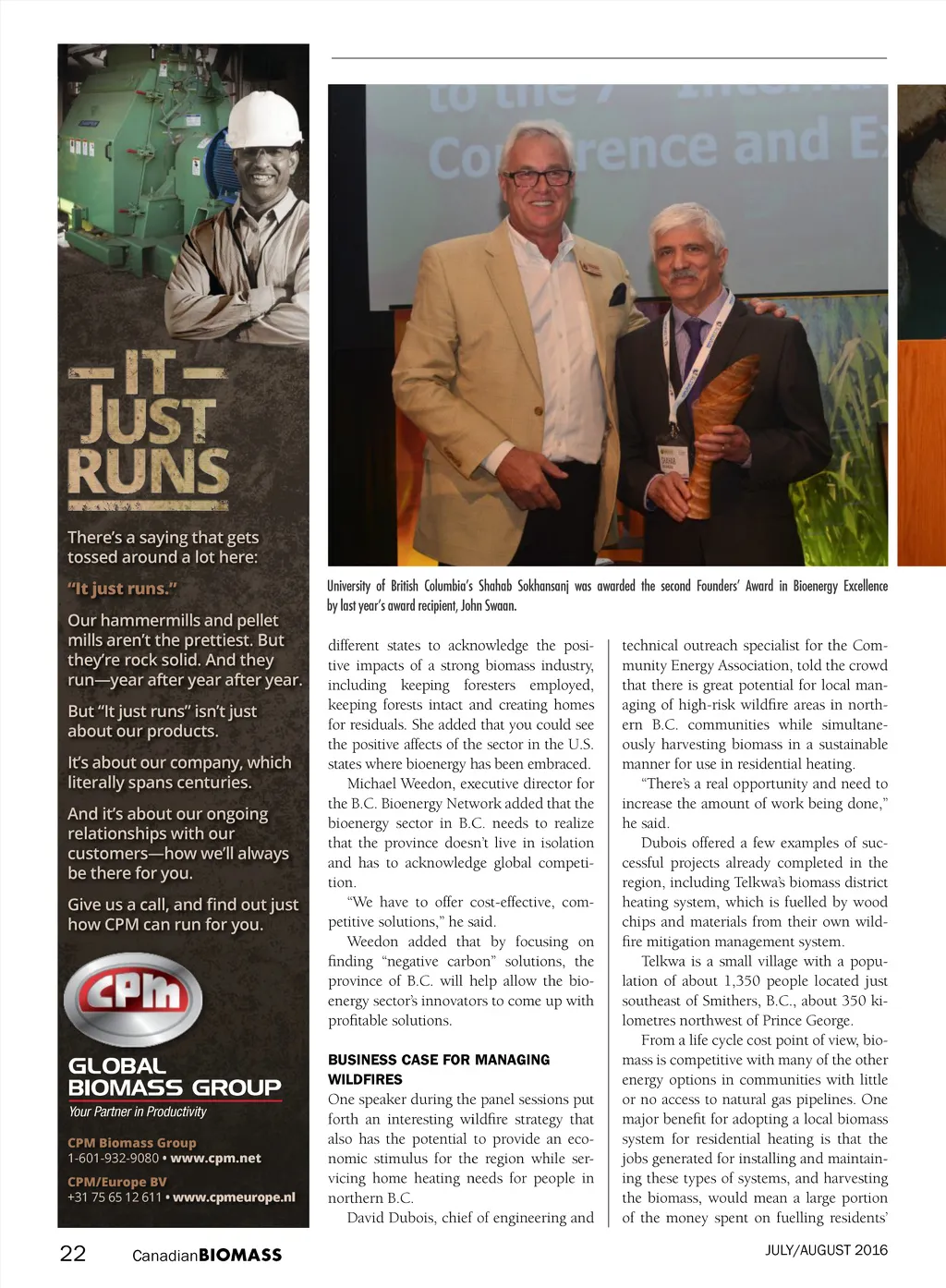
There’s a saying that gets tossed around a lot here: “It just runs.” Our hammermills and pellet mills aren’t the prettiest. But they’re rock solid. And they run—year after year after year. But “It just runs” isn’t just about our products. It’s about our company, which literally spans centuries. And it’s about our ongoing relationships with our customers—how we’ll always be there for you. Give us a call, and find out just how CPM can run for you. University of British Columbia’s Shahab Sokhansanj was awarded the second Founders’ Award in Bioenergy Excellence by last year’s award recipient, John Swaan. different states to acknowledge the posi-tive impacts of a strong biomass industry, including keeping foresters employed, keeping forests intact and creating homes for residuals. She added that you could see the positive affects of the sector in the U.S. states where bioenergy has been embraced. Michael Weedon, executive director for the B.C. Bioenergy Network added that the bioenergy sector in B.C. needs to realize that the province doesn’t live in isolation and has to acknowledge global competi-tion. “We have to offer cost-effective, com-petitive solutions,” he said. Weedon added that by focusing on finding “negative carbon” solutions, the province of B.C. will help allow the bio-energy sector’s innovators to come up with profitable solutions. BUSINESS CASE FOR MANAGING WILDFIRES GLOBAL BIOMASS GROUP Your Partner in Productivity CPM Biomass Group 1-601-932-9080 • www.cpm.net CPM/Europe BV +31 75 65 12 611 • www.cpmeurope.nl One speaker during the panel sessions put forth an interesting wildfire strategy that also has the potential to provide an eco-nomic stimulus for the region while ser-vicing home heating needs for people in northern B.C. David Dubois, chief of engineering and technical outreach specialist for the Com-munity Energy Association, told the crowd that there is great potential for local man-aging of high-risk wildfire areas in north-ern B.C. communities while simultane-ously harvesting biomass in a sustainable manner for use in residential heating. “There’s a real opportunity and need to increase the amount of work being done,” he said. Dubois offered a few examples of suc-cessful projects already completed in the region, including Telkwa’s biomass district heating system, which is fuelled by wood chips and materials from their own wild-fire mitigation management system. Telkwa is a small village with a popu-lation of about 1,350 people located just southeast of Smithers, B.C., about 350 ki-lometres northwest of Prince George. From a life cycle cost point of view, bio-mass is competitive with many of the other energy options in communities with little or no access to natural gas pipelines. One major benefit for adopting a local biomass system for residential heating is that the jobs generated for installing and maintain-ing these types of systems, and harvesting the biomass, would mean a large portion of the money spent on fuelling residents’ JULY/AUGUST 2016 CBM_CPMGlobal_JulyAu16_CSA.indd 1 Client: CPM Biomass BIOMASS Publication: Canadian Canadian Biomass Order: 828 Line: 3 22 2016-07-18 11:37 AM
Canadian Biomass July August 2016: Page 22