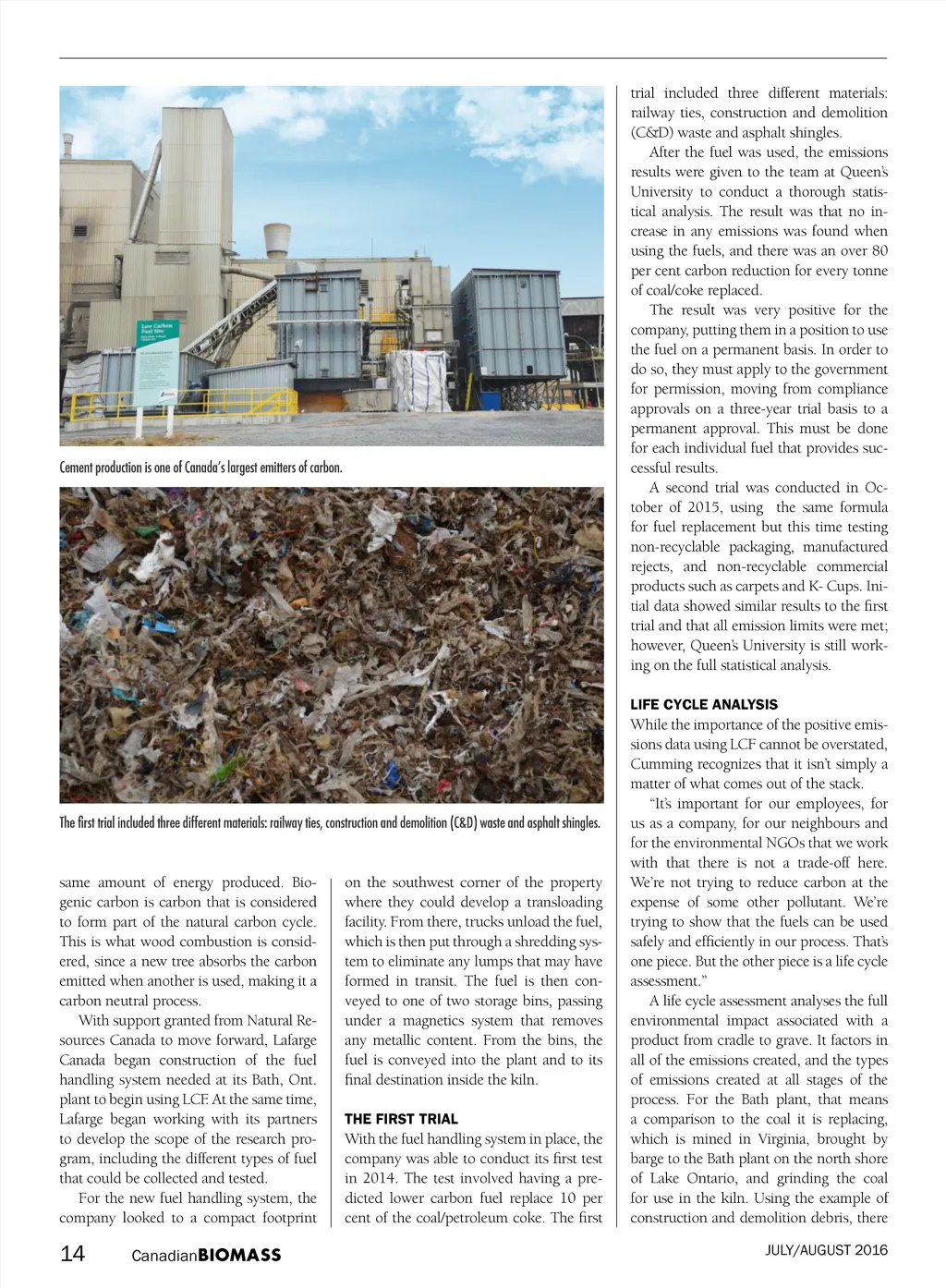
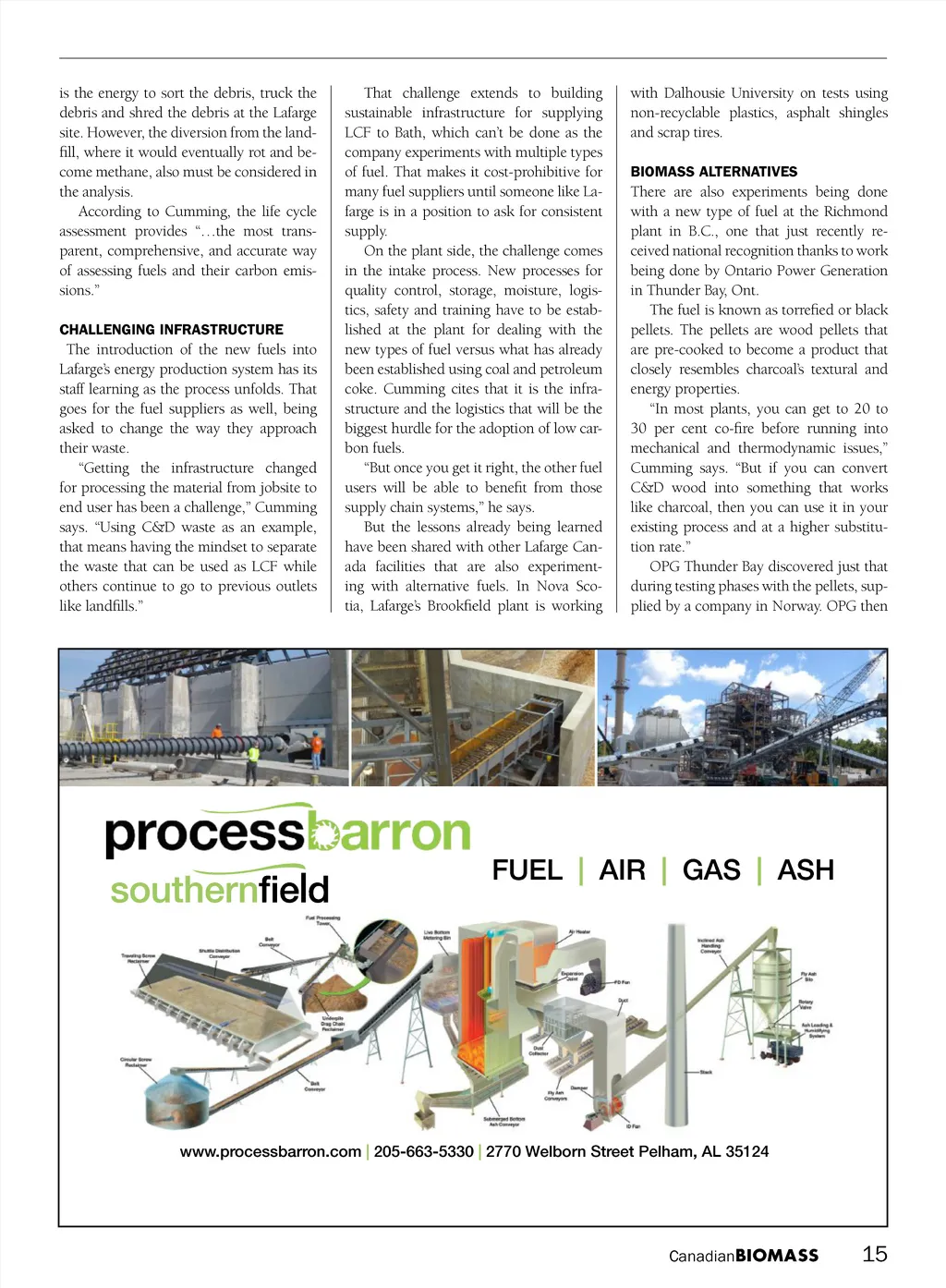
Cement production is one of Canada’s largest emitters of carbon. trial included three different materials: railway ties, construction and demolition (C&D) waste and asphalt shingles. After the fuel was used, the emissions results were given to the team at Queen’s University to conduct a thorough statis-tical analysis. The result was that no in-crease in any emissions was found when using the fuels, and there was an over 80 per cent carbon reduction for every tonne of coal/coke replaced. The result was very positive for the company, putting them in a position to use the fuel on a permanent basis. In order to do so, they must apply to the government for permission, moving from compliance approvals on a three-year trial basis to a permanent approval. This must be done for each individual fuel that provides suc-cessful results. A second trial was conducted in Oc-tober of 2015, using the same formula for fuel replacement but this time testing non-recyclable packaging, manufactured rejects, and non-recyclable commercial products such as carpets and K-Cups. Ini-tial data showed similar results to the first trial and that all emission limits were met; however, Queen’s University is still work-ing on the full statistical analysis. LIFE CYCLE ANALYSIS The first trial included three different materials: railway ties, construction and demolition (C&D) waste and asphalt shingles. same amount of energy produced. Bio-genic carbon is carbon that is considered to form part of the natural carbon cycle. This is what wood combustion is consid-ered, since a new tree absorbs the carbon emitted when another is used, making it a carbon neutral process. With support granted from Natural Re-sources Canada to move forward, Lafarge Canada began construction of the fuel handling system needed at its Bath, Ont. plant to begin using LCF . At the same time, Lafarge began working with its partners to develop the scope of the research pro-gram, including the different types of fuel that could be collected and tested. For the new fuel handling system, the company looked to a compact footprint on the southwest corner of the property where they could develop a transloading facility. From there, trucks unload the fuel, which is then put through a shredding sys-tem to eliminate any lumps that may have formed in transit. The fuel is then con-veyed to one of two storage bins, passing under a magnetics system that removes any metallic content. From the bins, the fuel is conveyed into the plant and to its final destination inside the kiln. THE FIRST TRIAL With the fuel handling system in place, the company was able to conduct its first test in 2014. The test involved having a pre-dicted lower carbon fuel replace 10 per cent of the coal/petroleum coke. The first While the importance of the positive emis-sions data using LCF cannot be overstated, Cumming recognizes that it isn’t simply a matter of what comes out of the stack. “It’s important for our employees, for us as a company, for our neighbours and for the environmental NGOs that we work with that there is not a trade-off here. We’re not trying to reduce carbon at the expense of some other pollutant. We’re trying to show that the fuels can be used safely and efficiently in our process. That’s one piece. But the other piece is a life cycle assessment.” A life cycle assessment analyses the full environmental impact associated with a product from cradle to grave. It factors in all of the emissions created, and the types of emissions created at all stages of the process. For the Bath plant, that means a comparison to the coal it is replacing, which is mined in Virginia, brought by barge to the Bath plant on the north shore of Lake Ontario, and grinding the coal for use in the kiln. Using the example of construction and demolition debris, there JULY/AUGUST 2016 14 Canadian BIOMASS
Canadian Biomass July August 2016: Page 14