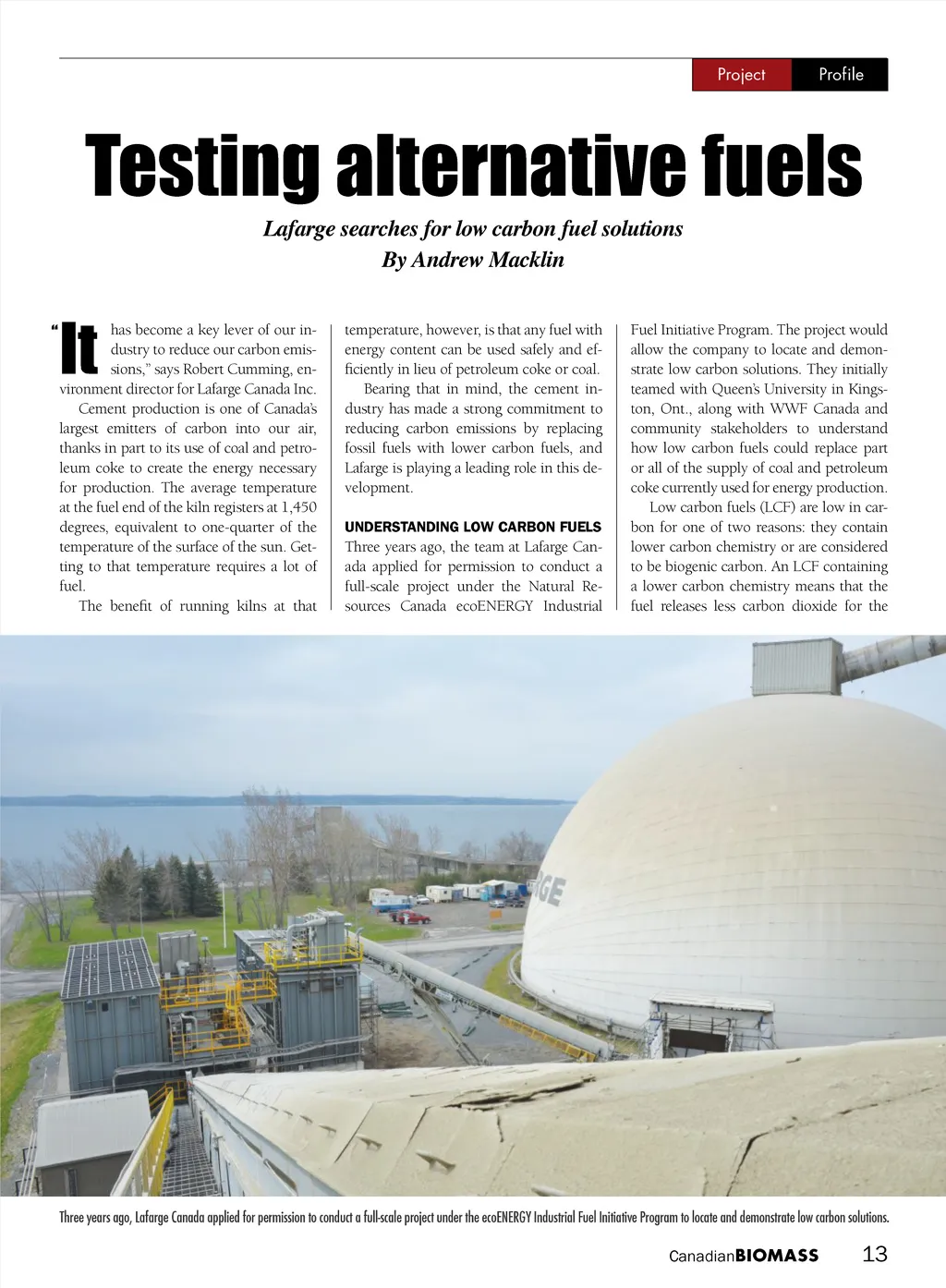
Project Profile Testing alternative fuels Lafarge searches for low carbon fuel solutions By Andrew Macklin temperature, however, is that any fuel with energy content can be used safely and ef-ficiently in lieu of petroleum coke or coal. Bearing that in mind, the cement in-dustry has made a strong commitment to reducing carbon emissions by replacing fossil fuels with lower carbon fuels, and Lafarge is playing a leading role in this de-velopment. UNDERSTANDING LOW CARBON FUELS “ has become a key lever of our in-dustry to reduce our carbon emis-sions,” says Robert Cumming, en-vironment director for Lafarge Canada Inc. Cement production is one of Canada’s largest emitters of carbon into our air, thanks in part to its use of coal and petro-leum coke to create the energy necessary for production. The average temperature at the fuel end of the kiln registers at 1,450 degrees, equivalent to one-quarter of the temperature of the surface of the sun. Get-ting to that temperature requires a lot of fuel. The benefit of running kilns at that It Three years ago, the team at Lafarge Can-ada applied for permission to conduct a full-scale project under the Natural Re-sources Canada ecoENERGY Industrial Fuel Initiative Program. The project would allow the company to locate and demon-strate low carbon solutions. They initially teamed with Queen’s University in Kings-ton, Ont., along with WWF Canada and community stakeholders to understand how low carbon fuels could replace part or all of the supply of coal and petroleum coke currently used for energy production. Low carbon fuels (LCF) are low in car-bon for one of two reasons: they contain lower carbon chemistry or are considered to be biogenic carbon. An LCF containing a lower carbon chemistry means that the fuel releases less carbon dioxide for the Three years ago, Lafarge Canada applied for permission to conduct a full-scale project under the ecoENERGY Industrial Fuel Initiative Program to locate and demonstrate low carbon solutions. Canadian BIOMASS 13
Canadian Biomass July August 2016: Page 13