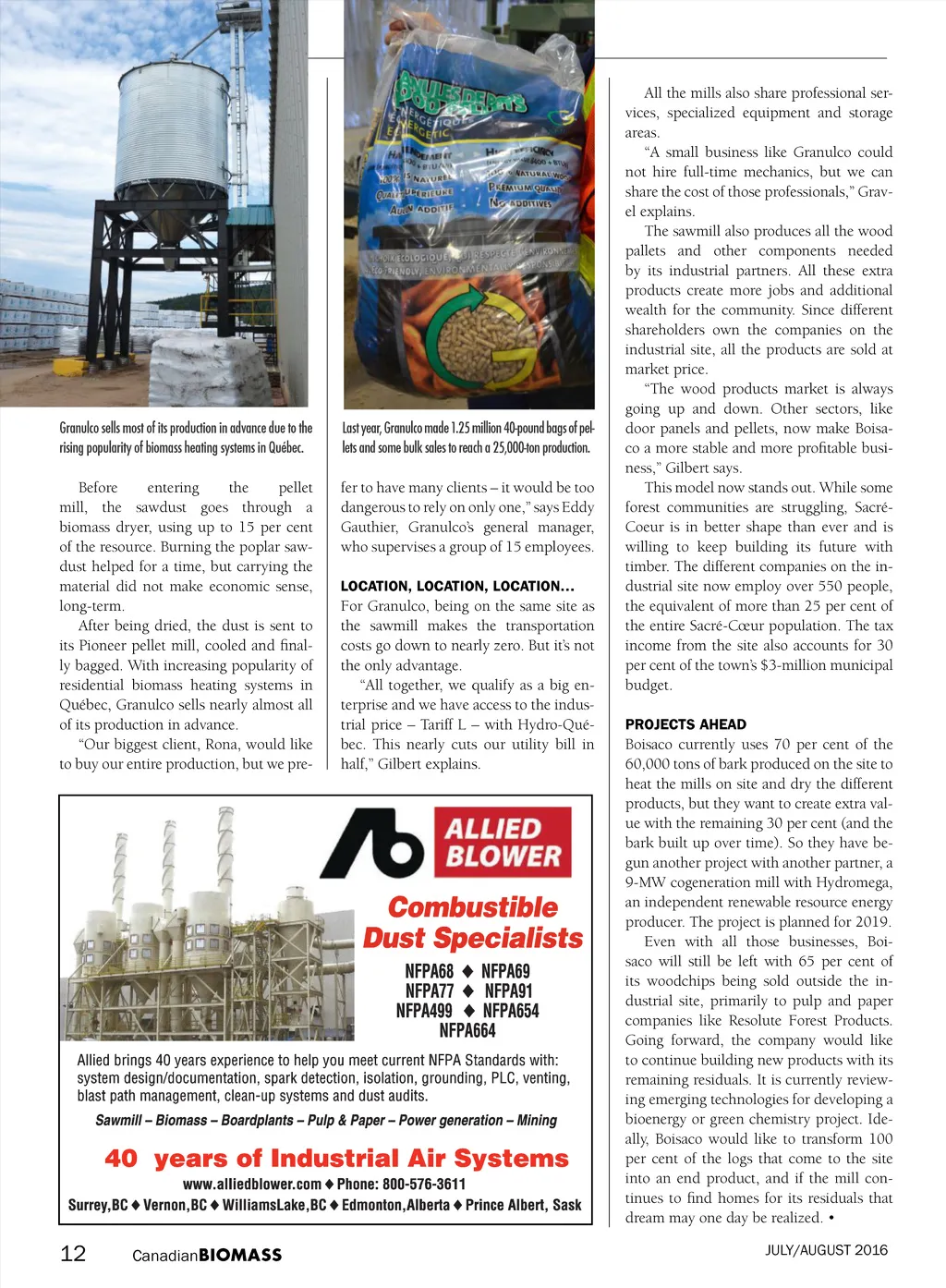
Granulco sells most of its production in advance due to the rising popularity of biomass heating systems in Québec. Last year, Granulco made 1.25 million 40-pound bags of pel-lets and some bulk sales to reach a 25,000-ton production. Before entering the pellet mill, the sawdust goes through a biomass dryer, using up to 15 per cent of the resource. Burning the poplar saw-dust helped for a time, but carrying the material did not make economic sense, long-term. After being dried, the dust is sent to its Pioneer pellet mill, cooled and final-ly bagged. With increasing popularity of residential biomass heating systems in Québec, Granulco sells nearly almost all of its production in advance. “Our biggest client, Rona, would like to buy our entire production, but we pre-fer to have many clients – it would be too dangerous to rely on only one,” says Eddy Gauthier, Granulco’s general manager, who supervises a group of 15 employees. LOCATION, LOCATION, LOCATION… For Granulco, being on the same site as the sawmill makes the transportation costs go down to nearly zero. But it’s not the only advantage. “All together, we qualify as a big en-terprise and we have access to the indus-trial price – Tariff L – with Hydro-Qué-bec. This nearly cuts our utility bill in half,” Gilbert explains. All the mills also share professional ser-vices, specialized equipment and storage areas. “A small business like Granulco could not hire full-time mechanics, but we can share the cost of those professionals,” Grav-el explains. The sawmill also produces all the wood pallets and other components needed by its industrial partners. All these extra products create more jobs and additional wealth for the community. Since different shareholders own the companies on the industrial site, all the products are sold at market price. “The wood products market is always going up and down. Other sectors, like door panels and pellets, now make Boisa-co a more stable and more profitable busi-ness,” Gilbert says. This model now stands out. While some forest communities are struggling, Sacré-Coeur is in better shape than ever and is willing to keep building its future with timber. The different companies on the in-dustrial site now employ over 550 people, the equivalent of more than 25 per cent of the entire Sacré-Cœur population. The tax income from the site also accounts for 30 per cent of the town’s $3-million municipal budget. PROJECTS AHEAD Boisaco currently uses 70 per cent of the 60,000 tons of bark produced on the site to heat the mills on site and dry the different products, but they want to create extra val-ue with the remaining 30 per cent (and the bark built up over time). So they have be-gun another project with another partner, a 9-MW cogeneration mill with Hydromega, an independent renewable resource energy producer. The project is planned for 2019. Even with all those businesses, Boi-saco will still be left with 65 per cent of its woodchips being sold outside the in-dustrial site, primarily to pulp and paper companies like Resolute Forest Products. Going forward, the company would like to continue building new products with its remaining residuals. It is currently review-ing emerging technologies for developing a bioenergy or green chemistry project. Ide-ally, Boisaco would like to transform 100 per cent of the logs that come to the site into an end product, and if the mill con-tinues to find homes for its residuals that dream may one day be realized. • JULY/AUGUST 2016 12 Canadian BIOMASS 2014-11-18 2:22 PM allied blower biomass novdec14.indd 1
Canadian Biomass July August 2016: Page 12