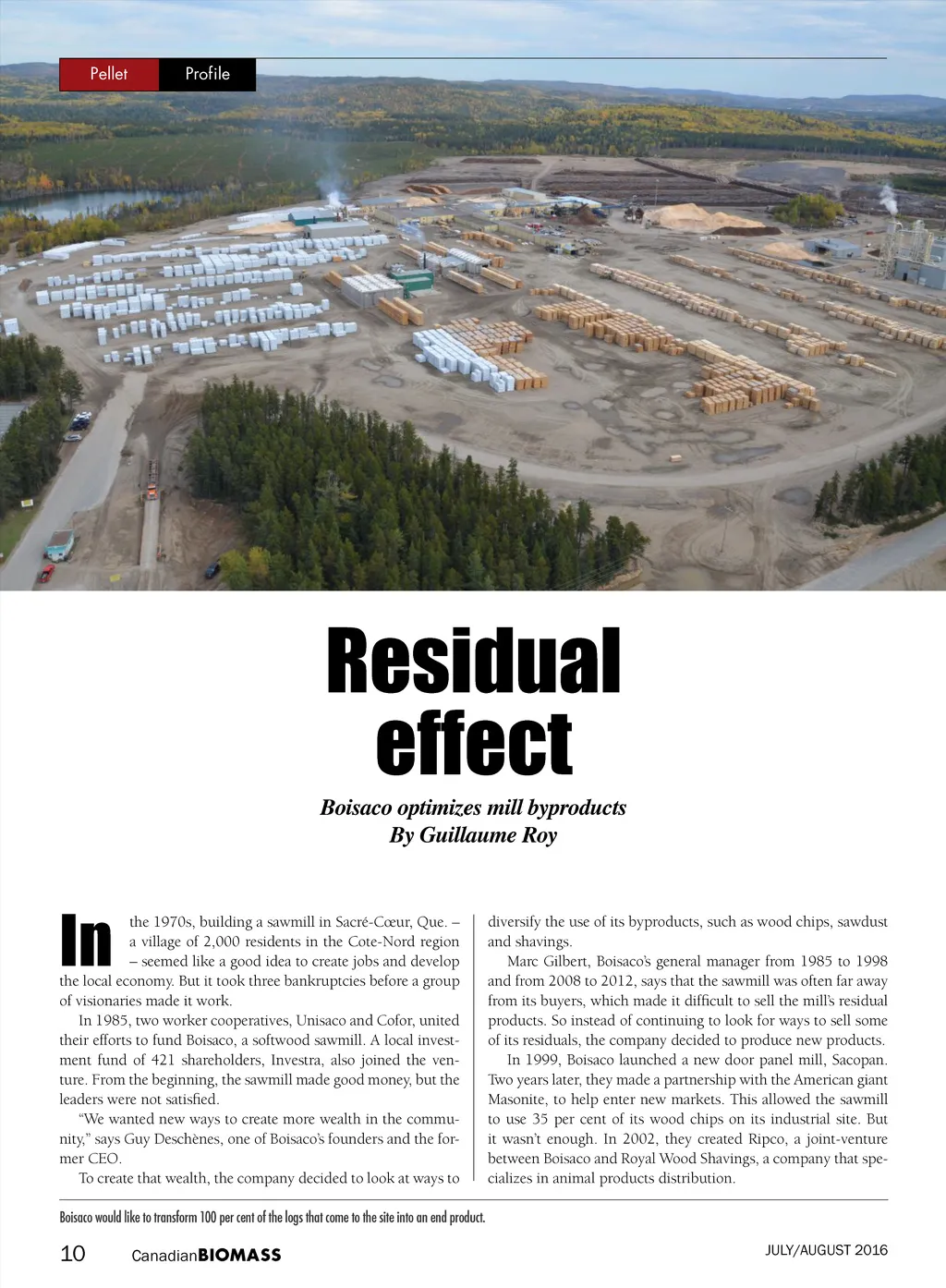
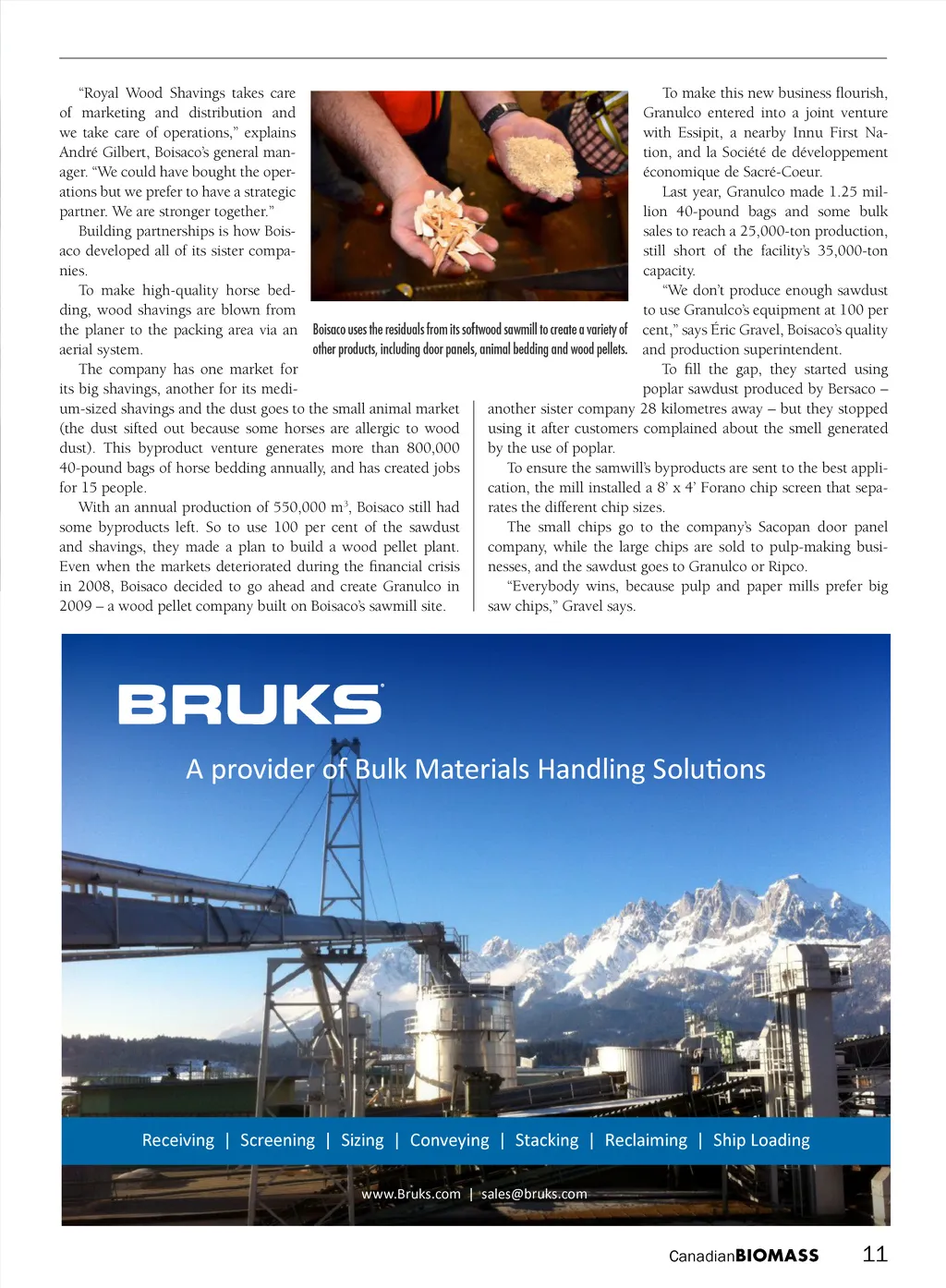
Pellet Profile Boisaco optimizes mill byproducts By Guillaume Roy Residual effect the 1970s, building a sawmill in Sacré-Cœur, Que. – a village of 2,000 residents in the Cote-Nord region – seemed like a good idea to create jobs and develop the local economy. But it took three bankruptcies before a group of visionaries made it work. In 1985, two worker cooperatives, Unisaco and Cofor, united their efforts to fund Boisaco, a softwood sawmill. A local invest-ment fund of 421 shareholders, Investra, also joined the ven-ture. From the beginning, the sawmill made good money, but the leaders were not satisfied. “We wanted new ways to create more wealth in the commu-nity,” says Guy Deschènes, one of Boisaco’s founders and the for-mer CEO. To create that wealth, the company decided to look at ways to Boisaco would like to transform 100 per cent of the logs that come to the site into an end product. In diversify the use of its byproducts, such as wood chips, sawdust and shavings. Marc Gilbert, Boisaco’s general manager from 1985 to 1998 and from 2008 to 2012, says that the sawmill was often far away from its buyers, which made it difficult to sell the mill’s residual products. So instead of continuing to look for ways to sell some of its residuals, the company decided to produce new products. In 1999, Boisaco launched a new door panel mill, Sacopan. Two years later, they made a partnership with the American giant Masonite, to help enter new markets. This allowed the sawmill to use 35 per cent of its wood chips on its industrial site. But it wasn’t enough. In 2002, they created Ripco, a joint-venture between Boisaco and Royal Wood Shavings, a company that spe-cializes in animal products distribution. 10 Canadian BIOMASS JULY/AUGUST 2016
Canadian Biomass July August 2016: Page 10