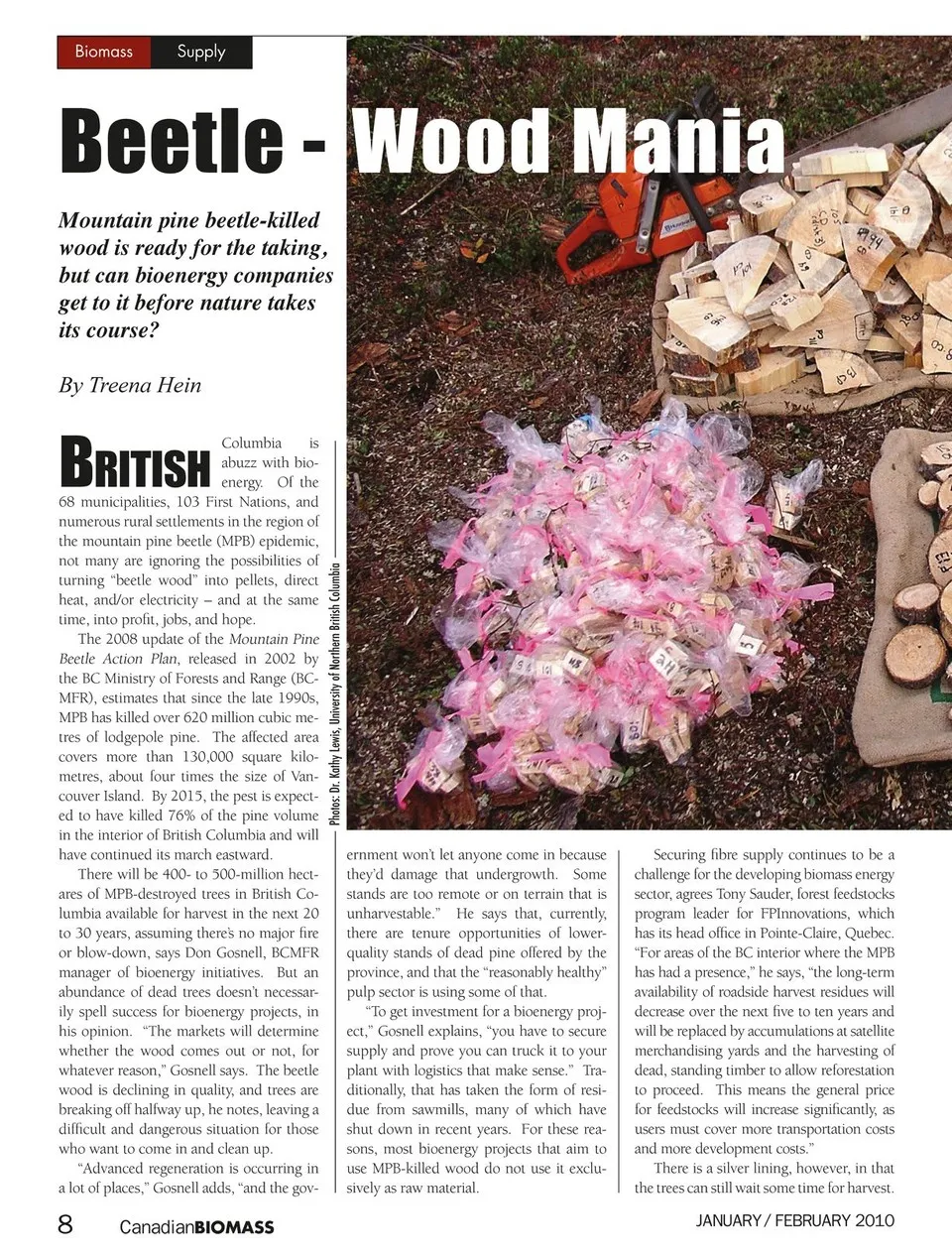
Biomass Supply Beetle - Wood Mania Mountain pine beetle-killed wood is ready for the taking, but can bioenergy companies get to it before nature takes its course? By Treena Hein 68 municipalities, 103 First Nations, and numerous rural settlements in the region of the mountain pine beetle (MPB) epidemic, not many are ignoring the possibilities of turning “beetle wood” into pellets, direct heat, and/or electricity – and at the same time, into profit, jobs, and hope. The 2008 update of the Mountain Pine British Beetle Action Plan, released in 2002 by the BC Ministry of Forests and Range (BC- MFR), estimates that since the late 1990s, MPB has killed over 620 million cubic me- tres of lodgepole pine. The affected area covers more than 130,000 square kilo- metres, about four times the size of Van- couver Island. By 2015, the pest is expect- ed to have killed 76% of the pine volume in the interior of British Columbia and will have continued its march eastward. There will be 400- to 500-million hect- ares of MPB-destroyed trees in British Co- lumbia available for harvest in the next 20 to 30 years, assuming there’s no major fire or blow-down, says Don Gosnell, BCMFR manager of bioenergy initiatives. But an abundance of dead trees doesn’t necessar- ily spell success for bioenergy projects, in his opinion. “The markets will determine whether the wood comes out or not, for whatever reason,” Gosnell says. The beetle wood is declining in quality, and trees are breaking off halfway up, he notes, leaving a difficult and dangerous situation for those who want to come in and clean up. “Advanced regeneration is occurring in a lot of places,” Gosnell adds, “and the gov- 8 CanadianBIOMASS Columbia is abuzz with bio- energy. Of the ernment won’t let anyone come in because they’d damage that undergrowth. Some stands are too remote or on terrain that is unharvestable.” He says that, currently, there are tenure opportunities of lower- quality stands of dead pine offered by the province, and that the “reasonably healthy” pulp sector is using some of that. “To get investment for a bioenergy proj- ect,” Gosnell explains, “you have to secure supply and prove you can truck it to your plant with logistics that make sense.” Tra- ditionally, that has taken the form of resi- due from sawmills, many of which have shut down in recent years. For these rea- sons, most bioenergy projects that aim to use MPB-killed wood do not use it exclu- sively as raw material. Securing fibre supply continues to be a challenge for the developing biomass energy sector, agrees Tony Sauder, forest feedstocks program leader for FPInnovations, which has its head office in Pointe-Claire, Quebec. “For areas of the BC interior where the MPB has had a presence,” he says, “the long-term availability of roadside harvest residues will decrease over the next five to ten years and will be replaced by accumulations at satellite merchandising yards and the harvesting of dead, standing timber to allow reforestation to proceed. This means the general price for feedstocks will increase significantly, as users must cover more transportation costs and more development costs.” There is a silver lining, however, in that the trees can still wait some time for harvest. JANUARY/ FEBRUARY 2010 Photos: Dr. Kathy Lewis, University of Northern British Columbia
Canadian Biomass January/February 2010: Page 8