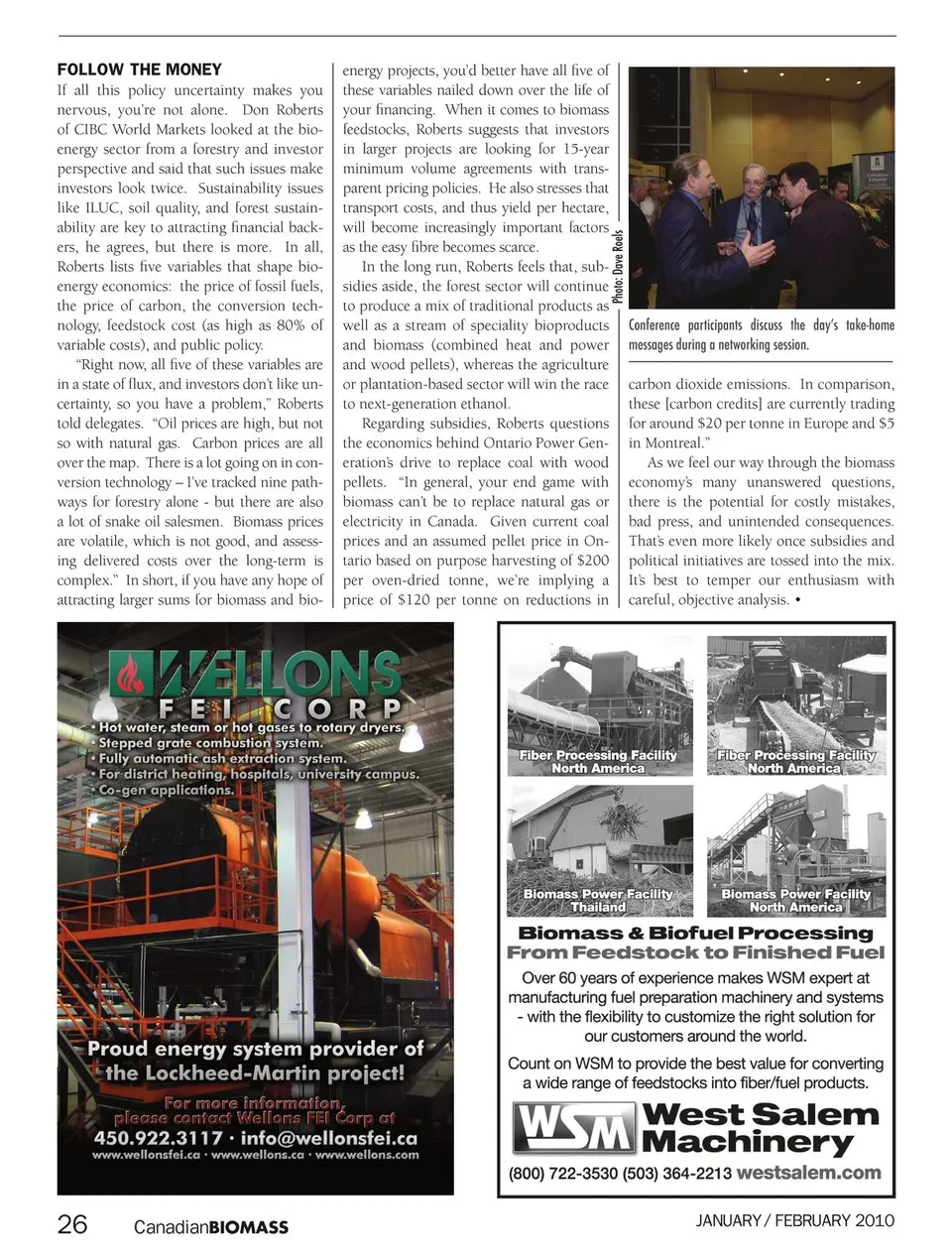
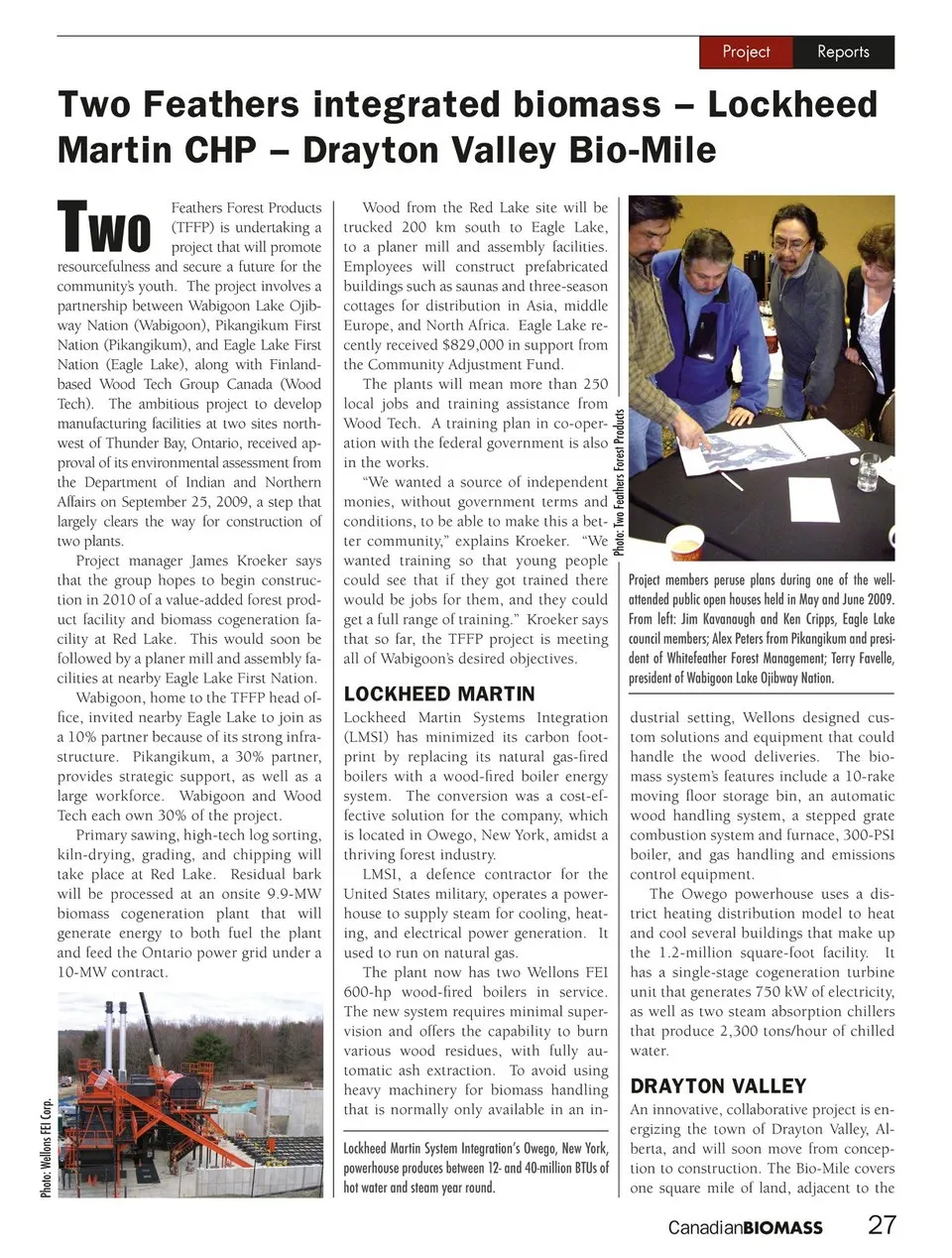
Project Reports two feathers integrated biomass – lockheed martin cHp – drayton valley bio-mile Wood from the Red Lake site will be two Feathers Forest Products (TFFP) is undertaking a project that will promote resourcefulness and secure a future for the community’s youth. The project involves a partnership between Wabigoon Lake Ojib- way Nation (Wabigoon), Pikangikum First Nation (Pikangikum), and Eagle Lake First Nation (Eagle Lake), along with Finland- based Wood Tech Group Canada (Wood Tech). The ambitious project to develop manufacturing facilities at two sites north- west of Thunder Bay, Ontario, received ap- proval of its environmental assessment from the Department of Indian and Northern Affairs on September 25, 2009, a step that largely clears the way for construction of two plants. Project manager James Kroeker says that the group hopes to begin construc- tion in 2010 of a value-added forest prod- uct facility and biomass cogeneration fa- cility at Red Lake. This would soon be followed by a planer mill and assembly fa- cilities at nearby Eagle Lake First Nation. Wabigoon, home to the TFFP head of- fice, invited nearby Eagle Lake to join as a 10% partner because of its strong infra- structure. Pikangikum, a 30% partner, provides strategic support, as well as a large workforce. Wabigoon and Wood Tech each own 30% of the project. Primary sawing, high-tech log sorting, kiln-drying, grading, and chipping will take place at Red Lake. Residual bark will be processed at an onsite 9.9-MW biomass cogeneration plant that will generate energy to both fuel the plant and feed the Ontario power grid under a 10-MW contract. trucked 200 km south to Eagle Lake, to a planer mill and assembly facilities. Employees will construct prefabricated buildings such as saunas and three-season cottages for distribution in Asia, middle Europe, and North Africa. Eagle Lake re- cently received $829,000 in support from the Community Adjustment Fund. The plants will mean more than 250 local jobs and training assistance from Wood Tech. A training plan in co-oper- ation with the federal government is also in the works. “We wanted a source of independent monies, without government terms and conditions, to be able to make this a bet- ter community,” explains Kroeker. “We wanted training so that young people could see that if they got trained there would be jobs for them, and they could get a full range of training.” Kroeker says that so far, the TFFP project is meeting all of Wabigoon’s desired objectives. lockHeed martin Lockheed Martin Systems Integration (LMSI) has minimized its carbon foot- print by replacing its natural gas-fired boilers with a wood-fired boiler energy system. The conversion was a cost-ef- fective solution for the company, which is located in Owego, New York, amidst a thriving forest industry. LMSI, a defence contractor for the United States military, operates a power- house to supply steam for cooling, heat- ing, and electrical power generation. It used to run on natural gas. The plant now has two Wellons FEI 600-hp wood-fired boilers in service. The new system requires minimal super- vision and offers the capability to burn various wood residues, with fully au- tomatic ash extraction. To avoid using heavy machinery for biomass handling that is normally only available in an in- Lockheed Martin System Integration’s Owego, New York, powerhouse produces between 12- and 40-million BTUs of hot water and steam year round. Project members peruse plans during one of the well- attended public open houses held in May and June 2009. From left: Jim Kavanaugh and Ken Cripps, Eagle Lake council members; Alex Peters from Pikangikum and presi- dent of Whitefeather Forest Management; Terry Favelle, president of Wabigoon Lake Ojibway Nation. dustrial setting, Wellons designed cus- tom solutions and equipment that could handle the wood deliveries. The bio- mass system’s features include a 10-rake moving floor storage bin, an automatic wood handling system, a stepped grate combustion system and furnace, 300-PSI boiler, and gas handling and emissions control equipment. The Owego powerhouse uses a dis- trict heating distribution model to heat and cool several buildings that make up the 1.2-million square-foot facility. It has a single-stage cogeneration turbine unit that generates 750 kW of electricity, as well as two steam absorption chillers that produce 2,300 tons/hour of chilled water. drayton valley An innovative, collaborative project is en- ergizing the town of Drayton Valley, Al- berta, and will soon move from concep- tion to construction. The Bio-Mile covers one square mile of land, adjacent to the CanadianBIOMASS 27 Photo: Wellons FEI Corp. Photo: Two Feathers Forest Products
Canadian Biomass January/February 2010: Page 27