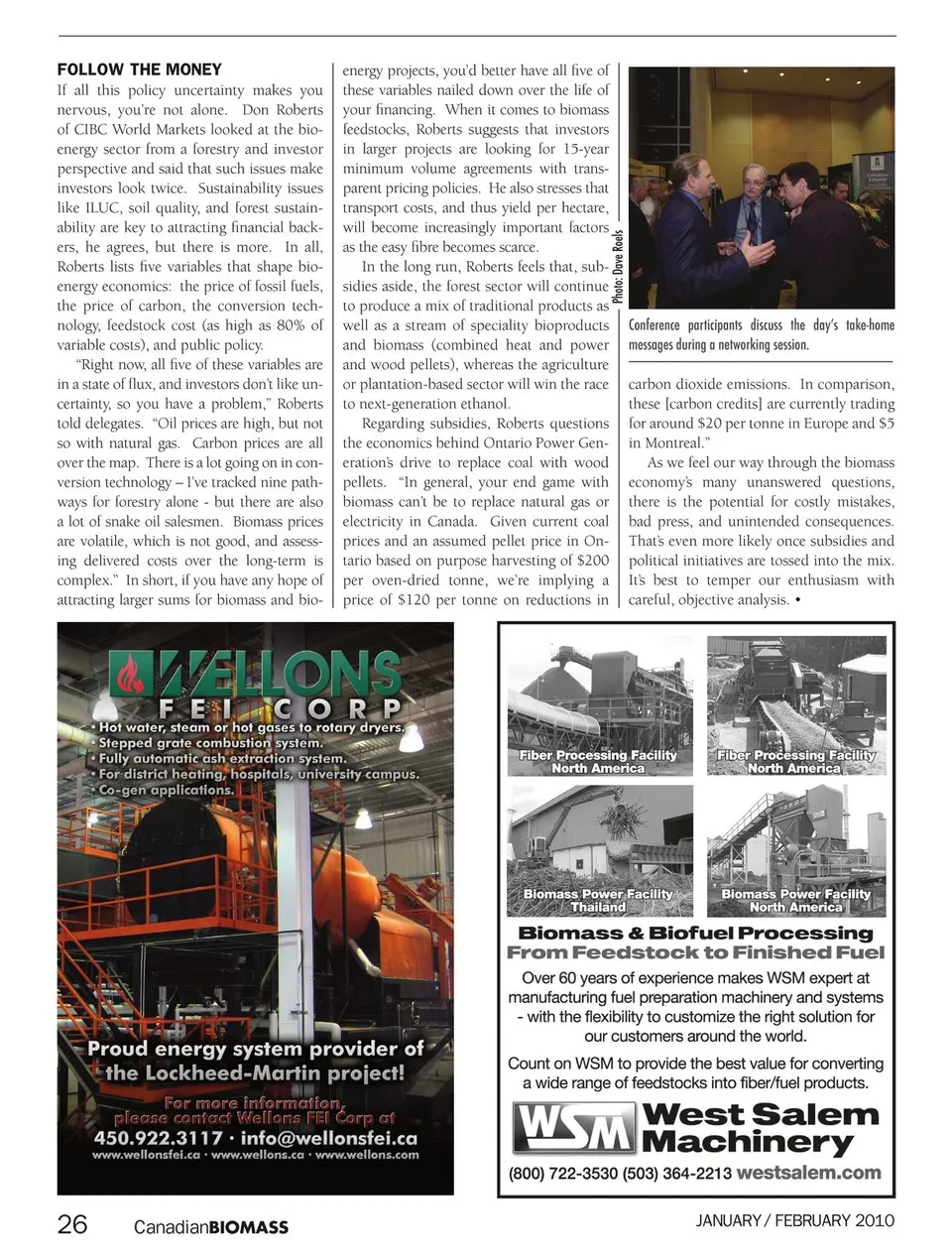
folloW tHe money If all this policy uncertainty makes you nervous, you’re not alone. Don Roberts of CIBC World Markets looked at the bio- energy sector from a forestry and investor perspective and said that such issues make investors look twice. Sustainability issues like ILUC, soil quality, and forest sustain- ability are key to attracting financial back- ers, he agrees, but there is more. In all, Roberts lists five variables that shape bio- energy economics: the price of fossil fuels, the price of carbon, the conversion tech- nology, feedstock cost (as high as 80% of variable costs), and public policy. “Right now, all five of these variables are in a state of flux, and investors don’t like un- certainty, so you have a problem,” Roberts told delegates. “Oil prices are high, but not so with natural gas. Carbon prices are all over the map. There is a lot going on in con- version technology – I’ve tracked nine path- ways for forestry alone - but there are also a lot of snake oil salesmen. Biomass prices are volatile, which is not good, and assess- ing delivered costs over the long-term is complex.” In short, if you have any hope of attracting larger sums for biomass and bio- energy projects, you’d better have all five of these variables nailed down over the life of your financing. When it comes to biomass feedstocks, Roberts suggests that investors in larger projects are looking for 15-year minimum volume agreements with trans- parent pricing policies. He also stresses that transport costs, and thus yield per hectare, will become increasingly important factors as the easy fibre becomes scarce. In the long run, Roberts feels that, sub- sidies aside, the forest sector will continue to produce a mix of traditional products as well as a stream of speciality bioproducts and biomass (combined heat and power and wood pellets), whereas the agriculture or plantation-based sector will win the race to next-generation ethanol. Regarding subsidies, Roberts questions the economics behind Ontario Power Gen- eration’s drive to replace coal with wood pellets. “In general, your end game with biomass can’t be to replace natural gas or electricity in Canada. Given current coal prices and an assumed pellet price in On- tario based on purpose harvesting of $200 per oven-dried tonne, we’re implying a price of $120 per tonne on reductions in Conference participants discuss the day’s take-home messages during a networking session. carbon dioxide emissions. In comparison, these [carbon credits] are currently trading for around $20 per tonne in Europe and $5 in Montreal.” As we feel our way through the biomass economy’s many unanswered questions, there is the potential for costly mistakes, bad press, and unintended consequences. That’s even more likely once subsidies and political initiatives are tossed into the mix. It’s best to temper our enthusiasm with careful, objective analysis. • 26 CanadianBIOMASS JANUARY/ FEBRUARY 2010 Photo: Dave Roels
Canadian Biomass January/February 2010: Page 26