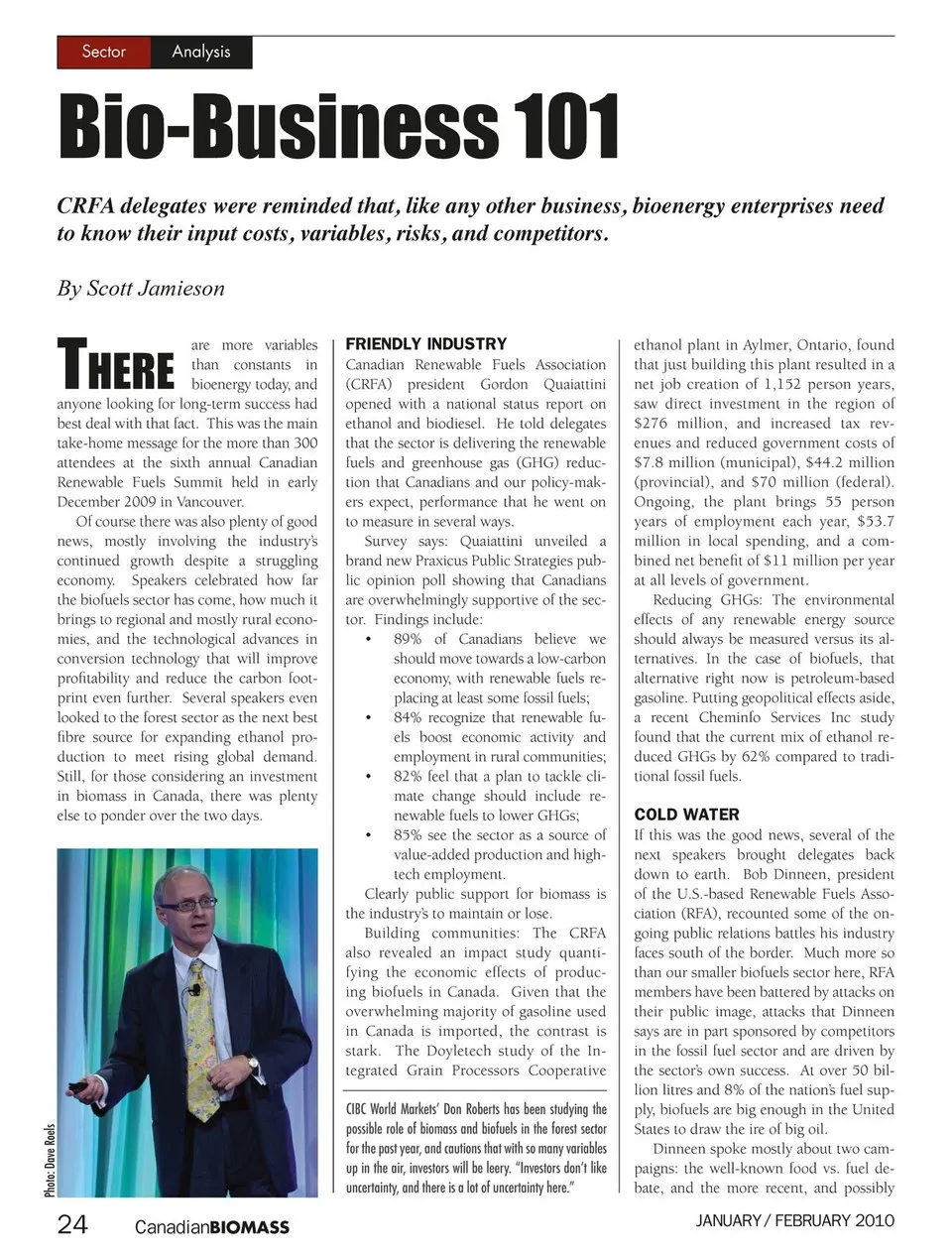
Sector Analysis Bio-Business 101 CRFAdelegates were reminded that, like any other business, bioenergy enterprises need to know their input costs, variables, risks, and competitors. By Scott Jamieson anyone looking for long-term success had best deal with that fact. This was the main take-home message for the more than 300 attendees at the sixth annual Canadian Renewable Fuels Summit held in early December 2009 in Vancouver. Of course there was also plenty of good there news, mostly involving the industry’s continued growth despite a struggling economy. Speakers celebrated how far the biofuels sector has come, how much it brings to regional and mostly rural econo- mies, and the technological advances in conversion technology that will improve profitability and reduce the carbon foot- print even further. Several speakers even looked to the forest sector as the next best fibre source for expanding ethanol pro- duction to meet rising global demand. Still, for those considering an investment in biomass in Canada, there was plenty else to ponder over the two days. are more variables than constants in bioenergy today, and friendly industry Canadian Renewable Fuels Association (CRFA) president Gordon Quaiattini opened with a national status report on ethanol and biodiesel. He told delegates that the sector is delivering the renewable fuels and greenhouse gas (GHG) reduc- tion that Canadians and our policy-mak- ers expect, performance that he went on to measure in several ways. Survey says: Quaiattini unveiled a brand new Praxicus Public Strategies pub- lic opinion poll showing that Canadians are overwhelmingly supportive of the sec- tor. Findings include: • 89% of Canadians believe we should move towards a low-carbon economy, with renewable fuels re- placing at least some fossil fuels; • 84% recognize that renewable fu- els boost economic activity and employment in rural communities; • 82% feel that a plan to tackle cli- mate change should include re- newable fuels to lower GHGs; • 85% see the sector as a source of value-added production and high- tech employment. Clearly public support for biomass is the industry’s to maintain or lose. Building communities: The CRFA also revealed an impact study quanti- fying the economic effects of produc- ing biofuels in Canada. Given that the overwhelming majority of gasoline used in Canada is imported, the contrast is stark. The Doyletech study of the In- tegrated Grain Processors Cooperative CIBC World Markets’ Don Roberts has been studying the possible role of biomass and biofuels in the forest sector for the past year, and cautions that with so many variables up in the air, investors will be leery. “Investors don’t like uncertainty, and there is a lot of uncertainty here.” 24 CanadianBIOMASS ethanol plant in Aylmer, Ontario, found that just building this plant resulted in a net job creation of 1,152 person years, saw direct investment in the region of $276 million, and increased tax rev- enues and reduced government costs of $7.8 million (municipal), $44.2 million (provincial), and $70 million (federal). Ongoing, the plant brings 55 person years of employment each year, $53.7 million in local spending, and a com- bined net benefit of $11 million per year at all levels of government. Reducing GHGs: The environmental effects of any renewable energy source should always be measured versus its al- ternatives. In the case of biofuels, that alternative right now is petroleum-based gasoline. Putting geopolitical effects aside, a recent Cheminfo Services Inc study found that the current mix of ethanol re- duced GHGs by 62% compared to tradi- tional fossil fuels. cold Water If this was the good news, several of the next speakers brought delegates back down to earth. Bob Dinneen, president of the U.S.-based Renewable Fuels Asso- ciation (RFA), recounted some of the on- going public relations battles his industry faces south of the border. Much more so than our smaller biofuels sector here, RFA members have been battered by attacks on their public image, attacks that Dinneen says are in part sponsored by competitors in the fossil fuel sector and are driven by the sector’s own success. At over 50 bil- lion litres and 8% of the nation’s fuel sup- ply, biofuels are big enough in the United States to draw the ire of big oil. Dinneen spoke mostly about two cam- paigns: the well-known food vs. fuel de- bate, and the more recent, and possibly JANUARY/ FEBRUARY 2010 Photo: Dave Roels
Canadian Biomass January/February 2010: Page 24