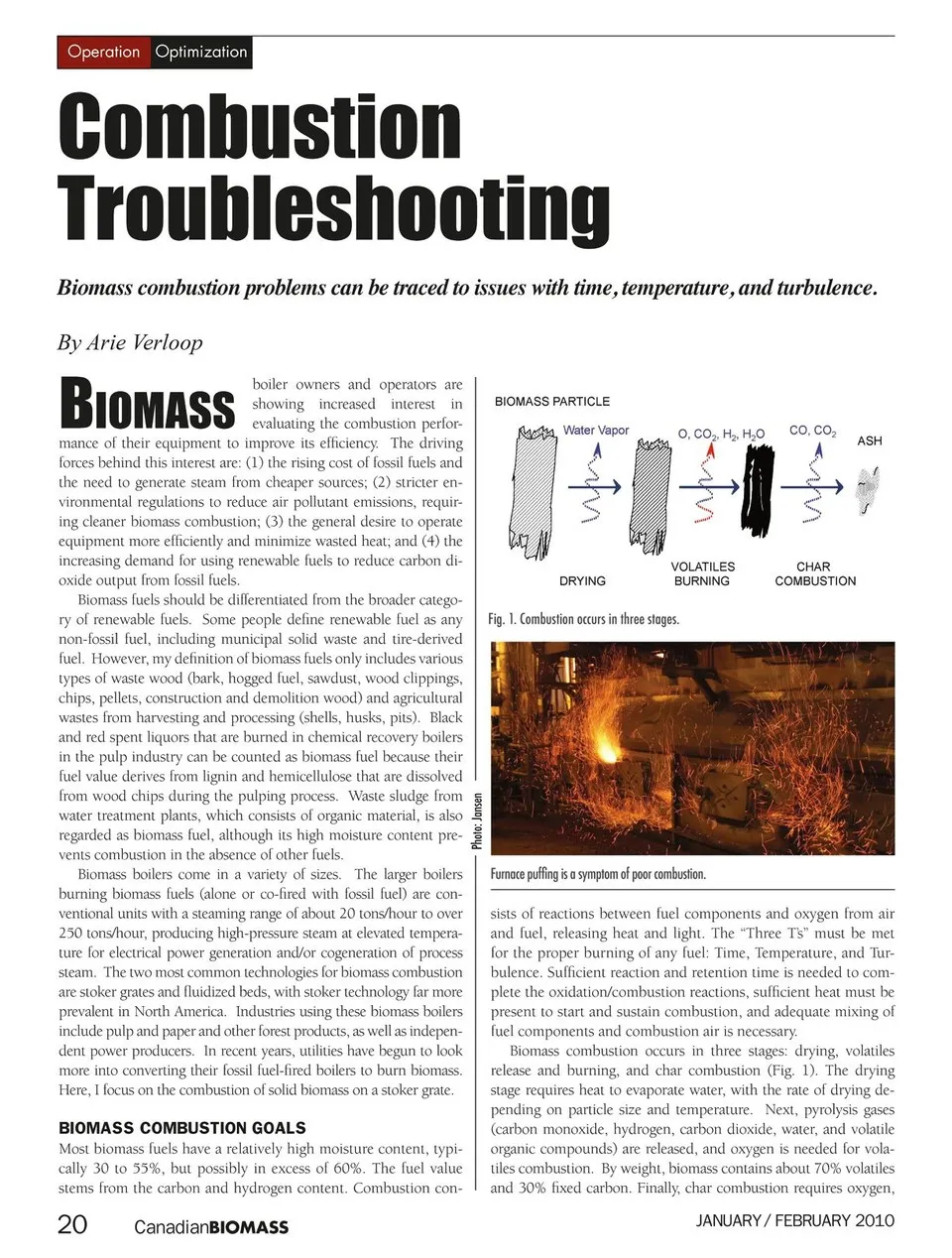
Operation Optimization Combustion Troubleshooting Biomass combustion problems can be traced to issues with time, temperature, and turbulence. By Arie Verloop mance of their equipment to improve its efficiency. The driving forces behind this interest are: (1) the rising cost of fossil fuels and the need to generate steam from cheaper sources; (2) stricter en- vironmental regulations to reduce air pollutant emissions, requir- ing cleaner biomass combustion; (3) the general desire to operate equipment more efficiently and minimize wasted heat; and (4) the increasing demand for using renewable fuels to reduce carbon di- oxide output from fossil fuels. Biomass fuels should be differentiated from the broader catego- Biomass ry of renewable fuels. Some people define renewable fuel as any non-fossil fuel, including municipal solid waste and tire-derived fuel. However, my definition of biomass fuels only includes various types of waste wood (bark, hogged fuel, sawdust, wood clippings, chips, pellets, construction and demolition wood) and agricultural wastes from harvesting and processing (shells, husks, pits). Black and red spent liquors that are burned in chemical recovery boilers in the pulp industry can be counted as biomass fuel because their fuel value derives from lignin and hemicellulose that are dissolved from wood chips during the pulping process. Waste sludge from water treatment plants, which consists of organic material, is also regarded as biomass fuel, although its high moisture content pre- vents combustion in the absence of other fuels. Biomass boilers come in a variety of sizes. The larger boilers burning biomass fuels (alone or co-fired with fossil fuel) are con- ventional units with a steaming range of about 20 tons/hour to over 250 tons/hour, producing high-pressure steam at elevated tempera- ture for electrical power generation and/or cogeneration of process steam. The two most common technologies for biomass combustion are stoker grates and fluidized beds, with stoker technology far more prevalent in North America. Industries using these biomass boilers include pulp and paper and other forest products, as well as indepen- dent power producers. In recent years, utilities have begun to look more into converting their fossil fuel-fired boilers to burn biomass. Here, I focus on the combustion of solid biomass on a stoker grate. biomass combustion goals Most biomass fuels have a relatively high moisture content, typi- cally 30 to 55%, but possibly in excess of 60%. The fuel value stems from the carbon and hydrogen content. Combustion con- 20 CanadianBIOMASS Fig. 1. Combustion occurs in three stages. boiler owners and operators are showing increased interest in evaluating the combustion perfor- Furnace puffing is a symptom of poor combustion. sists of reactions between fuel components and oxygen from air and fuel, releasing heat and light. The “Three T’s” must be met for the proper burning of any fuel: Time, Temperature, and Tur- bulence. Sufficient reaction and retention time is needed to com- plete the oxidation/combustion reactions, sufficient heat must be present to start and sustain combustion, and adequate mixing of fuel components and combustion air is necessary. Biomass combustion occurs in three stages: drying, volatiles release and burning, and char combustion (Fig. 1). The drying stage requires heat to evaporate water, with the rate of drying de- pending on particle size and temperature. Next, pyrolysis gases (carbon monoxide, hydrogen, carbon dioxide, water, and volatile organic compounds) are released, and oxygen is needed for vola- tiles combustion. By weight, biomass contains about 70% volatiles and 30% fixed carbon. Finally, char combustion requires oxygen, JANUARY/ FEBRUARY 2010 Photo: Jansen
Canadian Biomass January/February 2010: Page 20