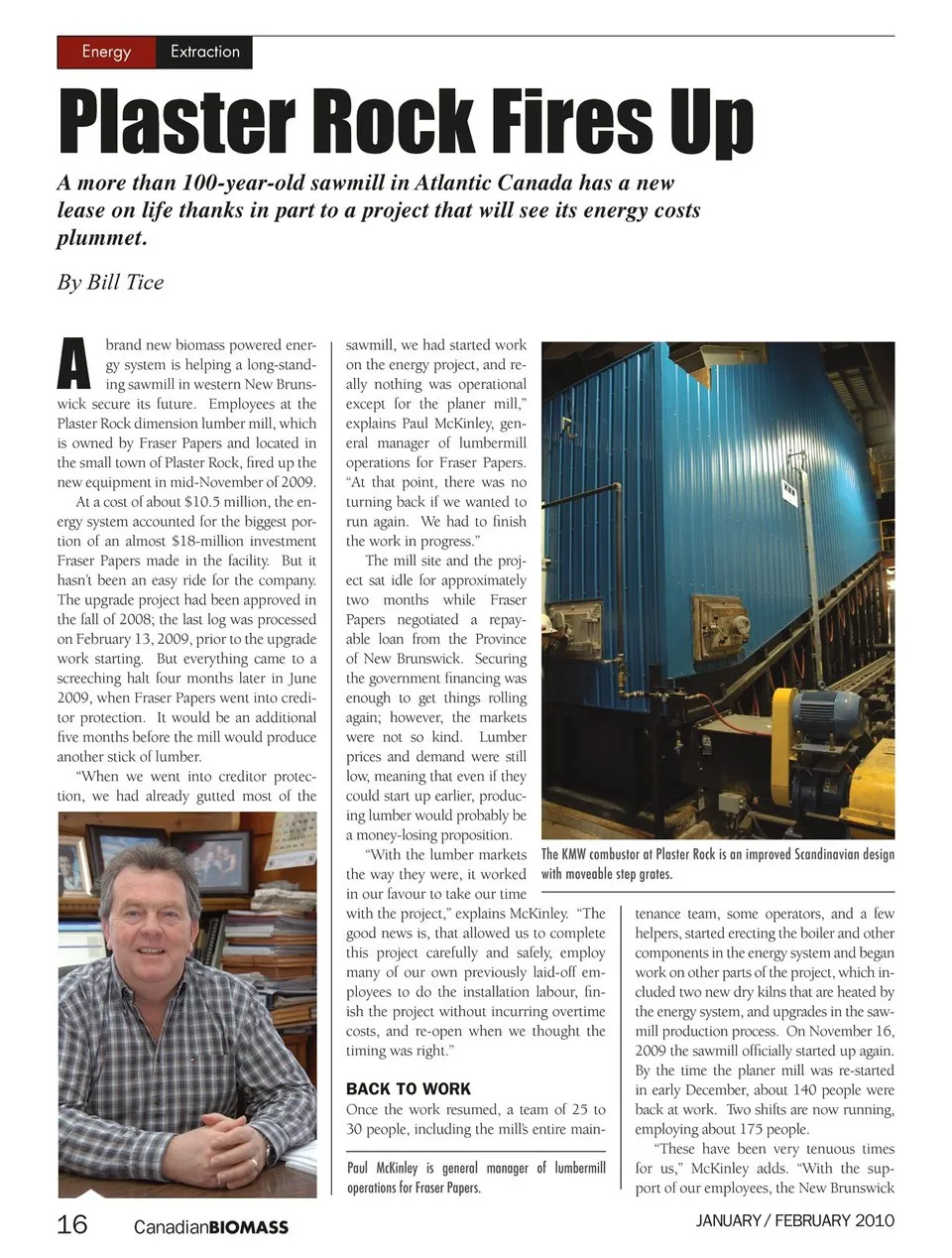
government, our owners, and our suppli- ers, we have been able to put some of our difficulties behind us and move on.” Now that they are up and running again, the cost savings alone from the new bio- mass powered energy system, when com- pared to the facility’s old oil burning energy plant, will help the mill be more competi- tive. Prior to the 2009 shutdown, the Plas- ter Rock mill consumed 5.5 million litres of oil annually when running at full capacity, most of that going to run a pair of approxi- mately 10-year-old oil-fired package boil- ers that biomass project co-ordinator Ron Beaulieu explains came preassembled on a skid and required only a hook-up for steam and water, and of course, oil. “We were using the oil-fired boilers for two-thirds of our energy, and we also used four old Dutch oven biomass boilers that date back 60 to 80 years for the balance of our heat,” adds Beaulieu, who is the manag- er of energy projects for Fraser Papers and splits his time between sawmill and pulp and paper operations across the company. “We were using bunker C oil, which is one of the lowest priced oils on the market, but when prices peaked at around $150 a bar- rel, our oil costs would have been about $3.5 million when calculated on an annual basis at full capacity.” fuel costs plummet Beaulieu estimates that with the annual fuel costs of running the new energy system at just $500,000 per year based on today’s cost of biomass, the mill will see a payback on the $10.5-million investment in about three years. “The financial benefits were of course one of the main driving factors behind the project, but the environmental benefits were also important to us,” he says. “Our emis- sions were controlled in the past, but with the new energy system in place, our green- house gas emissions have been substantially reduced and we are carbon neutral.” Biomass power isn’t new to Fraser Pa- pers. As Beaulieu explains, the Plaster Rock mill has been somewhat dependent on biomass boilers for years, and at the Edmundston pulp mill, the company in- stalled a cogeneration plant in 1996 that includes a 600,000-pound/hour biomass boiler and a 46-MW steam turbine. “Here at Plaster Rock, we didn’t install a turbine at this time, but we have left the space and designed the boiler such that we can install a 7.5-MW turbine at a later date,” Beaulieu says. “The timing just wasn’t right for us A new fuel bin at the Plaster Rock mill can hold up to 350 green tonnes of bark. The new biomass energy system consumes about half of the bark produced by the sawmill. right now, but we are looking at it for down the road. If it goes ahead, we could sell excess power to the grid.” making it Happen After a careful vendor selection process that included proposals and bids from five com- panies, Fraser Papers went with London, Ontario-based KMW as the main supplier for the Plaster Rock project. “Our timing was good,” Beaulieu says. “We started the submission process right at the beginning of the recession, and companies were start- ing to feel the pressure, so there were some Debarking and chipping for pulp mills or pellet plants • DEAL DEBARKERS Low maintenance Highest fiber recovery • • • ROTARY SCREENS Reliable performance Easy maintenance access • • • SLANT DISC CHIPPERS Mini chips for better drying, less milling High quality chips from residuals or round wood • • • WOOD ROOM PACKAGES Systems available include log decks and conveyors, as well as debarking, chipping and screening • Excellence in Chip Processing www.acrowood.com 425.258.3555 CanadianBIOMASS 17
Canadian Biomass January/February 2010: Page 17