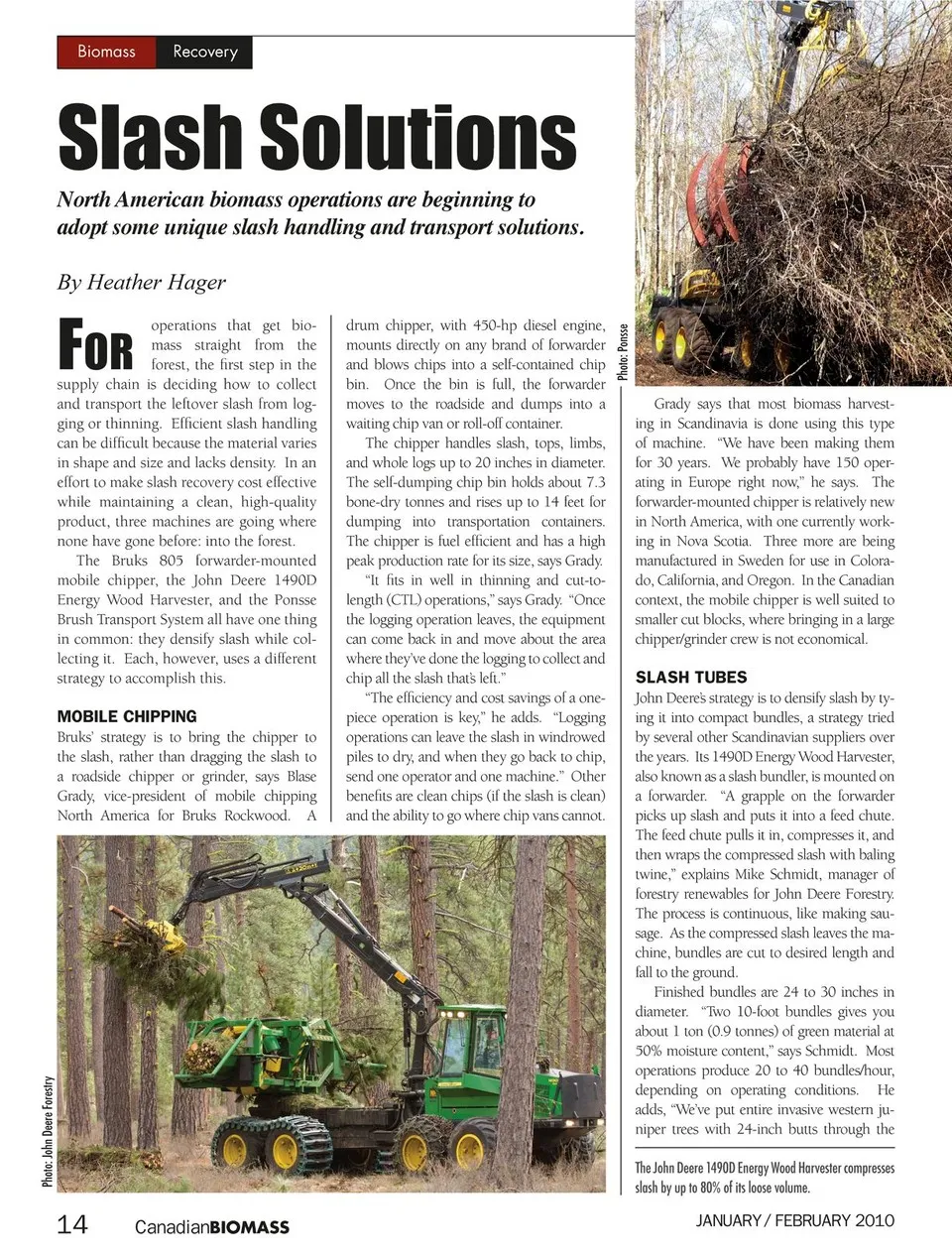
The Ponsse BTS compresses slash and can also handle roundwood. ging roads, especially in the western United States, where you cannot get chip vans on the road. But if you can get a log truck into the site, you can bring these bundles out,” explains Schmidt. In addition, the bundles can be piled and left to dry or stored until use without worrying about spontaneous combustion or degradation. The slash bundler is manufactured in machine without delimbing them, so you can put very large pieces through if you need to.” “In clear-cuts, if you know before you log a site that you’re going to be bundling that slash, then the machines that process the timber can orient the slash so that a bundler can come through and pick it up out of wind- rows. That eliminates most of the site prep work for replanting,” explains Schmidt. In thinning and CTL operations, the slash bun- dler can move within the remaining stand. A trailer-mounted model is under development for whole-tree operations, in which process- ing occurs at roadside. For a logger interested in producing biomass, says Schmidt, this will eliminate both the expense of an additional forwarder and the need to maintain chipping or grinding equipment. Bundles are transported using standard logging equipment. “There are a lot of log- Finland and has been available in Europe since 2002, with about 75 units operating in 16 European Union countries. It has recent- ly entered the North American market, with working units in Michigan, Texas, Wash- ington, and Maine. Typically, it requires a large biomass combustion plant with a large grinder as end user to handle the bundles. going forWard The newest strategy in slash handling is Ponsse’s Brush Transport System (BTS). It comprises forwarder-mounted curved bunk arms that move up and down, compressing slash as it is piled onto the forwarder. The original model has bunk arms at fixed lo- cations on the forwarder. A newer model has bunk arms that can be moved closer to the front or back of the forwarder, depend- ing on the distribution of slash in the load space, says Stacy Wagler, technical support and product development for Ponsse North America. The compression bunks can attach to any type of forwarder, provided that it has at least 15- to 16-tonne capacity. “If you put the bunks on too small of a machine, you will have trouble because you will overload the machine,” says Wagler. By compressing the slash, the BTS can double or triple the slash-carrying capacity of a standard forwarder, depending on the tree species. “We’ve done some comparison with a standard 16-tonne forwarder that would only get between four and six tonnes with the load maxed right out. With these bunks, we’re getting between 12 and 15 tonnes per load,” explains Wagler. He says the BTS par- ticularly increases efficiency for hardwood slash. “Because there’s so much air in the crowns, they need to be broken and crushed down in the load space to make it efficient.” Increasing the load capacity results in less travelling and fewer loads required than with a standard forwarder. This means less fuel consumption and greater efficiency. The BTS was developed for and intro- duced in North America in 2007 and is not currently available elsewhere. One unit is working in British Columbia, and there are several in the U.S. Great Lakes area. Gen- erally, this option requires considerably less capital investment for loggers just getting into the biomass business, but assumes some form of roadside grinding or chipping. These machines are designed to in- crease the mobility and efficiency of gath- ering slash in the field to make forest bio- mass collection an economical venture. Which option is best for the user will de- pend on his/her specific operational con- ditions, as well as the final purpose and end user of the biomass. • CanadianBIOMASS 15
Canadian Biomass January/February 2010: Page 15